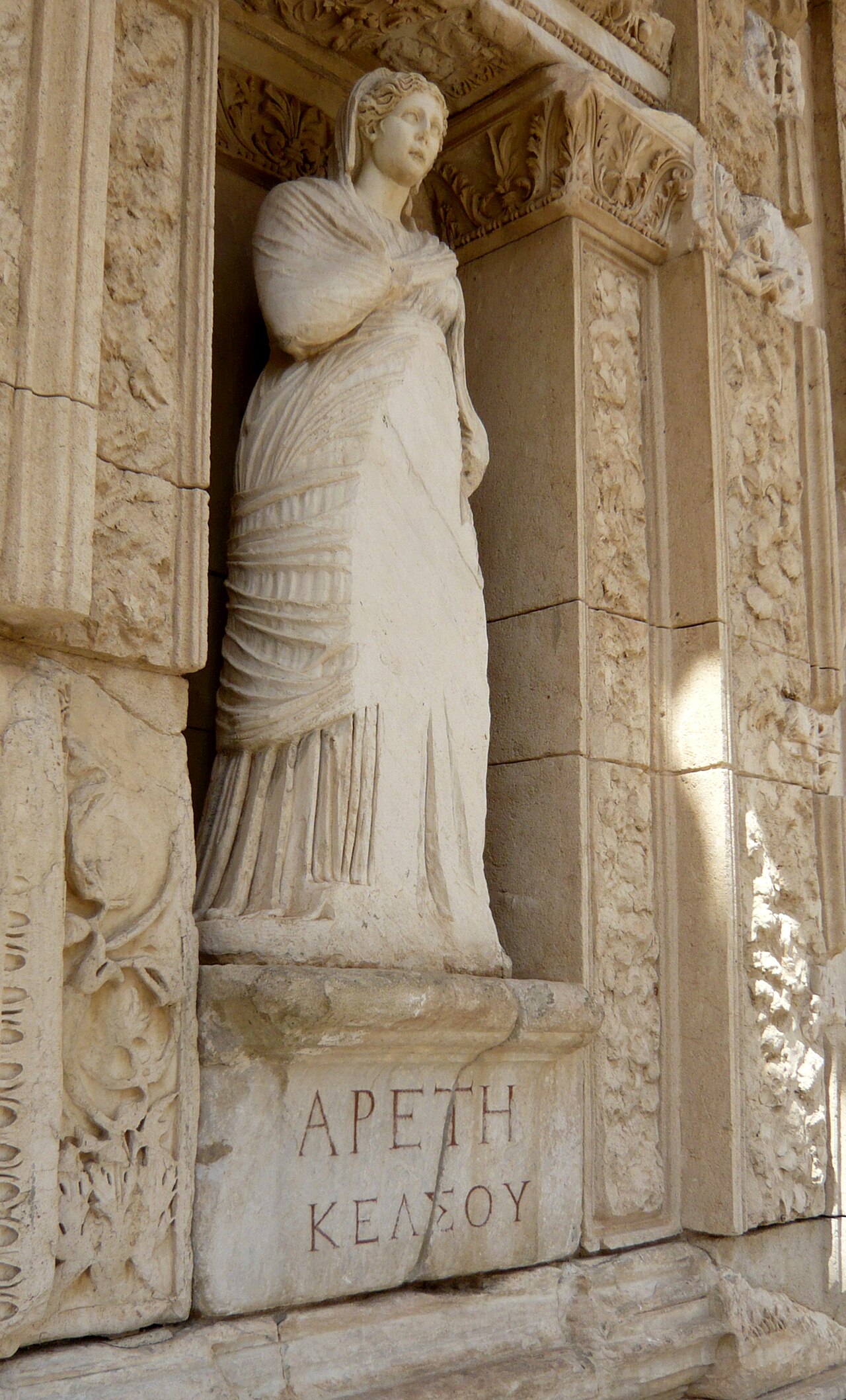

Other Ancient Hymns · Hymn 01
Arete: Divine Excellence
Εἰς Ἀρετήν
Prayer and ritual
These hymns may be spoken as complete prayers to the Gods. Within the Temple’s practice, a ritual is a direct theurgical act; hymnody gathers the mind and turns it toward the Divine, helping the initiate enter reverent communion with the Gods.
Use a hymn on its own in place of another prayer, or add it to the prayer portion of a suitable ritual. Choose according to the deity addressed and the petition expressed in the hymn. When combining them, preserve the ritual’s prescribed sequence and let the hymn give voice to its purpose.
The petition of this hymn
For steadfast excellence, courageous endurance, and fidelity to worthy friendship.
Recite the hymn when dedicating yourself to a demanding worthy task. It can accompany a rite to Zeus Xenios or a remembrance of faithful friendship, retaining the poem’s honour for Hermias and its heroic examples.
English hieratic rendering
Hymn 01 · An English rendering aligned with the Greek lines.
- O Excellence, won through many labours by the mortal race,
- fairest quarry of a human life,
- for the sake of your beauty, O Maiden,
- even death is an envied destiny in Hellas,
- and so is the bearing of fierce, unrelenting toils.
- Such is the fruit you sow within the mind,
- a fruit immortal, greater than gold,
- than parents, and than sleep with its gentle radiance.
- For your sake Heracles, born of Zeus, and the sons of Leda
- endured much through their deeds, pursuing your power.
- Through longing for you, Achilles and Ajax entered the house of Hades.
- For the sake of your beloved beauty, the fosterling of Atarneus also
- forsook the rays of the Sun.
- Therefore, for his deeds, they shall exalt him in song and make his fame immortal:
- the Muses,
- daughters of Memory, magnifying the reverence of Zeus Xenios
- and the honour of friendship that endures.
Ancient Greek & pronunciation
Read the English pronunciation spelling directly below each Greek line.
- Ἀρετὰ πολύμοχθε γένει βροτείῳ,ah-reh-TAH poh-LEE-mohkh-theh YEH-nee vroh-TEE-oh,
- θήραμα κάλλιστον βίῳ,THEE-rah-mah KAH-lee-stohn VEE-oh,
- σᾶς πέρι, παρθένε, μορφᾶςSAHS PEH-ree, pahr-THEH-neh, mohr-FAHS
- καὶ θανεῖν ζηλωτὸς ἐν Ἑλλάδι πότμοςKEH thah-NEEN zee-loh-TOHS ehn eh-LAH-dhee POHT-mohs
- καὶ πόνους τλῆναι μαλεροὺς ἀκάμαντας·KEH POH-noos TLEE-neh mah-leh-ROOS ah-KAH-mahn-dahs·
- τοῖον ἐπὶ φρένα βάλλειςTEE-ohn eh-PEE FREH-nah VAH-lees
- καρπόν τ’ ἀθάνατον χρυσοῦ τε κρείσσωkahr-POHN t’ ah-THAH-nah-tohn khree-SOO teh KREE-soh
- καὶ γονέων μαλακαυγήτοιό θ’ ὕπνου.KEH ghoh-NEH-ohn mah-lah-kahv-YEE-tee-OH th’ EEP-noo.
- σεῦ δ’ ἕνεχ’ οὑκ Διὸς Ἡρακλέης Λήδας τε κοῦροιSEHV dh’ EH-nehkh’ ook dhee-OHS ee-rah-KLEH-ees LEE-dhahs teh KOO-ree
- πόλλ’ ἀνέτλασαν ἔργοις σὰν ἀγρεύοντες δύναμιν.POHL’ ah-NEHT-lah-sahn EHR-yees SAHN ah-GHREH-vohn-dehs DHEE-nah-meen.
- σοῖς δὲ πόθοις Ἀχιλεὺς Αἴας τ’ Ἀίδα δόμον ἦλθον.SEES DHEH POH-thees ah-hyee-LEHFS EH-ahs t’ ah-EE-dhah DHOH-mohn EEL-thohn.
- σᾶς δ’ ἕνεκεν φιλίου μορφᾶς καὶ Ἀταρνέος ἔντροφοςSAHS dh’ EH-neh-kehn fee-LEE-oo mohr-FAHS KEH ah-tahr-NEH-ohs EHN-droh-fohs
- ἠελίου χήρωσεν αὐγάς.ee-eh-LEE-oo HYEE-roh-sehn ahv-GHAHS.
- τοιγὰρ ἀοίδιμον ἔργοις ἀθάνατόν τέ μιν αὐξήσουσιtee-GHAHR ah-EE-dhee-mohn EHR-yees ah-THAH-nah-TOHN TEH meen ahfk-SEE-soo-see
- Μοῦσαι,MOO-seh,
- Μνημοσύνης θύγατρες, Διὸς ξενίου σέβας αὔξουσαιmnee-moh-SEE-nees THEE-ghah-trehs, dhee-OHS kseh-NEE-oo SEH-vahs AHFK-soo-seh
- φιλίας τε γέρας βεβαίας.fee-LEE-ahs teh YEH-rahs veh-VEH-ahs.
Short sound guide for English speakers
Every line beneath the Greek uses English pronunciation spellings. Say each hyphenated syllable in sequence and emphasize the syllable in CAPITALS. For example, οὐρανόθεν is oo-rah-NOH-thehn. Read adjacent vowels separately: theh-AH has two syllables; oo-rah-NEE-een has four. Hyphens guide the voice; they do not mark pauses.
| Spelling | Sound to make |
|---|---|
| ah · eh · ee · oh · oo | father · met · see · go without its final glide · moon. Keep these vowels clear in unstressed syllables too. |
| th · dh | The unvoiced th in thin · the voiced th in this. Thus DHEE begins with the sound in “thee.” |
| kh | The ch in Scottish loch or German Bach: let air pass at the back of the mouth, without closing it into a k. |
| hy | The breathy beginning of a carefully spoken Hugh. Raise the middle of the tongue toward the roof of the mouth and let air pass without voice. In shy, sound s followed by hy; do not use the English sh sound or the English word “shy.” |
| gh | Make the kh sound above, then add voice. Keep the passage open; this is a flowing sound, not a hard g. |
| y · g | y as in yes, with gentle friction · always a hard g as in get. |
| r | Tap the tongue lightly behind the upper teeth, or use a light roll. |
| ks · ps | Sound both consonants, even at the beginning of a word: ks as in backs, ps as in lips. |
| n-g · m-b · n-d | Sound the nasal and the following consonant. In AHN-geh-leh, the n-g group is like finger, with the g audible. |
Always sound s as in hiss, even at the end of DHEE-kees; z is voiced, as in zero. All other consonants have their usual English sounds. Initial consonant groups may be unfamiliar: sound every written consonant, without inserting an extra vowel. A word without capitals carries no written stress in the Greek. Where two syllables have capitals, both written accents are retained. An apostrophe marks a vowel already elided in the Greek; do not add it back. A hyphen at the end of a Greek verse joins the unfinished word to the next verse.
These spellings follow the Modern Greek liturgical reading used throughout this library. Breathings and iota subscripts are silent; separately pronounced vowels remain separate. The few Greek consonants without an exact English equivalent use the sound cues above. Ancient vowel length, pitch accent and metre are not reconstructed.
Hymn notes
Sacred meaning
Arete is addressed as a divine maiden whose beauty draws the soul beyond comfort and wealth. Her reward is an immortal fruit in the mind. The remembered endurance of heroes and Hermias leads to the Muses, who preserve deeds and magnify the honour of Zeus as guardian of guests and the dignity of lasting friendship.
Textual note
This complete poem is conventionally called Aristotle’s Hymn to Virtue or Arete. Athenaeus discusses it as a skolion rather than a paean. The fosterling of Atarneus is Hermias. Lineation follows the 17 verse units of Kaibel’s text, including the brief separate invocation of the Muses; other editions divide the same poem differently.
Text and attribution
Aristotle, hymn to Arete, preserved in Athenaeus 15.51 (696b–d). Greek follows Georg Kaibel, Athenaei Naucratitae Dipnosophistarum libri XV, vol. III (1890), pp. 541–542; Perseus transcription. Greek source. The English hieratic rendering and suggested devotional use are new editorial work. The applications are guidance for this library, not additional lines of the ancient poem.