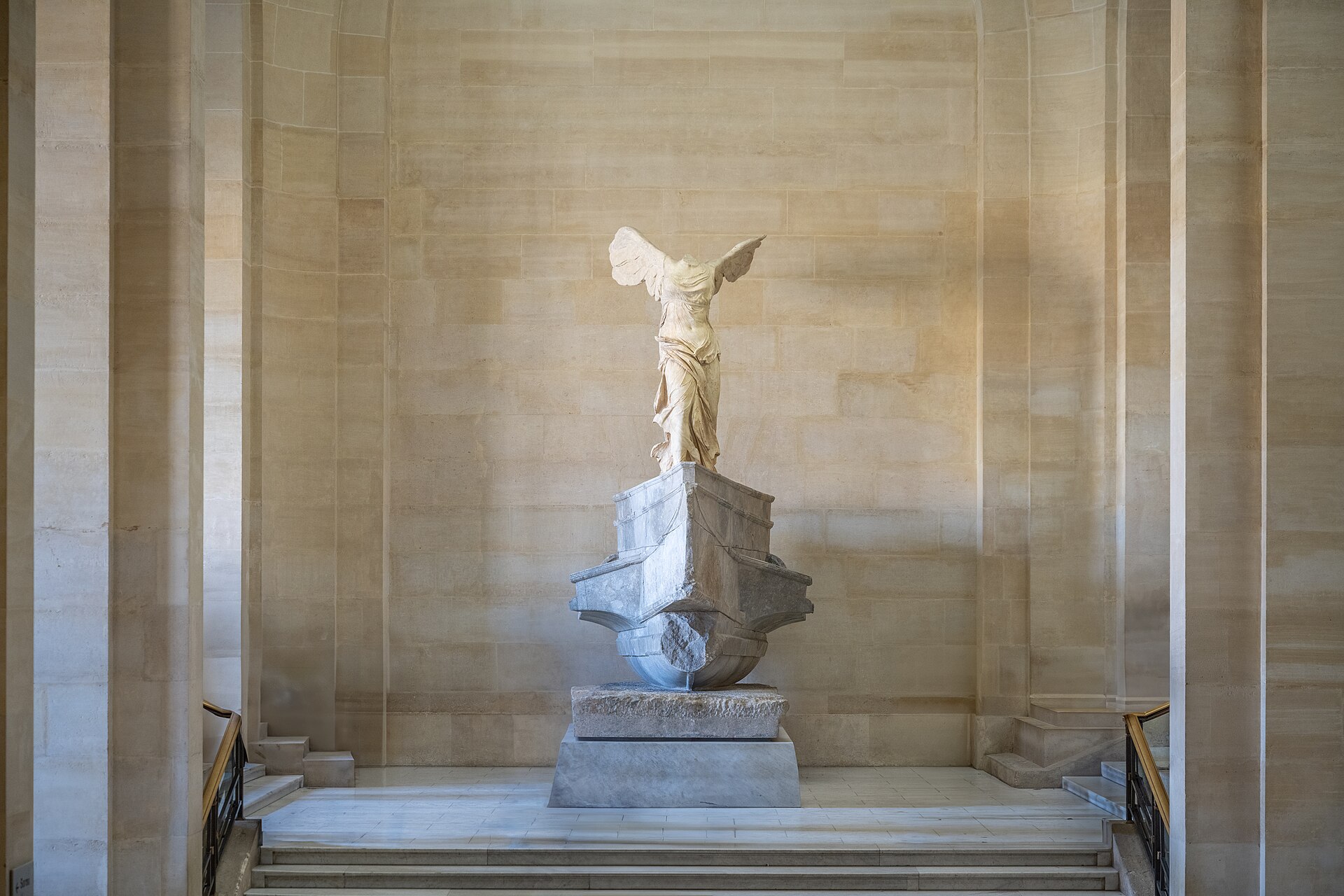

Orphic Hymns · Hymn 33
Nike: Victory
Νίκης
Prayer and ritual
These hymns may be spoken as complete prayers to the Gods. Within the Temple’s practice, a ritual is a direct theurgical act; hymnody gathers the mind and turns it toward the Divine, helping the initiate enter reverent communion with the Gods.
Use a hymn on its own in place of another prayer, or add it to the prayer portion of a suitable ritual. Choose according to the deity addressed and the petition expressed in the hymn. When combining them, preserve the ritual’s prescribed sequence and let the hymn give voice to its purpose.
The petition of this hymn
For honorable success and the resolution of painful contest under the blessing of Victory.
Recite this hymn as a prayer for a worthy endeavor to reach a good result. It may also accompany an existing rite for protection, a just contest, or successful work, directing the petition toward the honorable deeds named in its conclusion.
English hieratic rendering
Hymn 33 · An English rendering aligned with the Greek lines.
- I call upon mighty Nike, longed for by mortals,
- who alone brings mortals’ striving in the contest to its end,
- and painful strife in the battles of opposing sides,
- judging in wars through deeds that raise the trophy,
- to those upon whom you rush, bearing the sweetest triumph.
- For you hold sway over all, and the noble fame of every contest
- rests upon glorious Victory, abounding in festal joy.
- But come, O blessed one, with the radiant gaze for which we long,
- ever bringing good fulfillment upon glorious deeds.
Ancient Greek & pronunciation
Read the English pronunciation spelling directly below each Greek line.
- Εὐδύνατον καλέω Νίκην, θνητοῖσι ποθεινήν,ehv-DHEE-nah-tohn kah-LEH-oh NEE-keen, thnee-TEE-see poh-thee-NEEN,
- ἣ μούνη λύει θνητῶν ἐναγώνιον ὁρμὴνEE MOO-nee LEE-ee thnee-TOHN eh-nah-GHOH-nee-ohn ohr-MEEN
- καὶ στάσιν ἀλγινόεσσαν ἐπ’ ἀντιπάλοισι μάχῃσιν,KEH STAH-seen ahl-yee-NOH-eh-sahn ehp’ ahn-dee-PAH-lee-see MAH-hyee-seen,
- ἐν πολέμοις κρίνουσα τροπαιούχοισιν ἐπ’ ἔργοις,ehn poh-LEH-mees KREE-noo-sah troh-peh-OO-hyee-seen ehp’ EHR-yees,
- οἷς ἂν ἐφορμαίνουσα φέρῃς γλυκερώτατον εὖχος·EES AHN eh-fohr-MEH-noo-sah FEH-rees ghlee-keh-ROH-tah-tohn EHF-khohs·
- πάντων γὰρ κρατέεις, πάσης δ’ ἔριδος κλέος ἐσθλὸνPAHN-dohn GHAHR krah-TEH-ees, PAH-sees dh’ EH-ree-dhohs KLEH-ohs ehsth-LOHN
- Νίκῃ ἐπ' εὐδόξῳ κεῖται θαλίῃσι βρυάζον.NEE-kee ehp' ehv-DHOHK-soh KEE-teh thah-LEE-ee-see vree-AH-zohn.
- ἀλλά, μάκαιρ’, ἔλθοις πεποθημένῳ ὄμματι φαιδρῷ,ah-LAH, MAH-kehr’, EHL-thees peh-poh-thee-MEH-noh OH-mah-tee feh-DHROH,
- αἰεὶ ἐπ’ εὐδόξοις ἔργοις τέλος ἐσθλὸν ἄγουσα.eh-EE ehp’ ehv-DHOHK-sees EHR-yees TEH-lohs ehsth-LOHN AH-ghoo-sah.
Short sound guide for English speakers
Every line beneath the Greek uses English pronunciation spellings. Say each hyphenated syllable in sequence and emphasize the syllable in CAPITALS. For example, οὐρανόθεν is oo-rah-NOH-thehn. Read adjacent vowels separately: theh-AH has two syllables; oo-rah-NEE-een has four. Hyphens guide the voice; they do not mark pauses.
| Spelling | Sound to make |
|---|---|
| ah · eh · ee · oh · oo | father · met · see · go without its final glide · moon. Keep these vowels clear in unstressed syllables too. |
| th · dh | The unvoiced th in thin · the voiced th in this. Thus DHEE begins with the sound in “thee.” |
| kh | The ch in Scottish loch or German Bach: let air pass at the back of the mouth, without closing it into a k. |
| hy | The breathy beginning of a carefully spoken Hugh. Raise the middle of the tongue toward the roof of the mouth and let air pass without voice. In shy, sound s followed by hy; do not use the English sh sound or the English word “shy.” |
| gh | Make the kh sound above, then add voice. Keep the passage open; this is a flowing sound, not a hard g. |
| y · g | y as in yes, with gentle friction · always a hard g as in get. |
| r | Tap the tongue lightly behind the upper teeth, or use a light roll. |
| ks · ps | Sound both consonants, even at the beginning of a word: ks as in backs, ps as in lips. |
| n-g · m-b · n-d | Sound the nasal and the following consonant. In AHN-geh-leh, the n-g group is like finger, with the g audible. |
Always sound s as in hiss, even at the end of DHEE-kees; z is voiced, as in zero. All other consonants have their usual English sounds. Initial consonant groups may be unfamiliar: sound every written consonant, without inserting an extra vowel. A word without capitals carries no written stress in the Greek. Where two syllables have capitals, both written accents are retained. An apostrophe marks a vowel already elided in the Greek; do not add it back. A hyphen at the end of a Greek verse joins the unfinished word to the next verse.
These spellings follow the Modern Greek liturgical reading used throughout this library. Breathings and iota subscripts are silent; separately pronounced vowels remain separate. The few Greek consonants without an exact English equivalent use the sound cues above. Ancient vowel length, pitch accent and metre are not reconstructed.
Hymn notes
Sacred meaning
Nike brings contest to its decisive end and transforms struggle into flourishing renown. The hymn speaks explicitly of opposing battles, yet its closing request is for a good completion of glorious deeds. Its prayer is therefore grounded in the quality of the deed as well as in success.
Ancient offering rubric: Manna.
Text and attribution
Greek text: Eugenius Abel, Orphica (1885), printed pages 76. The text follows the printed main reading of this edition; source-specific variants are recorded where relevant. Read the digitised edition. Greek source. Wikisource transcription, revision 124309; checked and corrected against Abel’s print. The English hieratic rendering and suggested devotional use are new editorial work. The applications are guidance for this library, not additional lines of the ancient poem.