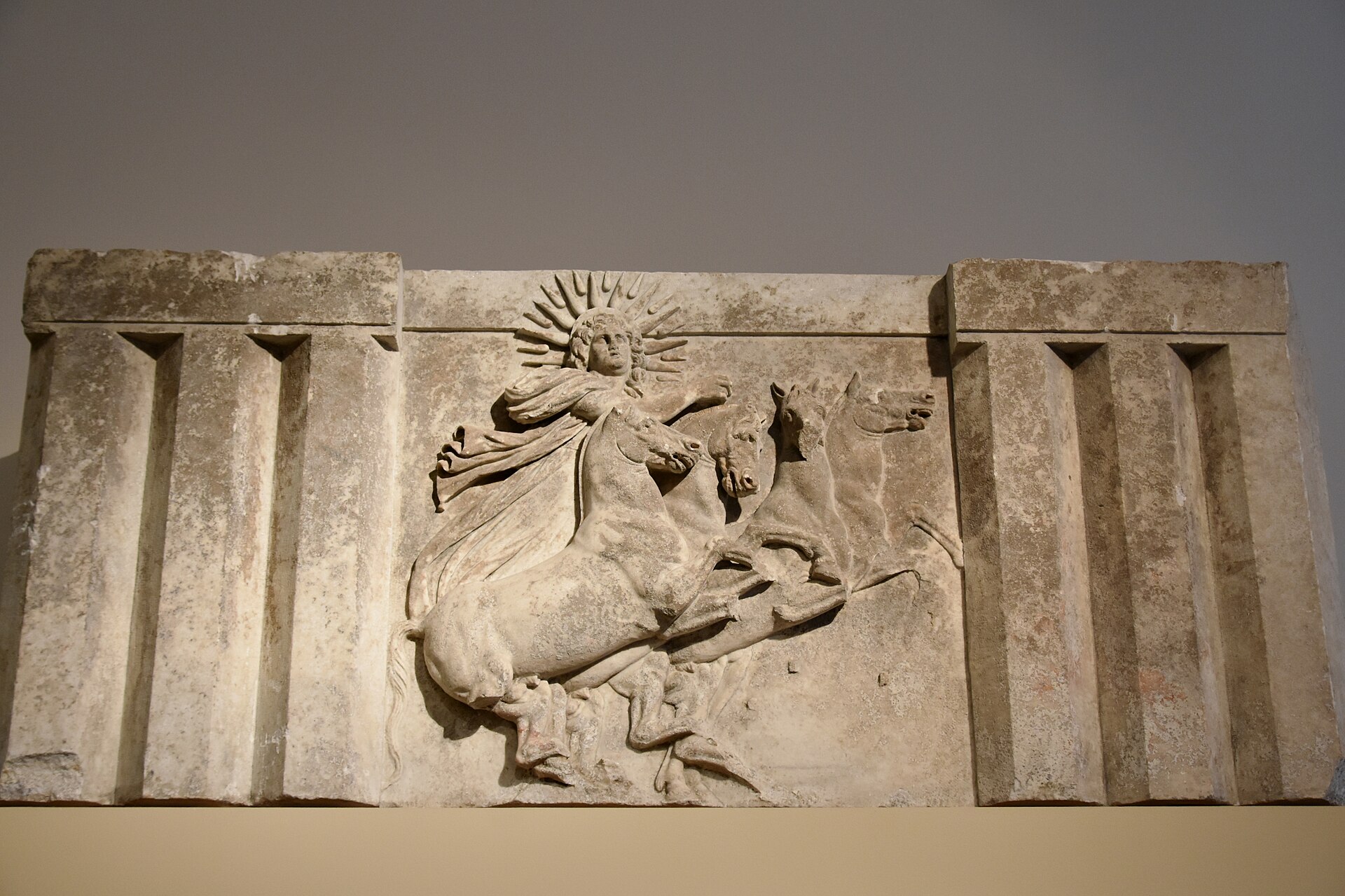
.jpg)
Homeric Hymns · Hymn 31
Helios, Radiant Sun
Ἥλιος
Prayer and ritual
These hymns may be spoken as complete prayers to the Gods. Within the Temple’s practice, a ritual is a direct theurgical act; hymnody gathers the mind and turns it toward the Divine, helping the initiate enter reverent communion with the Gods.
Use a hymn on its own in place of another prayer, or add it to the prayer portion of a suitable ritual. Choose according to the deity addressed and the petition expressed in the hymn. When combining them, preserve the ritual’s prescribed sequence and let the hymn give voice to its purpose.
The petition of this hymn
Honour Helios’ radiant course and seek the gift of a heart gladdening life.
Use this hymn as a complete prayer of praise to Helios at a suitable time for solar devotion. It may supplement a rite for illumination, vitality, or good livelihood, letting the image of the shining chariot direct the mind toward the ordered passage of light.
English hieratic rendering
Hymn 31 · An English rendering aligned with the Greek lines.
- Begin once more to hymn Helios, Muse, child of Zeus,
- Kalliope: the shining Sun, whom wide eyed Euryphaessa
- bore to the child of Gaia and starry Ouranos.
- For Hyperion wedded Euryphaessa of glorious renown,
- his own sister, who bore him beautiful children:
- Eos of the rosy arms, Selene of lovely hair,
- and Helios unwearied, like the Immortals,
- who shines for mortals and the immortal Gods,
- mounted upon his horses; terribly he gazes with his eyes
- from his golden helmet, and from him brilliant rays
- gleam in splendour, while beside his temples the bright locks
- from his head frame his gracious face,
- shining far. About his body a beautiful garment gleams,
- finely wrought, in the breath of the winds; beneath him are stallions.
- There, halting his chariot with its golden yoke and his horses,
- [he rests there at the summit of Heaven, until once more]
- he, the divine one, sends them through Heaven toward Okeanos.
- Hail, sovereign Lord; in kindness grant a heart gladdening life.
- Beginning with you, I shall celebrate the race of mortal men,
- the demigods, whose deeds the Goddesses revealed to mortals.
Ancient Greek & pronunciation
Read the English pronunciation spelling directly below each Greek line.
- ἥλιον ὑμνεῖν αὖτε Διὸς τέκος ἄρχεο Μοῦσα,EE-lee-ohn eem-NEEN AHF-teh dhee-OHS TEH-kohs AHR-hyeh-oh MOO-sah,
- Καλλιόπη, φαέθοντα, τὸν Εὐρυφάεσσα βοῶπιςkah-lee-OH-pee, fah-EH-thohn-dah, TOHN eh-vree-FAH-eh-sah voh-OH-pees
- γείνατο Γαίης παιδὶ καὶ Οὐρανοῦ ἀστερόεντος·YEE-nah-toh YEH-ees peh-DHEE KEH oo-rah-NOO ah-steh-ROH-ehn-dohs·
- γῆμε γὰρ Εὐρυφάεσσαν ἀγακλειτὴν Ὑπερίων,YEE-meh GHAHR eh-vree-FAH-eh-sahn ah-ghah-klee-TEEN ee-peh-REE-ohn,
- αὐτοκασιγνήτην, ἥ οἱ τέκε κάλλιμα τέκνα,ahf-toh-kah-seegh-NEE-teen, EE ee TEH-keh KAH-lee-mah TEHK-nah,
- Ἠῶ τε ῥοδόπηχυν ἐυπλόκαμόν τε Σελήνηνee-OH teh roh-DHOH-pee-hyeen eh-ee-PLOH-kah-MOHN teh seh-LEE-neen
- Ἠέλιόν τʼ ἀκάμαντʼ, ἐπιείκελον ἀθανάτοισιν,ee-EH-lee-OHN t’ ah-KAH-mahnd’, eh-pee-EE-keh-lohn ah-thah-NAH-tee-seen,
- ὃς φαίνει θνητοῖσι καὶ ἀθανάτοισι θεοῖσινOHS FEH-nee thnee-TEE-see KEH ah-thah-NAH-tee-see theh-EE-seen
- ἵπποις ἐμβεβαώς· σμερδνὸν δʼ ὅ γε δέρκεται ὄσσοιςEE-pees ehm-veh-vah-OHS· zmehrdh-NOHN dh’ OH yeh DHEHR-keh-teh OH-sees
- χρυσέης ἐκ κόρυθος· λαμπραὶ δʼ ἀκτῖνες ἀπʼ αὐτοῦkhree-SEH-ees ehk KOH-ree-thohs· lahm-BREH dh’ ahk-TEE-nehs ahp’ ahf-TOO
- αἰγλῆεν στίλβουσι παρὰ κροτάφων δέ τʼ ἔθειραιeh-GHLEE-ehn STEEL-voo-see pah-RAH kroh-TAH-fohn DHEH t’ EH-thee-reh
- λαμπραὶ ἀπὸ κρατὸς χαρίεν κατέχουσι πρόσωπονlahm-BREH ah-POH krah-TOHS khah-REE-ehn kah-TEH-khoo-see PROH-soh-pohn
- τηλαυγές· καλὸν δὲ περὶ χροῒ λάμπεται ἔσθοςtee-lahv-YEHS· kah-LOHN DHEH peh-REE khroh-EE LAHM-beh-teh EHS-thohs
- λεπτουργές, πνοιῇ ἀνέμων· ὕπο δʼ ἄρσενες ἵπποι.lehp-toor-YEHS, pnee-EE ah-NEH-mohn· EE-poh dh’ AHR-seh-nehs EE-pee.
- ἔνθʼ ἄρʼ ὅ γε στήσας χρυσόζυγον ἅρμα καὶ ἵππους,EHNTH’ AHR’ OH yeh STEE-sahs khree-SOH-zee-ghohn AHR-mah KEH EE-poos,
- [αὔτοθι παύεται ἄκρου ἐπʼ οὐρανοῦ, εἰσόκεν αὖτις]AHF-toh-thee PAH-veh-teh AH-kroo ehp’ oo-rah-NOO, ee-SOH-kehn AHF-tees
- θεσπέσιος πέμπῃσι διʼ οὐρανοῦ Ὠκεανόνδε.theh-SPEH-see-ohs PEHM-bee-see dhee’ oo-rah-NOO oh-keh-ah-NOHN-dheh.
- χαῖρε, ἄναξ, πρόφρων δὲ βίον θυμήρεʼ ὄπαζε.HYEH-reh, AH-nahks, PROH-frohn DHEH VEE-ohn thee-MEE-reh’ OH-pah-zeh.
- ἐκ σέο δʼ ἀρξάμενος κλῄσω μερόπων γένος ἀνδρῶνehk SEH-oh dh’ ahrk-SAH-meh-nohs KLEE-soh meh-ROH-pohn YEH-nohs ahn-DHROHN
- ἡμιθέων, ὧν ἔργα θεαὶ θνητοῖσιν ἔδειξαν.ee-mee-THEH-ohn, OHN EHR-ghah theh-EH thnee-TEE-seen EH-dheek-sahn.
Short sound guide for English speakers
Every line beneath the Greek uses English pronunciation spellings. Say each hyphenated syllable in sequence and emphasize the syllable in CAPITALS. For example, οὐρανόθεν is oo-rah-NOH-thehn. Read adjacent vowels separately: theh-AH has two syllables; oo-rah-NEE-een has four. Hyphens guide the voice; they do not mark pauses.
| Spelling | Sound to make |
|---|---|
| ah · eh · ee · oh · oo | father · met · see · go without its final glide · moon. Keep these vowels clear in unstressed syllables too. |
| th · dh | The unvoiced th in thin · the voiced th in this. Thus DHEE begins with the sound in “thee.” |
| kh | The ch in Scottish loch or German Bach: let air pass at the back of the mouth, without closing it into a k. |
| hy | The breathy beginning of a carefully spoken Hugh. Raise the middle of the tongue toward the roof of the mouth and let air pass without voice. In shy, sound s followed by hy; do not use the English sh sound or the English word “shy.” |
| gh | Make the kh sound above, then add voice. Keep the passage open; this is a flowing sound, not a hard g. |
| y · g | y as in yes, with gentle friction · always a hard g as in get. |
| r | Tap the tongue lightly behind the upper teeth, or use a light roll. |
| ks · ps | Sound both consonants, even at the beginning of a word: ks as in backs, ps as in lips. |
| n-g · m-b · n-d | Sound the nasal and the following consonant. In AHN-geh-leh, the n-g group is like finger, with the g audible. |
Always sound s as in hiss, even at the end of DHEE-kees; z is voiced, as in zero. All other consonants have their usual English sounds. Initial consonant groups may be unfamiliar: sound every written consonant, without inserting an extra vowel. A word without capitals carries no written stress in the Greek. Where two syllables have capitals, both written accents are retained. An apostrophe marks a vowel already elided in the Greek; do not add it back. A hyphen at the end of a Greek verse joins the unfinished word to the next verse.
These spellings follow the Modern Greek liturgical reading used throughout this library. Breathings and iota subscripts are silent; separately pronounced vowels remain separate. The few Greek consonants without an exact English equivalent use the sound cues above. Ancient vowel length, pitch accent and metre are not reconstructed.
Hymn notes
Sacred meaning
Helios belongs to the family of Eos and Selene, joining dawn, Sun, and Moon within a divine genealogy. His helmet, rays, hair, garments, and horses make radiance visible in several forms. The final petition connects the celestial course with human well-being, before the singer turns to the deeds of demigods.
Textual note
The edition contains 19 numbered verses plus the bracketed supplementary verse 15a, producing 20 displayed lines. The bracketed verse and its uncertainty remain visible.
Euryphaessa is the name used for the mother of Helios in this hymn; no different genealogy is substituted.
Text and attribution
Greek text: Hugh G. Evelyn-White, Hymn 31 To Helios (1914), Perseus Digital Library. Greek source. The English hieratic rendering and suggested devotional use are new editorial work. The applications are guidance for this library, not additional lines of the ancient poem.