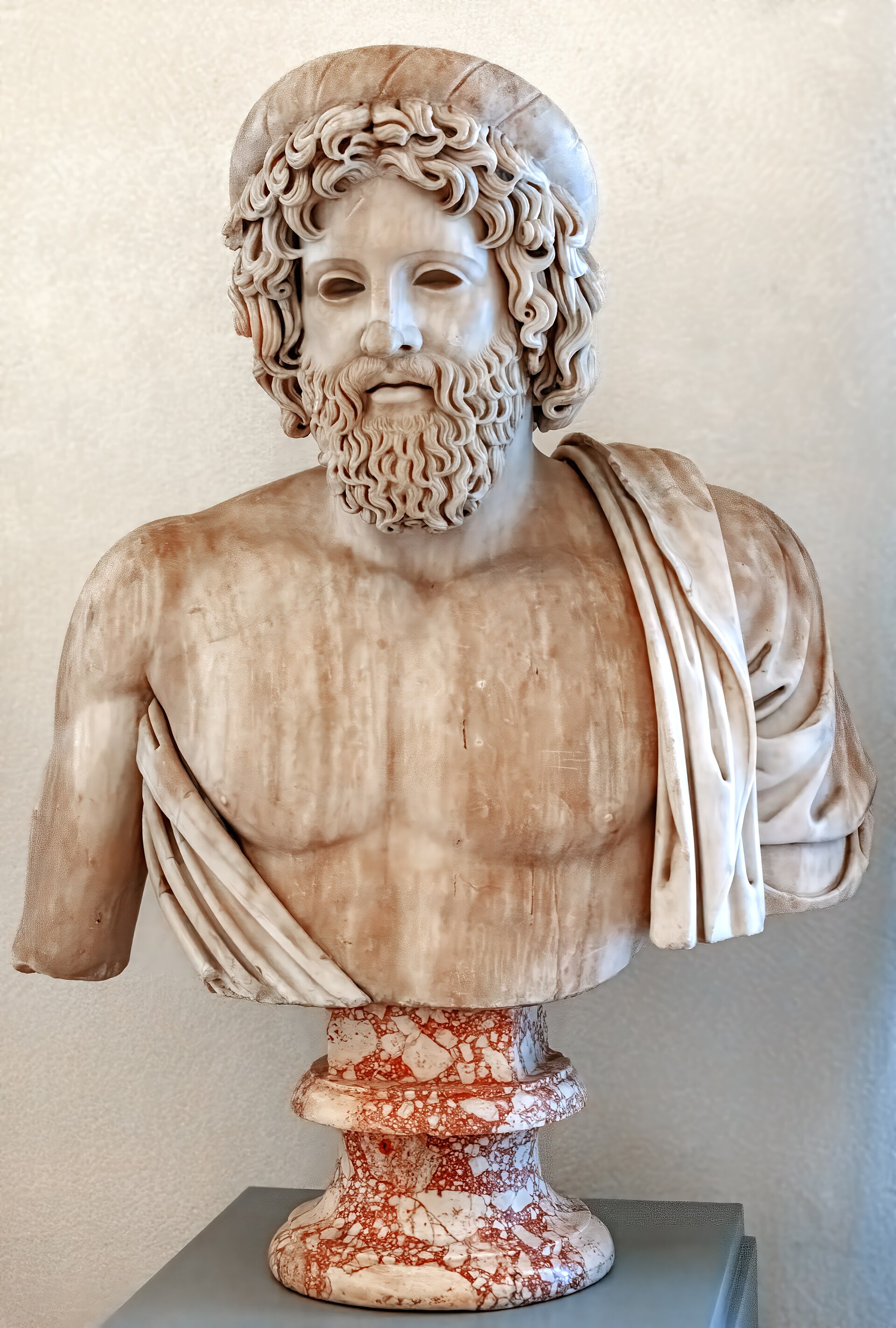
_Bust_of_Asclepius_in_Correr_Museum.jpg)
Orphic Hymns · Hymn 67
Asclepius
Ἀσκληπιοῦ
Prayer and ritual
These hymns may be spoken as complete prayers to the Gods. Within the Temple’s practice, a ritual is a direct theurgical act; hymnody gathers the mind and turns it toward the Divine, helping the initiate enter reverent communion with the Gods.
Use a hymn on its own in place of another prayer, or add it to the prayer portion of a suitable ritual. Choose according to the deity addressed and the petition expressed in the hymn. When combining them, preserve the ritual’s prescribed sequence and let the hymn give voice to its purpose.
The petition of this hymn
For health, relief from affliction, and a blessed course of life.
Recite the hymn as a prayer to Asclepius for healing and preservation. It may accompany an existing healing ritual as its hymn of invocation, with the final verse offered for the person or community named in the rite.
English hieratic rendering
Hymn 67 · An English rendering aligned with the Greek lines.
- Healer of all, Asclepius, sovereign Paean,
- soothing the many-pained afflictions of disease among humankind,
- gentle in your gifts and mighty, come bringing health,
- stilling diseases and the grievous dooms of death.
- Youth who makes life flourish, averter of evil, blessed in your portion,
- strong and gloriously honoured offspring of Phoebus Apollo,
- foe of disease, with blameless Hygieia sharing your bed,
- come, blessed Saviour, granting a noble fulfilment of life.
Ancient Greek & pronunciation
Read the English pronunciation spelling directly below each Greek line.
- Ἰητὴρ πάντων, Ἀσκληπιέ, δέσποτα Παιάν,ee-ee-TEER PAHN-dohn, ah-sklee-pee-EH, DHEH-spoh-tah peh-AHN,
- θέλγων ἀνθρώπων πολυαλγέα πήματα νούσων,THEHL-ghohn ahn-THROH-pohn poh-lee-ahl-YEH-ah PEE-mah-tah NOO-sohn,
- ἠπιόδωρε, κραταιέ, μόλοις κατάγων ὑγίειανee-pee-OH-dhoh-reh, krah-teh-EH, MOH-lees kah-TAH-ghohn ee-YEE-ee-ahn
- καὶ παύων νούσους, χαλεπὰς θανάτοιο τε κῆρας,KEH PAH-vohn NOO-soos, khah-leh-PAHS thah-NAH-tee-oh teh KEE-rahs,
- αὐξιθαλὲς κοῦρος καὶ ἀλεξίκακ’, ὀλβιόμοιρε,ahfk-see-thah-LEHS KOO-rohs KEH ah-lehk-SEE-kahk’, ohl-vee-OH-mee-reh,
- Φοίβου Ἀπόλλωνος κρατερὸν θάλος ἀγλαότιμον,FEE-voo ah-POH-loh-nohs krah-teh-ROHN THAH-lohs ah-ghlah-OH-tee-mohn,
- ἐχθρὲ νόσων, Ὑγίειαν ἔχων σύλλεκτρον ἀμεμφῆ,ehkh-THREH NOH-sohn, ee-YEE-ee-ahn EH-khohn SEE-lehk-trohn ah-mehm-FEE,
- ἐλθέ, μάκαρ, σωτήρ, βιοτῆς τέλος ἐσθλὸν ὀπάζων.ehl-THEH, MAH-kahr, soh-TEER, vee-oh-TEES TEH-lohs ehsth-LOHN oh-PAH-zohn.
Short sound guide for English speakers
Every line beneath the Greek uses English pronunciation spellings. Say each hyphenated syllable in sequence and emphasize the syllable in CAPITALS. For example, οὐρανόθεν is oo-rah-NOH-thehn. Read adjacent vowels separately: theh-AH has two syllables; oo-rah-NEE-een has four. Hyphens guide the voice; they do not mark pauses.
| Spelling | Sound to make |
|---|---|
| ah · eh · ee · oh · oo | father · met · see · go without its final glide · moon. Keep these vowels clear in unstressed syllables too. |
| th · dh | The unvoiced th in thin · the voiced th in this. Thus DHEE begins with the sound in “thee.” |
| kh | The ch in Scottish loch or German Bach: let air pass at the back of the mouth, without closing it into a k. |
| hy | The breathy beginning of a carefully spoken Hugh. Raise the middle of the tongue toward the roof of the mouth and let air pass without voice. In shy, sound s followed by hy; do not use the English sh sound or the English word “shy.” |
| gh | Make the kh sound above, then add voice. Keep the passage open; this is a flowing sound, not a hard g. |
| y · g | y as in yes, with gentle friction · always a hard g as in get. |
| r | Tap the tongue lightly behind the upper teeth, or use a light roll. |
| ks · ps | Sound both consonants, even at the beginning of a word: ks as in backs, ps as in lips. |
| n-g · m-b · n-d | Sound the nasal and the following consonant. In AHN-geh-leh, the n-g group is like finger, with the g audible. |
Always sound s as in hiss, even at the end of DHEE-kees; z is voiced, as in zero. All other consonants have their usual English sounds. Initial consonant groups may be unfamiliar: sound every written consonant, without inserting an extra vowel. A word without capitals carries no written stress in the Greek. Where two syllables have capitals, both written accents are retained. An apostrophe marks a vowel already elided in the Greek; do not add it back. A hyphen at the end of a Greek verse joins the unfinished word to the next verse.
These spellings follow the Modern Greek liturgical reading used throughout this library. Breathings and iota subscripts are silent; separately pronounced vowels remain separate. The few Greek consonants without an exact English equivalent use the sound cues above. Ancient vowel length, pitch accent and metre are not reconstructed.
Hymn notes
Sacred meaning
Asclepius comes as the healer whose gentle gift is inseparable from mighty power. The hymn places him in the line of Phoebus Apollo and joins him intimately with Hygieia. Its petition encompasses the easing of disease, deliverance from the powers of death, and the good fulfilment of life.
Ancient offering rubric: Manna incense.
Textual note
Verse 7 calls Hygieia the bedfellow of Asclepius. This relationship is preserved as stated in this hymn, rather than altered to match other genealogies.
Text and attribution
Greek text: Eugenius Abel, Orphica (1885), printed pages 93, 94. The text follows the printed main reading of this edition; source-specific variants are recorded where relevant. Read the digitised edition. Greek source. Wikisource transcription, revision 124458; checked and corrected against Abel’s print. The English hieratic rendering and suggested devotional use are new editorial work. The applications are guidance for this library, not additional lines of the ancient poem.