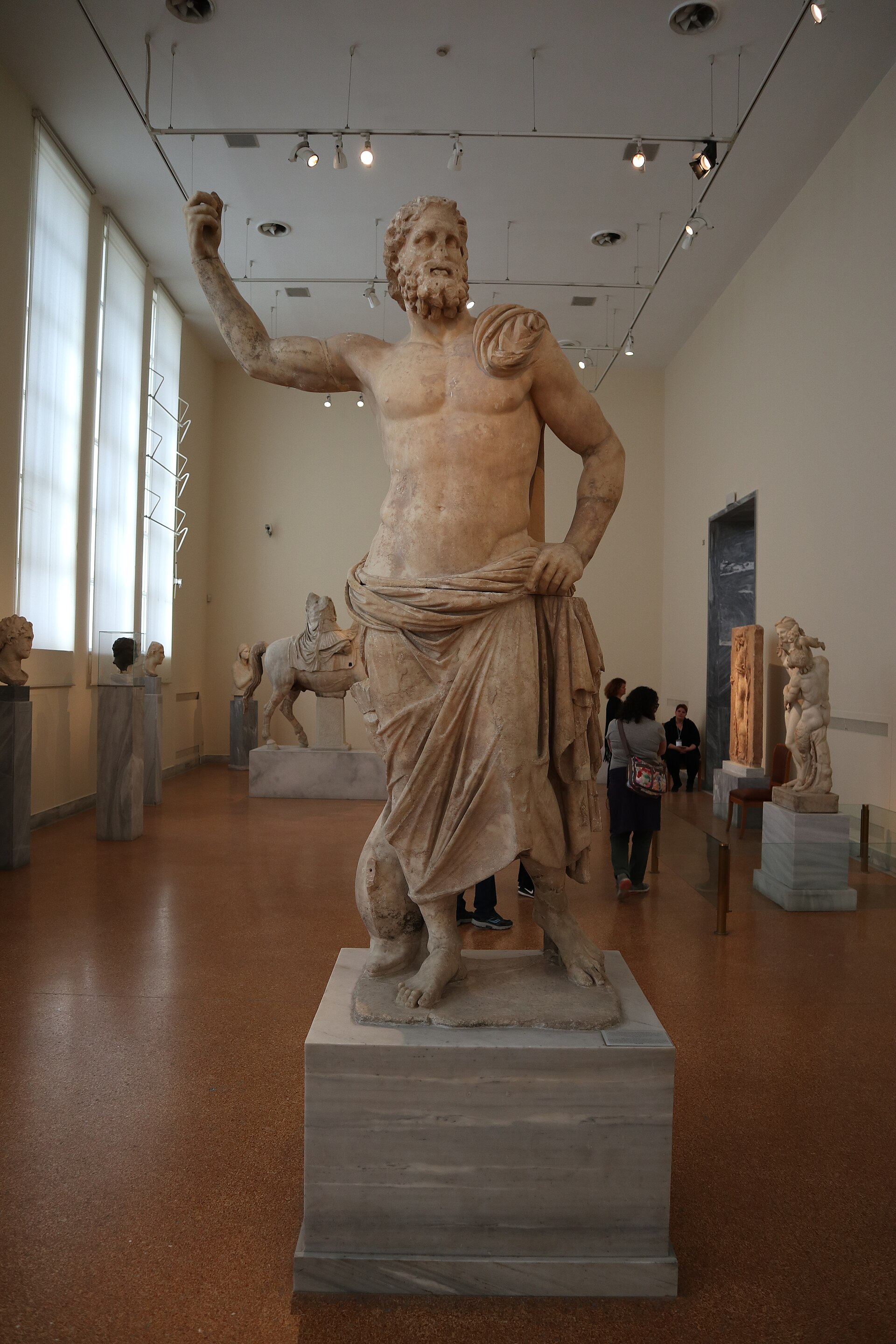

Orphic Hymns · Hymn 17
Poseidon
Ποσειδῶνος
Prayer and ritual
These hymns may be spoken as complete prayers to the Gods. Within the Temple’s practice, a ritual is a direct theurgical act; hymnody gathers the mind and turns it toward the Divine, helping the initiate enter reverent communion with the Gods.
Use a hymn on its own in place of another prayer, or add it to the prayer portion of a suitable ritual. Choose according to the deity addressed and the petition expressed in the hymn. When combining them, preserve the ritual’s prescribed sequence and let the hymn give voice to its purpose.
The petition of this hymn
Prayer to Poseidon for stable foundations of Earth and favourable passage of ships. It joins protection on land and sea with peace, health, and prosperity.
Use alone before a sea journey or in prayer for the security of a dwelling. It may supplement an established rite to Poseidon or a maritime protective rite, with attention to the paired request for steady Earth and swift navigation.
English hieratic rendering
Hymn 17 · An English rendering aligned with the Greek lines.
- Hear, Poseidon, holder of the Earth, with dark blue hair,
- lord of horses, bearing in your hands the trident wrought in bronze,
- who dwell in the foundations of the Sea with its deep bosom,
- ruler of the Sea, resounding over salt water, deeply thundering, shaker of Earth,
- abounding in waves, gracious of countenance, driving a chariot of four,
- stirring the salt water with the roar of the Sea,
- who received as the third portion the deep stream of the Sea,
- rejoicing in the waves and in their creatures, sovereign Daimon,
- preserve the foundations of Earth and the swift passage of ships,
- bringing peace, health, and prosperity without reproach.
Ancient Greek & pronunciation
Read the English pronunciation spelling directly below each Greek line.
- Κλῦθι, Ποσείδαον γαιήοχε, κυανοχαῖτα,KLEE-thee, poh-SEE-dhah-ohn yeh-EE-oh-hyeh, kee-ah-noh-HYEH-tah,
- ἵππιε, χαλκοτόρευτον ἔχων χείρεσσι τρίαιναν,EE-pee-eh, khahl-koh-TOH-rehf-tohn EH-khohn HYEE-reh-see TREE-eh-nahn,
- ὃς ναίεις πόντοιο βαθυστέρνοιο θέμεθλα,OHS NEH-ees POHN-dee-oh vah-thee-STEHR-nee-oh THEH-mehth-lah,
- ποντομέδων, ἁλίδουπε, βαρύκτυπος, ἐννοσίγαιε,pohn-doh-MEH-dhohn, ah-LEE-dhoo-peh, vah-REEK-tee-pohs, eh-noh-SEE-yeh-eh,
- κυμοθαλές, χαριτῶπα, τετράορον ἅρμα διώκων,kee-moh-thah-LEHS, khah-ree-TOH-pah, teh-TRAH-oh-rohn AHR-mah dhee-OH-kohn,
- εἰναλίοις ῥοίζοισι τινάσσων ἁλμυρὸν ὕδωρ,ee-nah-LEE-ees REE-zee-see tee-NAH-sohn ahl-mee-ROHN EE-dhohr,
- ὃς τριτάτης μοίρης ἔλαχες βαθὺ χεῦμα θαλάσσης,OHS tree-TAH-tees MEE-rees EH-lah-hyehs vah-THEE HYEHV-mah thah-LAH-sees,
- κύμασι τερπόμενος, θηρσίν θ’ ἅμα, πότνιε δαῖμον·KEE-mah-see tehr-POH-meh-nohs, theer-SEEN th’ AH-mah, POHT-nee-eh DHEH-mohn·
- ἕδρανα γῆς σῴζοις καὶ νηῶν εὔδρομον ὁρμήν,EH-dhrah-nah YEES SOH-zees KEH nee-OHN EHV-dhroh-mohn ohr-MEEN,
- εἰρήνην, ὑγίειαν ἄγων, ἠδ’ ὄλβον ἀμεμφῆ.ee-REE-neen, ee-YEE-ee-ahn AH-ghohn, eedh’ OHL-vohn ah-mehm-FEE.
Short sound guide for English speakers
Every line beneath the Greek uses English pronunciation spellings. Say each hyphenated syllable in sequence and emphasize the syllable in CAPITALS. For example, οὐρανόθεν is oo-rah-NOH-thehn. Read adjacent vowels separately: theh-AH has two syllables; oo-rah-NEE-een has four. Hyphens guide the voice; they do not mark pauses.
| Spelling | Sound to make |
|---|---|
| ah · eh · ee · oh · oo | father · met · see · go without its final glide · moon. Keep these vowels clear in unstressed syllables too. |
| th · dh | The unvoiced th in thin · the voiced th in this. Thus DHEE begins with the sound in “thee.” |
| kh | The ch in Scottish loch or German Bach: let air pass at the back of the mouth, without closing it into a k. |
| hy | The breathy beginning of a carefully spoken Hugh. Raise the middle of the tongue toward the roof of the mouth and let air pass without voice. In shy, sound s followed by hy; do not use the English sh sound or the English word “shy.” |
| gh | Make the kh sound above, then add voice. Keep the passage open; this is a flowing sound, not a hard g. |
| y · g | y as in yes, with gentle friction · always a hard g as in get. |
| r | Tap the tongue lightly behind the upper teeth, or use a light roll. |
| ks · ps | Sound both consonants, even at the beginning of a word: ks as in backs, ps as in lips. |
| n-g · m-b · n-d | Sound the nasal and the following consonant. In AHN-geh-leh, the n-g group is like finger, with the g audible. |
Always sound s as in hiss, even at the end of DHEE-kees; z is voiced, as in zero. All other consonants have their usual English sounds. Initial consonant groups may be unfamiliar: sound every written consonant, without inserting an extra vowel. A word without capitals carries no written stress in the Greek. Where two syllables have capitals, both written accents are retained. An apostrophe marks a vowel already elided in the Greek; do not add it back. A hyphen at the end of a Greek verse joins the unfinished word to the next verse.
These spellings follow the Modern Greek liturgical reading used throughout this library. Breathings and iota subscripts are silent; separately pronounced vowels remain separate. The few Greek consonants without an exact English equivalent use the sound cues above. Ancient vowel length, pitch accent and metre are not reconstructed.
Hymn notes
Sacred meaning
Poseidon holds the depths of the Sea and shakes the Earth, yet is asked to preserve both foundations and passage. The third portion assigned to him places this power within the ordered division of divine sovereignty.
Ancient offering rubric: Myrrh.
Textual note
Abel prints an alternative manuscript hymn after the ten line main text. It is not merged with the main hymn. The printed Ποσείδαον in line 1 and the main text word order of line 7 are followed.
Text and attribution
Greek text: Eugenius Abel, Orphica (1885), printed pages 67, 68. The text follows the printed main reading of this edition; source-specific variants are recorded where relevant. Read the digitised edition. Greek source. Wikisource transcription, revision 124153; checked and corrected against Abel’s print. The English hieratic rendering and suggested devotional use are new editorial work. The applications are guidance for this library, not additional lines of the ancient poem.