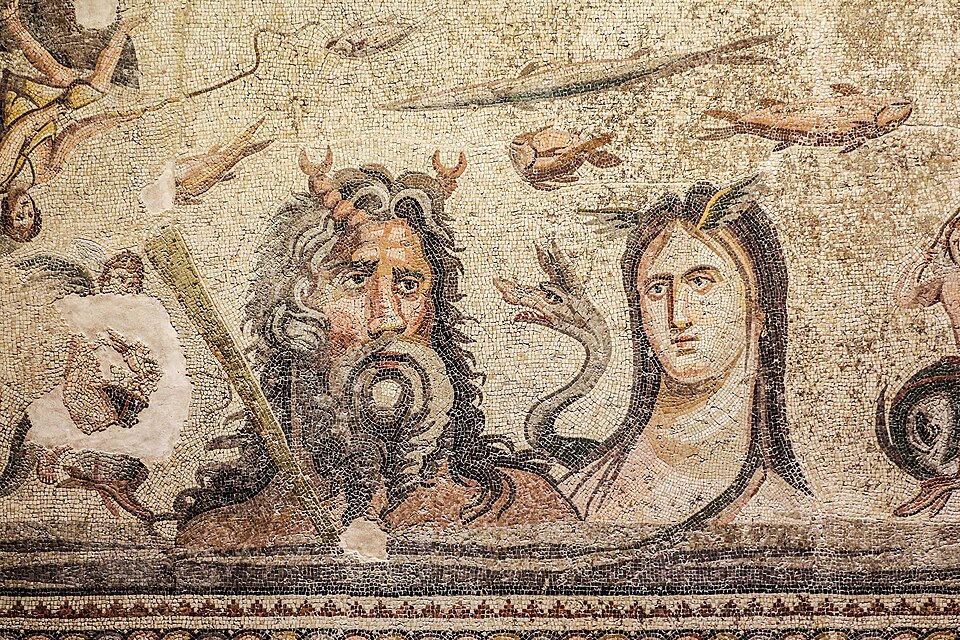

Hymns of Mesomedes · Hymn 07
Adrias, the Open Sea
Εἰς Ἀδρίαν
Prayer and ritual
These hymns may be spoken as complete prayers to the Gods. Within the Temple’s practice, a ritual is a direct theurgical act; hymnody gathers the mind and turns it toward the Divine, helping the initiate enter reverent communion with the Gods.
Use a hymn on its own in place of another prayer, or add it to the prayer portion of a suitable ritual. Choose according to the deity addressed and the petition expressed in the hymn. When combining them, preserve the ritual’s prescribed sequence and let the hymn give voice to its purpose.
The petition of this hymn
For a safe passage across the sea, fair winds, and the traveller’s return to land.
Recite the hymn as a complete prayer before or during a sea journey. It may supplement an existing rite for maritime protection or a thanksgiving for safe arrival, preserving the ancient speaker’s final vow as part of the transmitted poem.
English hieratic rendering
Hymn 07 · An English rendering aligned with the Greek lines.
- O Adrias of deep sailing, where shall I begin
- to hymn you, who dwell in the midst of the sea?
- How, or what spring, gave birth to you,
- and how does this all-blessed water
- stand fast, though earth does not enclose it?
- For nowhere is an outflow seen.
- No herdsman, no tribe of birds,
- no shepherd has piped to the bleating flocks;
- there are waters here, and the wide air.
- Into you again has inclined the dance of stars,
- and the moon’s radiant points,
- and the noble stars of the Pleiad.
- Grant me, O Master, to see land once more;
- grant winds that bring no harm, winds of fair weather;
- and when I behold the city that is mother of the earth,
- then I shall sacrifice to you a fair-horned fawn.
Ancient Greek & pronunciation
Read the English pronunciation spelling directly below each Greek line.
- Ἀδρία βαθύπλου, πόθεν ἄρξομαιah-DHREE-ah vah-THEE-ploo, POH-thehn AHRK-soh-meh
- ὑμνεῖν σε μεσαίπολε πόντου·eem-NEEN seh meh-SEH-poh-leh POHN-doo·
- πῶς ἢ τίς ἔτικτε σε παγά,POHS EE TEES EH-teek-teh seh pah-GHAH,
- ἢ πῶς τὸ πανόλβιον ὕδωρEE POHS TOH pah-NOHL-vee-ohn EE-dhohr
- χθονὶ μὴ περικείμενον ἵσταται;khthoh-NEE MEE peh-ree-KEE-meh-nohn EE-stah-teh;
- οὐ γὰρ βλέπετ’ ἔνθεν ἀπορροά.oo GHAHR VLEH-peht’ EHN-thehn ah-poh-roh-AH.
- οὐ βουκόλος, οὐ γένος ὀρνέων,oo voo-KOH-lohs, oo YEH-nohs ohr-NEH-ohn,
- οὐ μηκάσι σύρισε ποιμήν,oo mee-KAH-see SEE-ree-seh pee-MEEN,
- ἔνθ’ ὕδατα καὶ πλατὺς ἀήρ.EHNTH’ EE-dhah-tah KEH plah-TEES ah-EER.
- χορὸς εἰς σὲ πάλιν κέκλιτ’ ἀστέρωνkhoh-ROHS ees SEH PAH-leen KEH-kleet’ ah-STEH-rohn
- καὶ κέντρα φαεινὰ σελάναςKEH KEHN-drah fah-ee-NAH seh-LAH-nahs
- καὶ πλειάδος ἀστέρες εὐγενεῖς.KEH plee-AH-dhohs ah-STEH-rehs ehv-yeh-NEES.
- δὸς ἰδεῖν χθόνα δέσποτα καὶ πάλινDHOHS ee-DHEEN KHTHOH-nah DHEH-spoh-tah KEH PAH-leen
- ἀνέμους δὸς ἀπήμονας εὐδίους,ah-NEH-moos DHOHS ah-PEE-moh-nahs ehv-DHEE-oos,
- καὶ μητέρα γῆς ἐσιδὼν πόλινKEH mee-TEH-rah YEES eh-see-DHOHN POH-leen
- θύσω τότε σοι νεβρὸν εὔκερω.THEE-soh TOH-teh see neh-VROHN EHF-keh-roh.
Short sound guide for English speakers
Every line beneath the Greek uses English pronunciation spellings. Say each hyphenated syllable in sequence and emphasize the syllable in CAPITALS. For example, οὐρανόθεν is oo-rah-NOH-thehn. Read adjacent vowels separately: theh-AH has two syllables; oo-rah-NEE-een has four. Hyphens guide the voice; they do not mark pauses.
| Spelling | Sound to make |
|---|---|
| ah · eh · ee · oh · oo | father · met · see · go without its final glide · moon. Keep these vowels clear in unstressed syllables too. |
| th · dh | The unvoiced th in thin · the voiced th in this. Thus DHEE begins with the sound in “thee.” |
| kh | The ch in Scottish loch or German Bach: let air pass at the back of the mouth, without closing it into a k. |
| hy | The breathy beginning of a carefully spoken Hugh. Raise the middle of the tongue toward the roof of the mouth and let air pass without voice. In shy, sound s followed by hy; do not use the English sh sound or the English word “shy.” |
| gh | Make the kh sound above, then add voice. Keep the passage open; this is a flowing sound, not a hard g. |
| y · g | y as in yes, with gentle friction · always a hard g as in get. |
| r | Tap the tongue lightly behind the upper teeth, or use a light roll. |
| ks · ps | Sound both consonants, even at the beginning of a word: ks as in backs, ps as in lips. |
| n-g · m-b · n-d | Sound the nasal and the following consonant. In AHN-geh-leh, the n-g group is like finger, with the g audible. |
Always sound s as in hiss, even at the end of DHEE-kees; z is voiced, as in zero. All other consonants have their usual English sounds. Initial consonant groups may be unfamiliar: sound every written consonant, without inserting an extra vowel. A word without capitals carries no written stress in the Greek. Where two syllables have capitals, both written accents are retained. An apostrophe marks a vowel already elided in the Greek; do not add it back. A hyphen at the end of a Greek verse joins the unfinished word to the next verse.
These spellings follow the Modern Greek liturgical reading used throughout this library. Breathings and iota subscripts are silent; separately pronounced vowels remain separate. The few Greek consonants without an exact English equivalent use the sound cues above. Ancient vowel length, pitch accent and metre are not reconstructed.
Hymn notes
Sacred meaning
The speaker’s praise begins in wonder before open water that seems to stand without a visible containing shore or outlet. Herdsmen, birds, and pastoral song give way to water, air, and the stars that incline toward the sea. The cosmic prospect becomes an immediate petition for land and harmless winds, followed by a vow of thanksgiving upon reaching the great mother-city.
Textual note
Wilamowitz, Griechische Verskunst (1921), p. 599. The complete 16-line main text is retained, including its closing sacrificial vow. The manuscript readings and corrections printed in the apparatus are not substituted for the main text. The editor understands the mother-city of line 15 as Rome; the translation preserves the poem’s designation rather than inserting the city’s name. Adrias is the sea addressed as a divine master; the poem’s open-water setting need not be restricted to the modern geographical limits of the Adriatic.
Text and attribution
Ulrich von Wilamowitz-Moellendorff, Griechische Verskunst (1921), printed main text, pp. 596–599. Greek source. The English hieratic rendering and suggested devotional use are new editorial work. The applications are guidance for this library, not additional lines of the ancient poem.