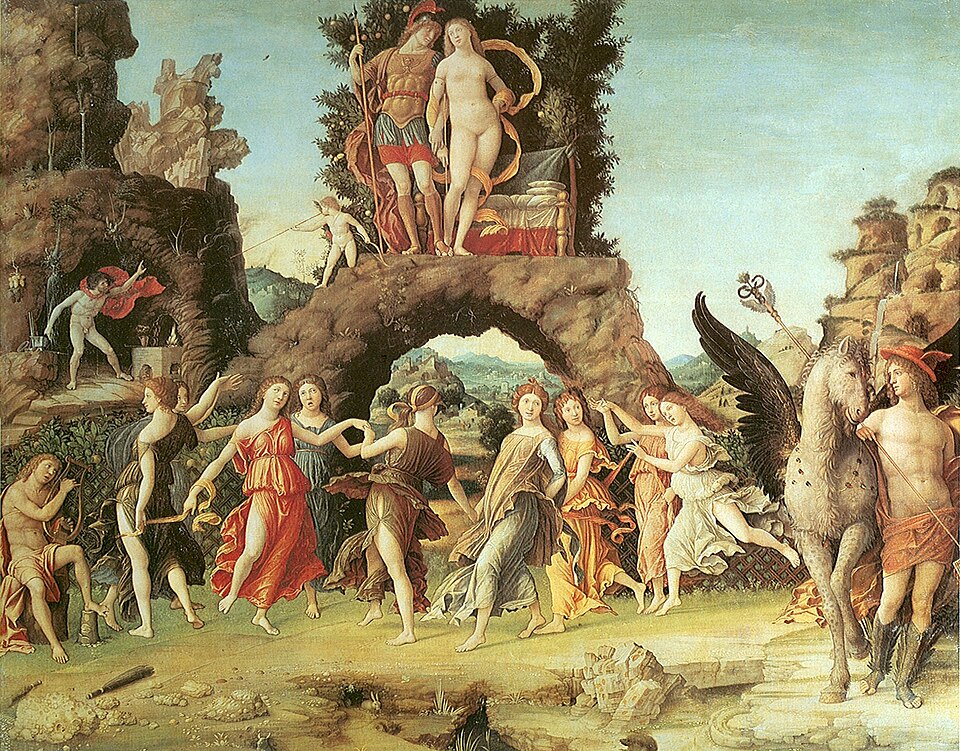

Hymns of Mesomedes · Hymn 01
The Beloved Muse
Εἰς Μοῦσαν
Prayer and ritual
These hymns may be spoken as complete prayers to the Gods. Within the Temple’s practice, a ritual is a direct theurgical act; hymnody gathers the mind and turns it toward the Divine, helping the initiate enter reverent communion with the Gods.
Use a hymn on its own in place of another prayer, or add it to the prayer portion of a suitable ritual. Choose according to the deity addressed and the petition expressed in the hymn. When combining them, preserve the ritual’s prescribed sequence and let the hymn give voice to its purpose.
The petition of this hymn
For inspiration that awakens the mind and gives sacred song its beginning.
Speak this short invocation before study, composition, or the recitation of a longer hymn. Alone, it is a complete prayer inviting the Muse to awaken the inward source of song.
English hieratic rendering
Hymn 01 · An English rendering aligned with the Greek lines.
- Sing for me, beloved Muse,
- and lead the beginning of my song.
- May a breeze from your sacred groves
- stir the depths of my mind.
Ancient Greek & pronunciation
Read the English pronunciation spelling directly below each Greek line.
- Ἄειδε μοῦσά μοι φίλη,AH-ee-dheh MOO-SAH mee FEE-lee,
- μολπῆς δ’ ἐμῆς κατάρχου·mohl-PEES dh’ eh-MEES kah-TAHR-khoo·
- αὔρη δὲ σῶν ἀπ’ ἀλσέωνAH-vree DHEH SOHN ahp’ ahl-SEH-ohn
- ἐμὰς φρένας δονείτω.eh-MAHS FREH-nahs dhoh-NEE-toh.
Short sound guide for English speakers
Every line beneath the Greek uses English pronunciation spellings. Say each hyphenated syllable in sequence and emphasize the syllable in CAPITALS. For example, οὐρανόθεν is oo-rah-NOH-thehn. Read adjacent vowels separately: theh-AH has two syllables; oo-rah-NEE-een has four. Hyphens guide the voice; they do not mark pauses.
| Spelling | Sound to make |
|---|---|
| ah · eh · ee · oh · oo | father · met · see · go without its final glide · moon. Keep these vowels clear in unstressed syllables too. |
| th · dh | The unvoiced th in thin · the voiced th in this. Thus DHEE begins with the sound in “thee.” |
| kh | The ch in Scottish loch or German Bach: let air pass at the back of the mouth, without closing it into a k. |
| hy | The breathy beginning of a carefully spoken Hugh. Raise the middle of the tongue toward the roof of the mouth and let air pass without voice. In shy, sound s followed by hy; do not use the English sh sound or the English word “shy.” |
| gh | Make the kh sound above, then add voice. Keep the passage open; this is a flowing sound, not a hard g. |
| y · g | y as in yes, with gentle friction · always a hard g as in get. |
| r | Tap the tongue lightly behind the upper teeth, or use a light roll. |
| ks · ps | Sound both consonants, even at the beginning of a word: ks as in backs, ps as in lips. |
| n-g · m-b · n-d | Sound the nasal and the following consonant. In AHN-geh-leh, the n-g group is like finger, with the g audible. |
Always sound s as in hiss, even at the end of DHEE-kees; z is voiced, as in zero. All other consonants have their usual English sounds. Initial consonant groups may be unfamiliar: sound every written consonant, without inserting an extra vowel. A word without capitals carries no written stress in the Greek. Where two syllables have capitals, both written accents are retained. An apostrophe marks a vowel already elided in the Greek; do not add it back. A hyphen at the end of a Greek verse joins the unfinished word to the next verse.
These spellings follow the Modern Greek liturgical reading used throughout this library. Breathings and iota subscripts are silent; separately pronounced vowels remain separate. The few Greek consonants without an exact English equivalent use the sound cues above. Ancient vowel length, pitch accent and metre are not reconstructed.
Hymn notes
Sacred meaning
The Muse is asked both to sing and to lead the worshipper’s own song. The breeze from her sacred groves becomes an image of inspiration stirring the mind. The prayer places the beginning of expression in divine companionship.
Textual note
A complete four-line proem transmitted with the musical hymns associated with Mesomedes. Its personal authorship is uncertain. Jan prints it before the distinct invocation of Calliope and Apollo; this library gives each prayer its own page.
Text and attribution
Carl von Jan, Musici scriptores Graeci, Supplementum: Melodiarum reliquiae (1899). Greek transcribed from the printed score; musical syllable separators are joined to recover ordinary words. Musical notation is not reproduced. Printed p. 44. Greek source. The English hieratic rendering and suggested devotional use are new editorial work. The applications are guidance for this library, not additional lines of the ancient poem.