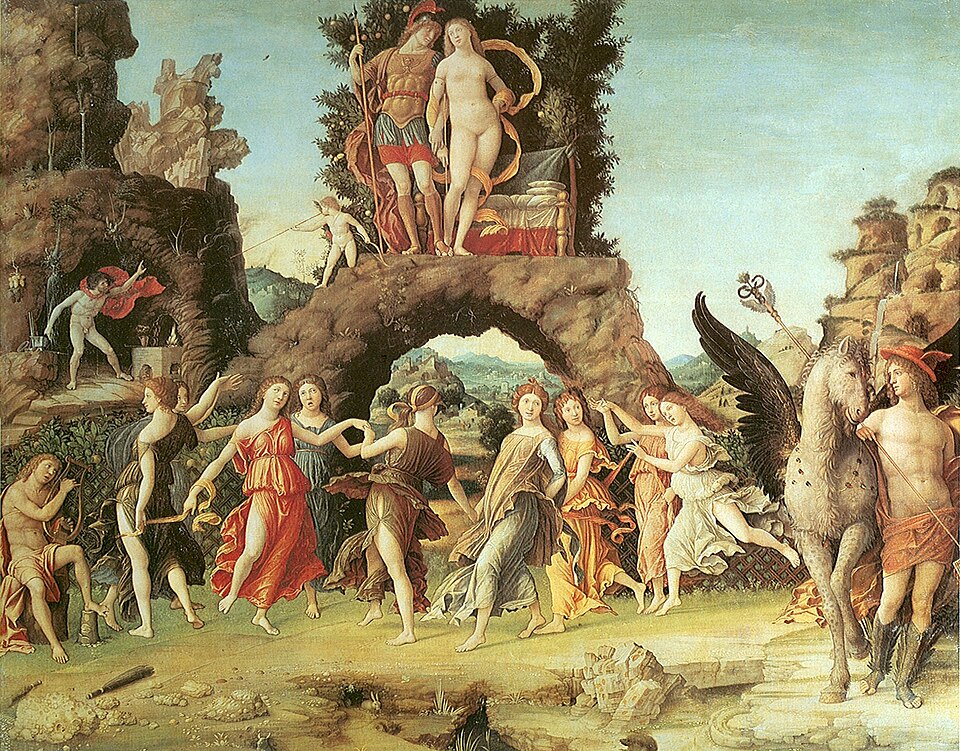

Homeric Hymns · Hymn 25
Muses and Apollon
Μοῦσαι καὶ Ἀπόλλων
Prayer and ritual
These hymns may be spoken as complete prayers to the Gods. Within the Temple’s practice, a ritual is a direct theurgical act; hymnody gathers the mind and turns it toward the Divine, helping the initiate enter reverent communion with the Gods.
Use a hymn on its own in place of another prayer, or add it to the prayer portion of a suitable ritual. Choose according to the deity addressed and the petition expressed in the hymn. When combining them, preserve the ritual’s prescribed sequence and let the hymn give voice to its purpose.
The petition of this hymn
Acknowledge the divine sources of song and noble speech, and ask the Muses to honour the offering.
Recite this hymn alone before singing, writing, or speaking in a sacred gathering. It may supplement a rite for inspiration or learning, directing attention to the sweetness of voice that flows from the Muses’ favour.
English hieratic rendering
Hymn 25 · An English rendering aligned with the Greek lines.
- Let me begin with the Muses, and Apollon, and Zeus;
- for from the Muses and Apollon the Far Shooter
- come singers and players of the lyre upon the Earth,
- and from Zeus come kings. Blessed is the one whom the Muses
- love; sweet flows the voice from his mouth.
- Hail, children of Zeus, and honour my song;
- and I shall remember both you and another song.
Ancient Greek & pronunciation
Read the English pronunciation spelling directly below each Greek line.
- μουσάων ἄρχωμαι Ἀπόλλωνός τε Διός τε·moo-SAH-ohn AHR-khoh-meh ah-POH-loh-NOHS teh dhee-OHS teh·
- ἐκ γὰρ Μουσάων καὶ ἑκηβόλου Ἀπόλλωνοςehk GHAHR moo-SAH-ohn KEH eh-kee-VOH-loo ah-POH-loh-nohs
- ἄνδρες ἀοιδοὶ ἔασιν ἐπὶ χθονὶ καὶ κιθαρισταί,AHN-dhrehs ah-ee-DHEE EH-ah-seen eh-PEE khthoh-NEE KEH kee-thah-ree-STEH,
- ἐκ δὲ Διὸς βασιλῆες· ὃ δʼ ὄλβιος, ὅν τινα Μοῦσαιehk DHEH dhee-OHS vah-see-LEE-ehs· OH dh’ OHL-vee-ohs, OHN tee-nah MOO-seh
- φίλωνται· γλυκερή οἱ ἀπὸ στόματος ῥέει αὐδή.FEE-lohn-deh· ghlee-keh-REE ee ah-POH STOH-mah-tohs REH-ee ahv-DHEE.
- χαίρετε, τέκνα Διός, καὶ ἐμὴν τιμήσατʼ ἀοιδήν·HYEH-reh-teh, TEHK-nah dhee-OHS, KEH eh-MEEN tee-MEE-saht’ ah-ee-DHEEN·
- αὐτὰρ ἐγὼν ὑμέων τε καὶ ἄλλης μνήσομʼ ἀοιδῆς.ahf-TAHR eh-GHOHN ee-MEH-ohn teh KEH AH-lees MNEE-sohm’ ah-ee-DHEES.
Short sound guide for English speakers
Every line beneath the Greek uses English pronunciation spellings. Say each hyphenated syllable in sequence and emphasize the syllable in CAPITALS. For example, οὐρανόθεν is oo-rah-NOH-thehn. Read adjacent vowels separately: theh-AH has two syllables; oo-rah-NEE-een has four. Hyphens guide the voice; they do not mark pauses.
| Spelling | Sound to make |
|---|---|
| ah · eh · ee · oh · oo | father · met · see · go without its final glide · moon. Keep these vowels clear in unstressed syllables too. |
| th · dh | The unvoiced th in thin · the voiced th in this. Thus DHEE begins with the sound in “thee.” |
| kh | The ch in Scottish loch or German Bach: let air pass at the back of the mouth, without closing it into a k. |
| hy | The breathy beginning of a carefully spoken Hugh. Raise the middle of the tongue toward the roof of the mouth and let air pass without voice. In shy, sound s followed by hy; do not use the English sh sound or the English word “shy.” |
| gh | Make the kh sound above, then add voice. Keep the passage open; this is a flowing sound, not a hard g. |
| y · g | y as in yes, with gentle friction · always a hard g as in get. |
| r | Tap the tongue lightly behind the upper teeth, or use a light roll. |
| ks · ps | Sound both consonants, even at the beginning of a word: ks as in backs, ps as in lips. |
| n-g · m-b · n-d | Sound the nasal and the following consonant. In AHN-geh-leh, the n-g group is like finger, with the g audible. |
Always sound s as in hiss, even at the end of DHEE-kees; z is voiced, as in zero. All other consonants have their usual English sounds. Initial consonant groups may be unfamiliar: sound every written consonant, without inserting an extra vowel. A word without capitals carries no written stress in the Greek. Where two syllables have capitals, both written accents are retained. An apostrophe marks a vowel already elided in the Greek; do not add it back. A hyphen at the end of a Greek verse joins the unfinished word to the next verse.
These spellings follow the Modern Greek liturgical reading used throughout this library. Breathings and iota subscripts are silent; separately pronounced vowels remain separate. The few Greek consonants without an exact English equivalent use the sound cues above. Ancient vowel length, pitch accent and metre are not reconstructed.
Hymn notes
Sacred meaning
The Muses and Apollon give rise to singers and lyre players, while Zeus is named as the source of kings. The poet’s gift belongs within a wider distribution of divine powers among human callings. The blessed speaker is one loved by the Muses, and the singer asks that this present song receive their honour.
Textual note
Zeus is named in the opening and the divine genealogy of kings, although the traditional title names only the Muses and Apollon.
Text and attribution
Greek text: Hugh G. Evelyn-White, Hymn 25 To the Muses and Apollo (1914), Perseus Digital Library. Greek source. The English hieratic rendering and suggested devotional use are new editorial work. The applications are guidance for this library, not additional lines of the ancient poem.