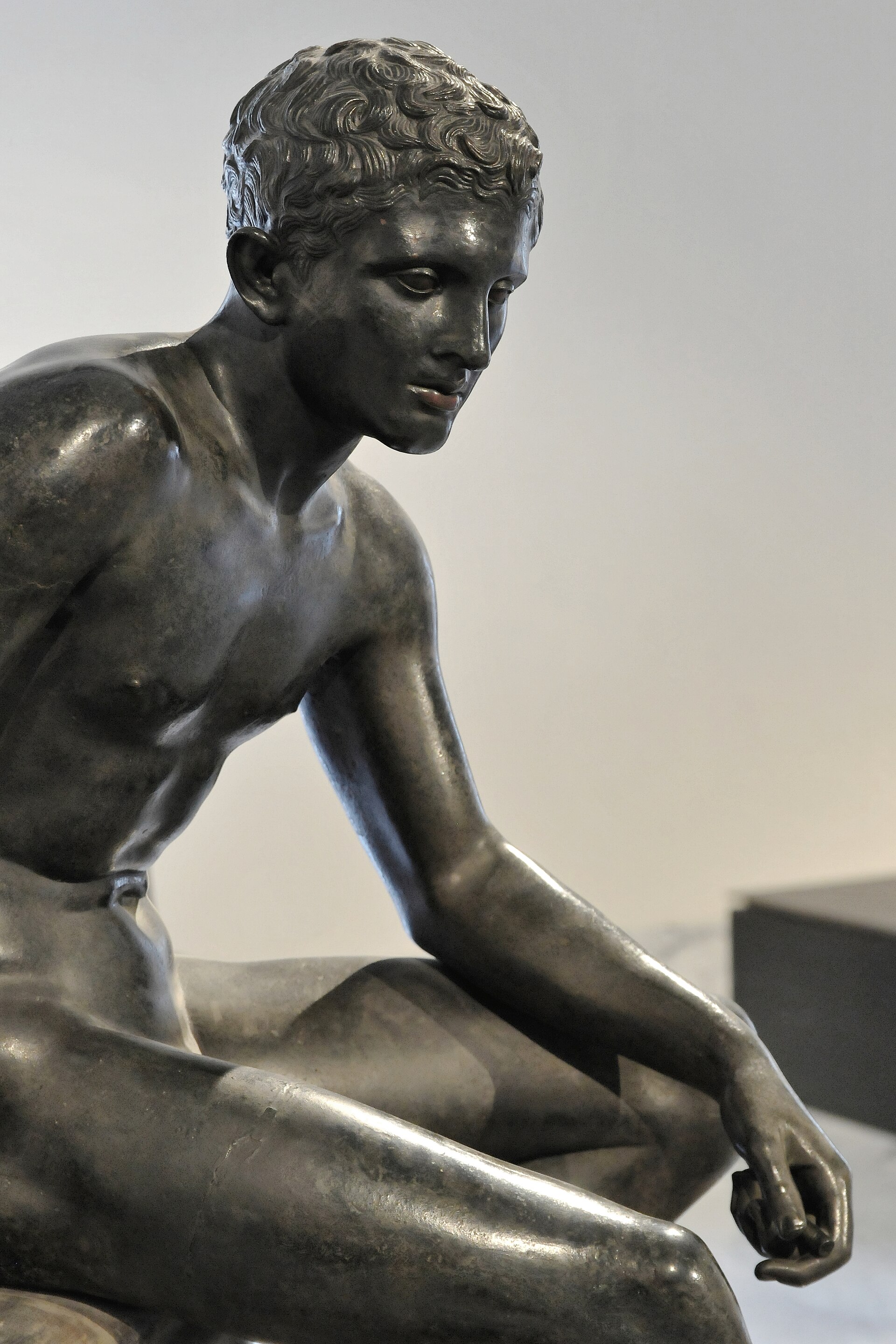

Homeric Hymns · Hymn 18
Hermes of Kyllene
Ἑρμῆς
Prayer and ritual
These hymns may be spoken as complete prayers to the Gods. Within the Temple’s practice, a ritual is a direct theurgical act; hymnody gathers the mind and turns it toward the Divine, helping the initiate enter reverent communion with the Gods.
Use a hymn on its own in place of another prayer, or add it to the prayer portion of a suitable ritual. Choose according to the deity addressed and the petition expressed in the hymn. When combining them, preserve the ritual’s prescribed sequence and let the hymn give voice to its purpose.
The petition of this hymn
Praise Hermes as divine Messenger and beneficent giver, remembering his birth from Zeus and Maia.
Read the hymn as a standalone prayer before travel, communication, or an undertaking that requires goodwill. It may supplement a rite to Hermes by establishing his parentage and sacred dwelling before the rite’s specific request; the bracketed final verse is an ancient alternative ending.
English hieratic rendering
Hymn 18 · An English rendering aligned with the Greek lines.
- I sing Hermes of Kyllene, the Slayer of Argos,
- who rules Kyllene and Arkadia rich in sheep,
- the beneficent Messenger of the Immortals, whom Maia bore,
- the daughter of Atlas, after joining with Zeus in love,
- revered Maia, who shunned the company of the blessed Gods,
- dwelling in a deeply shaded cave. There the Son of Kronos
- would join with the Nymph of lovely hair in the depth of night,
- when sweet sleep held Hera of the white arms;
- he escaped the notice of immortal Gods and mortal men.
- And so hail, son of Zeus and Maia;
- having begun with you, I shall pass onward to another hymn.
- [Hail, Hermes, giver of grace, Messenger, bestower of good things.]
Ancient Greek & pronunciation
Read the English pronunciation spelling directly below each Greek line.
- Ἑρμῆν ἀείδω Κυλλήνιον, Ἀργειφόντην,ehr-MEEN ah-EE-dhoh kee-LEE-nee-ohn, ahr-yee-FOHN-deen,
- Κυλλήνης μεδέοντα καὶ Ἀρκαδίης πολυμήλου,kee-LEE-nees meh-DHEH-ohn-dah KEH ahr-kah-DHEE-ees poh-lee-MEE-loo,
- ἄγγελον ἀθανάτων ἐριούνιον, ὃν τέκε Μαῖα,AHN-geh-lohn ah-thah-NAH-tohn eh-ree-OO-nee-ohn, OHN TEH-keh MEH-ah,
- Ἄτλαντος θυγάτηρ, Διὸς ἐν φιλότητι μιγεῖσα,AHT-lahn-dohs thee-GHAH-teer, dhee-OHS ehn fee-LOH-tee-tee mee-YEE-sah,
- αἰδοίη· μακάρων δὲ θεῶν ἀλέεινεν ὅμιλον,eh-DHEE-ee· mah-KAH-rohn DHEH theh-OHN ah-LEH-ee-nehn OH-mee-lohn,
- ἄντρῳ ναιετάουσα παλισκίῳ· ἔνθα ΚρονίωνAHN-droh neh-eh-TAH-oo-sah pah-lee-SKEE-oh· EHN-thah kroh-NEE-ohn
- νύμφῃ ἐυπλοκάμῳ μισγέσκετο νυκτὸς ἀμολγῷ,NEEM-fee eh-ee-ploh-KAH-moh meez-YEH-skeh-toh neek-TOHS ah-mohl-GHOH,
- εὖτε κατὰ γλυκὺς ὕπνος ἔχοι λευκώλενον Ἥρην·EHF-teh kah-TAH ghlee-KEES EEP-nohs EH-hyee lehf-KOH-leh-nohn EE-reen·
- λάνθανε δ’ ἀθανάτους τε θεοὺς θνητούς τ’ ἀνθρώπους.LAHN-thah-neh dh’ ah-thah-NAH-toos teh theh-OOS thnee-TOOS t’ ahn-THROH-poos.
- καὶ σὺ μὲν οὕτω χαῖρε, Διὸς καὶ Μαιάδος υἱέ·KEH SEE MEHN OO-toh HYEH-reh, dhee-OHS KEH meh-AH-dhohs ee-EH·
- σεῦ δ’ ἐγὼ ἀρξάμενος μεταβήσομαι ἄλλον ἐς ὕμνον.SEHV dh’ eh-GHOH ahrk-SAH-meh-nohs meh-tah-VEE-soh-meh AH-lohn ehs EEM-nohn.
- [χαῖρ’. Ἑρμῆ χαριδῶτα, διάκτορε, δῶτορ ἐάων.]HYEHR’. ehr-MEE khah-ree-DHOH-tah, dhee-AHK-toh-reh, DHOH-tohr eh-AH-ohn.
Short sound guide for English speakers
Every line beneath the Greek uses English pronunciation spellings. Say each hyphenated syllable in sequence and emphasize the syllable in CAPITALS. For example, οὐρανόθεν is oo-rah-NOH-thehn. Read adjacent vowels separately: theh-AH has two syllables; oo-rah-NEE-een has four. Hyphens guide the voice; they do not mark pauses.
| Spelling | Sound to make |
|---|---|
| ah · eh · ee · oh · oo | father · met · see · go without its final glide · moon. Keep these vowels clear in unstressed syllables too. |
| th · dh | The unvoiced th in thin · the voiced th in this. Thus DHEE begins with the sound in “thee.” |
| kh | The ch in Scottish loch or German Bach: let air pass at the back of the mouth, without closing it into a k. |
| hy | The breathy beginning of a carefully spoken Hugh. Raise the middle of the tongue toward the roof of the mouth and let air pass without voice. In shy, sound s followed by hy; do not use the English sh sound or the English word “shy.” |
| gh | Make the kh sound above, then add voice. Keep the passage open; this is a flowing sound, not a hard g. |
| y · g | y as in yes, with gentle friction · always a hard g as in get. |
| r | Tap the tongue lightly behind the upper teeth, or use a light roll. |
| ks · ps | Sound both consonants, even at the beginning of a word: ks as in backs, ps as in lips. |
| n-g · m-b · n-d | Sound the nasal and the following consonant. In AHN-geh-leh, the n-g group is like finger, with the g audible. |
Always sound s as in hiss, even at the end of DHEE-kees; z is voiced, as in zero. All other consonants have their usual English sounds. Initial consonant groups may be unfamiliar: sound every written consonant, without inserting an extra vowel. A word without capitals carries no written stress in the Greek. Where two syllables have capitals, both written accents are retained. An apostrophe marks a vowel already elided in the Greek; do not add it back. A hyphen at the end of a Greek verse joins the unfinished word to the next verse.
These spellings follow the Modern Greek liturgical reading used throughout this library. Breathings and iota subscripts are silent; separately pronounced vowels remain separate. The few Greek consonants without an exact English equivalent use the sound cues above. Ancient vowel length, pitch accent and metre are not reconstructed.
Hymn notes
Sacred meaning
Hermes’ public office as Messenger is set beside the hidden cave in which Maia dwells. His divine birth unfolds apart from the company of Gods and humans, yet he becomes a bearer of communication and benefit. The alternative closing verse gives this benefit the names of grace and good gifts.
Textual note
The duplicated Atlas reading arose from concatenating the XML sic and corr branches. The corrected Ἄτλαντος agrees with the printed page and appears once.
The bracketed last verse is retained as an alternative to lines 10–11, as the edition’s note states. It is not presented as an additional mandatory conclusion.
Text and attribution
Greek text: Hugh G. Evelyn-White, Hymn 18 To Hermes (1914), Perseus Digital Library. Greek source. The English hieratic rendering and suggested devotional use are new editorial work. The applications are guidance for this library, not additional lines of the ancient poem.