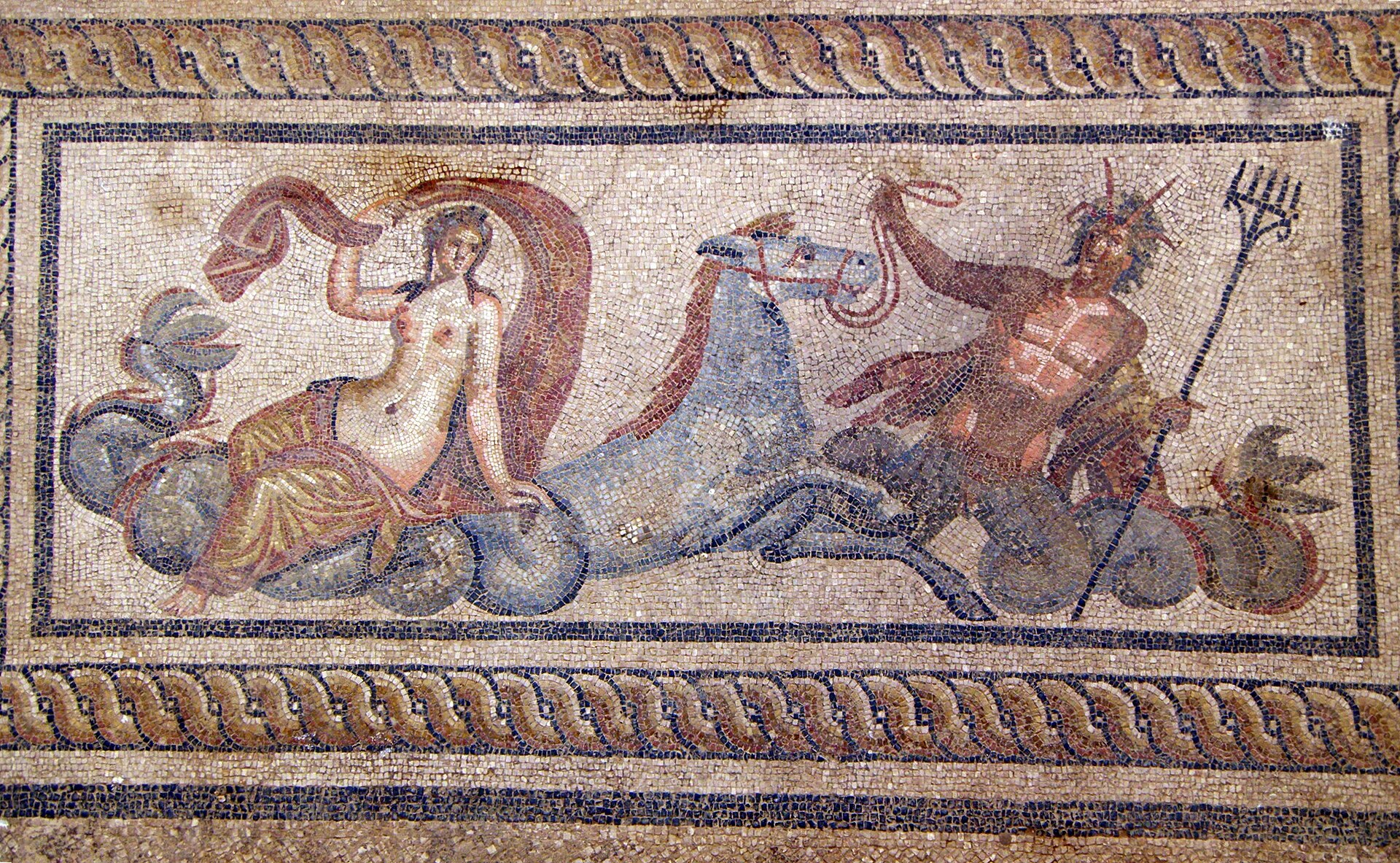
_and_a_Triton,_late_1st_or_2nd_century_AD,_Ephesus,_Turkey.jpg)
Orphic Hymns · Hymn 24
The Nereids
Νηρηίδων
Prayer and ritual
These hymns may be spoken as complete prayers to the Gods. Within the Temple’s practice, a ritual is a direct theurgical act; hymnody gathers the mind and turns it toward the Divine, helping the initiate enter reverent communion with the Gods.
Use a hymn on its own in place of another prayer, or add it to the prayer portion of a suitable ritual. Choose according to the deity addressed and the petition expressed in the hymn. When combining them, preserve the ritual’s prescribed sequence and let the hymn give voice to its purpose.
The petition of this hymn
Prayer to the fifty Nereids and the living powers of the Sea for abundant prosperity. Its ending honours their part in revealing the mysteries of Bacchos and Persephone.
Recite independently in thanksgiving for the Sea's life and in prayer for divine favour. It may accompany an established maritime or initiatory rite whose deities and purpose accord with the hymn's invocation of Bacchos, Persephone, Apollon, and Kalliope.
English hieratic rendering
Hymn 24 · An English rendering aligned with the Greek lines.
- Holy Nymphs of sea dwelling Nereus, with faces like flower buds,
- awesome dwellers in the deep, delighting in dances, travelling watery paths,
- fifty maidens celebrating Bacchic dances among the waves,
- rejoicing on the chariots of Tritons, upon their backs
- in the shapes of creatures whose bodies the Sea sustains,
- and the others who inhabit the deep, the Tritonian swell,
- coursers of the waters, leapers, wheeling about the waves,
- dolphins wandering the Sea, resounding in salt water, darkly radiant,
- I invoke you to send abundant prosperity to the initiates;
- for you first revealed the solemn rite
- of holy Bacchos and pure Persephone,
- together with my mother Kalliope and sovereign Apollon.
Ancient Greek & pronunciation
Read the English pronunciation spelling directly below each Greek line.
- Νηρέος εἰναλίου νύμφαι καλυκώπιδες, ἁγναί,nee-REH-ohs ee-nah-LEE-oo NEEM-feh kah-lee-KOH-pee-dhehs, ahgh-NEH,
- φρικαλέαι, βύθιαι, χοροπαίγμονες, ὑγροκέλευθοι,free-kah-LEH-eh, VEE-thee-eh, khoh-roh-PEHGH-moh-nehs, ee-ghroh-KEH-lehf-thee,
- πεντήκοντα κόραι περὶ κύμασι βακχεύουσαι,pehn-DEE-kohn-dah KOH-reh peh-REE KEE-mah-see vahk-HYEH-voo-seh,
- Τριτώνων ἐπ’ ὄχοισιν ἀγαλλόμεναι περὶ νῶταtree-TOH-nohn ehp’ OH-hyee-seen ah-ghah-LOH-meh-neh peh-REE NOH-tah
- θηροτύποις μορφαῖς, ὧν βόσκει σώματα πόντος·thee-roh-TEE-pees mohr-FEHS, OHN VOH-skee SOH-mah-tah POHN-dohs·
- ἄλλοι θ’ οἳ ναίουσι βυθόν, Τριτώνιον οἶδμα,AH-lee th’ EE NEH-oo-see vee-THOHN, tree-TOH-nee-ohn EEDH-mah,
- ὑδροδρόμοι, σκιρτηταί, ἑλισσόμενοι περὶ κῦμα,ee-dhroh-DHROH-mee, skeer-tee-TEH, eh-lee-SOH-meh-nee peh-REE KEE-mah,
- ποντοπλάνοι δελφῖνες, ἁλιρρόθιοι, κυαναυγεῖς·pohn-doh-PLAH-nee dhehl-FEE-nehs, ah-lee-ROH-thee-ee, kee-ah-nahv-YEES·
- ὑμᾶς κικλήσκω πέμπειν μύσταις πολὺν ὄλβον·ee-MAHS kee-KLEE-skoh PEHM-been MEE-stehs poh-LEEN OHL-vohn·
- ὑμεῖς γὰρ πρῶται τελετὴν ἀνεδείξατε σεμνὴνee-MEES GHAHR PROH-teh teh-leh-TEEN ah-neh-DHEEK-sah-teh sehm-NEEN
- εὐιέρου Βάκχοιο καὶ ἁγνῆς Φερσεφονείης,eh-vee-EH-roo VAHK-hyee-oh KEH ahgh-NEES fehr-seh-foh-NEE-ees,
- Καλλιόπῃ σὺν μητρὶ καὶ Ἀπόλλωνι ἄνακτι.kah-lee-OH-pee SEEN mee-TREE KEH ah-POH-loh-nee AH-nahk-tee.
Short sound guide for English speakers
Every line beneath the Greek uses English pronunciation spellings. Say each hyphenated syllable in sequence and emphasize the syllable in CAPITALS. For example, οὐρανόθεν is oo-rah-NOH-thehn. Read adjacent vowels separately: theh-AH has two syllables; oo-rah-NEE-een has four. Hyphens guide the voice; they do not mark pauses.
| Spelling | Sound to make |
|---|---|
| ah · eh · ee · oh · oo | father · met · see · go without its final glide · moon. Keep these vowels clear in unstressed syllables too. |
| th · dh | The unvoiced th in thin · the voiced th in this. Thus DHEE begins with the sound in “thee.” |
| kh | The ch in Scottish loch or German Bach: let air pass at the back of the mouth, without closing it into a k. |
| hy | The breathy beginning of a carefully spoken Hugh. Raise the middle of the tongue toward the roof of the mouth and let air pass without voice. In shy, sound s followed by hy; do not use the English sh sound or the English word “shy.” |
| gh | Make the kh sound above, then add voice. Keep the passage open; this is a flowing sound, not a hard g. |
| y · g | y as in yes, with gentle friction · always a hard g as in get. |
| r | Tap the tongue lightly behind the upper teeth, or use a light roll. |
| ks · ps | Sound both consonants, even at the beginning of a word: ks as in backs, ps as in lips. |
| n-g · m-b · n-d | Sound the nasal and the following consonant. In AHN-geh-leh, the n-g group is like finger, with the g audible. |
Always sound s as in hiss, even at the end of DHEE-kees; z is voiced, as in zero. All other consonants have their usual English sounds. Initial consonant groups may be unfamiliar: sound every written consonant, without inserting an extra vowel. A word without capitals carries no written stress in the Greek. Where two syllables have capitals, both written accents are retained. An apostrophe marks a vowel already elided in the Greek; do not add it back. A hyphen at the end of a Greek verse joins the unfinished word to the next verse.
These spellings follow the Modern Greek liturgical reading used throughout this library. Breathings and iota subscripts are silent; separately pronounced vowels remain separate. The few Greek consonants without an exact English equivalent use the sound cues above. Ancient vowel length, pitch accent and metre are not reconstructed.
Hymn notes
Sacred meaning
The dance of the fifty maidens is joined by Tritons and dolphins, giving sacred motion to the depths. The closing claim that the Nereids first revealed the mysteries connects this marine chorus with the revelation of divine rites.
Ancient offering rubric: Aromatic substances.
Textual note
The mother Kalliope in line 12 is the speaker's mother within the Orphic voice, not the mother of the Nereids. Line 7 follows the printed ὑδροδρόμοι, water coursers, correcting the digital ὑδρόδομοι.
Text and attribution
Greek text: Eugenius Abel, Orphica (1885), printed pages 71. The text follows the printed main reading of this edition; source-specific variants are recorded where relevant. Read the digitised edition. Greek source. Wikisource transcription, revision 124267; checked and corrected against Abel’s print. The English hieratic rendering and suggested devotional use are new editorial work. The applications are guidance for this library, not additional lines of the ancient poem.