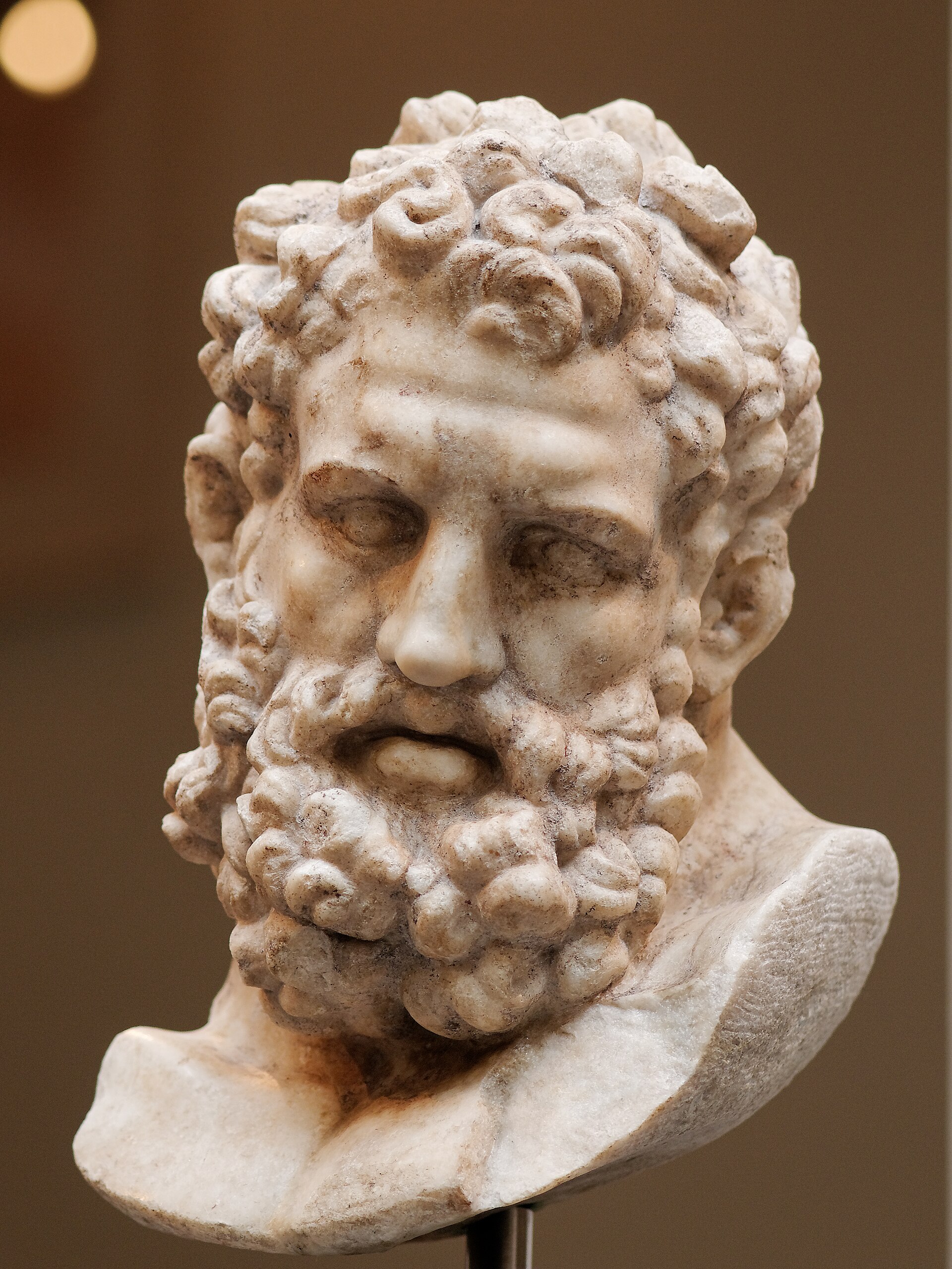

Homeric Hymns · Hymn 15
Herakles the Lionhearted
Ἡρακλῆς
Prayer and ritual
These hymns may be spoken as complete prayers to the Gods. Within the Temple’s practice, a ritual is a direct theurgical act; hymnody gathers the mind and turns it toward the Divine, helping the initiate enter reverent communion with the Gods.
Use a hymn on its own in place of another prayer, or add it to the prayer portion of a suitable ritual. Choose according to the deity addressed and the petition expressed in the hymn. When combining them, preserve the ritual’s prescribed sequence and let the hymn give voice to its purpose.
The petition of this hymn
Remember Herakles’ labours and divine dwelling, and seek excellence and prosperity.
Use the hymn as a prayer for perseverance in demanding work and gratitude for completion. It may supplement a rite concerned with strength or the passage from hardship into a stable new condition, following the poem’s movement from wandering to the seat of Olympos.
English hieratic rendering
Hymn 15 · An English rendering aligned with the Greek lines.
- I shall sing Herakles, son of Zeus, whom Alkmene bore,
- by far the best of those upon the Earth, in Thebes of lovely dancing places,
- after joining with the Son of Kronos of the dark clouds.
- He formerly wandered over the vast Earth and Sea,
- at the commands of sovereign Eurystheus,
- and himself performed many reckless deeds, and endured many things.
- But now in the beautiful seat of snowy Olympos
- he dwells in delight, and has Hebe of the lovely ankles.
- Hail, sovereign Lord, son of Zeus; grant excellence and prosperity.
Ancient Greek & pronunciation
Read the English pronunciation spelling directly below each Greek line.
- Ἡρακλέα, Διὸς υἱόν, ἀείσομαι, ὃν μέγʼ ἄριστονee-rah-KLEH-ah, dhee-OHS ee-OHN, ah-EE-soh-meh, OHN MEHGH’ AH-ree-stohn
- γείνατʼ ἐπιχθονίων Θήβῃς ἔνι καλλιχόροισινYEE-naht’ eh-peekh-thoh-NEE-ohn THEE-vees EH-nee kah-lee-KHOH-ree-seen
- Ἀλκμήνη μιχθεῖσα κελαινεφέι Κρονίωνι·ahlk-MEE-nee meekh-THEE-sah keh-leh-neh-FEH-ee kroh-NEE-oh-nee·
- ὃς πρὶν μὲν κατὰ γαῖαν ἀθέσφατον ἠδὲ θάλασσανOHS PREEN MEHN kah-TAH YEH-ahn ah-THEH-sfah-tohn ee-DHEH THAH-lah-sahn
- πλαζόμενος πομπῇσιν ὕπʼ Εὐρυσθῆος ἄνακτοςplah-ZOH-meh-nohs pohm-BEE-seen EEP’ eh-vrees-THEE-ohs AH-nahk-tohs
- πολλὰ μὲν αὐτὸς ἔρεξεν ἀτάσθαλα, πολλὰ δʼ ἀνέτλη·poh-LAH MEHN ahf-TOHS EH-rehk-sehn ah-TAHS-thah-lah, poh-LAH dh’ ah-NEHT-lee·
- νῦν δʼ ἤδη κατὰ καλὸν ἕδος νιφόεντος ὈλύμπουNEEN dh’ EE-dhee kah-TAH kah-LOHN EH-dhohs nee-FOH-ehn-dohs oh-LEEM-boo
- ναίει τερπόμενος καὶ ἔχει καλλίσφυρον Ἥβην.NEH-ee tehr-POH-meh-nohs KEH EH-hyee kah-LEE-sfee-rohn EE-veen.
- χαῖρε, ἄναξ, Διὸς υἱέ· δίδου δʼ ἀρετήν τε καὶ ὄλβον.HYEH-reh, AH-nahks, dhee-OHS ee-EH· DHEE-dhoo dh’ ah-reh-TEEN teh KEH OHL-vohn.
Short sound guide for English speakers
Every line beneath the Greek uses English pronunciation spellings. Say each hyphenated syllable in sequence and emphasize the syllable in CAPITALS. For example, οὐρανόθεν is oo-rah-NOH-thehn. Read adjacent vowels separately: theh-AH has two syllables; oo-rah-NEE-een has four. Hyphens guide the voice; they do not mark pauses.
| Spelling | Sound to make |
|---|---|
| ah · eh · ee · oh · oo | father · met · see · go without its final glide · moon. Keep these vowels clear in unstressed syllables too. |
| th · dh | The unvoiced th in thin · the voiced th in this. Thus DHEE begins with the sound in “thee.” |
| kh | The ch in Scottish loch or German Bach: let air pass at the back of the mouth, without closing it into a k. |
| hy | The breathy beginning of a carefully spoken Hugh. Raise the middle of the tongue toward the roof of the mouth and let air pass without voice. In shy, sound s followed by hy; do not use the English sh sound or the English word “shy.” |
| gh | Make the kh sound above, then add voice. Keep the passage open; this is a flowing sound, not a hard g. |
| y · g | y as in yes, with gentle friction · always a hard g as in get. |
| r | Tap the tongue lightly behind the upper teeth, or use a light roll. |
| ks · ps | Sound both consonants, even at the beginning of a word: ks as in backs, ps as in lips. |
| n-g · m-b · n-d | Sound the nasal and the following consonant. In AHN-geh-leh, the n-g group is like finger, with the g audible. |
Always sound s as in hiss, even at the end of DHEE-kees; z is voiced, as in zero. All other consonants have their usual English sounds. Initial consonant groups may be unfamiliar: sound every written consonant, without inserting an extra vowel. A word without capitals carries no written stress in the Greek. Where two syllables have capitals, both written accents are retained. An apostrophe marks a vowel already elided in the Greek; do not add it back. A hyphen at the end of a Greek verse joins the unfinished word to the next verse.
These spellings follow the Modern Greek liturgical reading used throughout this library. Breathings and iota subscripts are silent; separately pronounced vowels remain separate. The few Greek consonants without an exact English equivalent use the sound cues above. Ancient vowel length, pitch accent and metre are not reconstructed.
Hymn notes
Sacred meaning
The hymn keeps together what Herakles performed and what he endured under Eurystheus. His present delight with Hebe contrasts with the long course of earthly labour. A devotional reading can find in that transition an image of excellence brought through ordeal into lasting fulfilment.
Textual note
Line 6 retains the edition’s ἀτάσθαλα, translated “reckless deeds”. The apparatus records a different manuscript wording; it has not been substituted to soften the main text.
Text and attribution
Greek text: Hugh G. Evelyn-White, Hymn 15 To Heracles the Lion-Hearted (1914), Perseus Digital Library. Greek source. The English hieratic rendering and suggested devotional use are new editorial work. The applications are guidance for this library, not additional lines of the ancient poem.