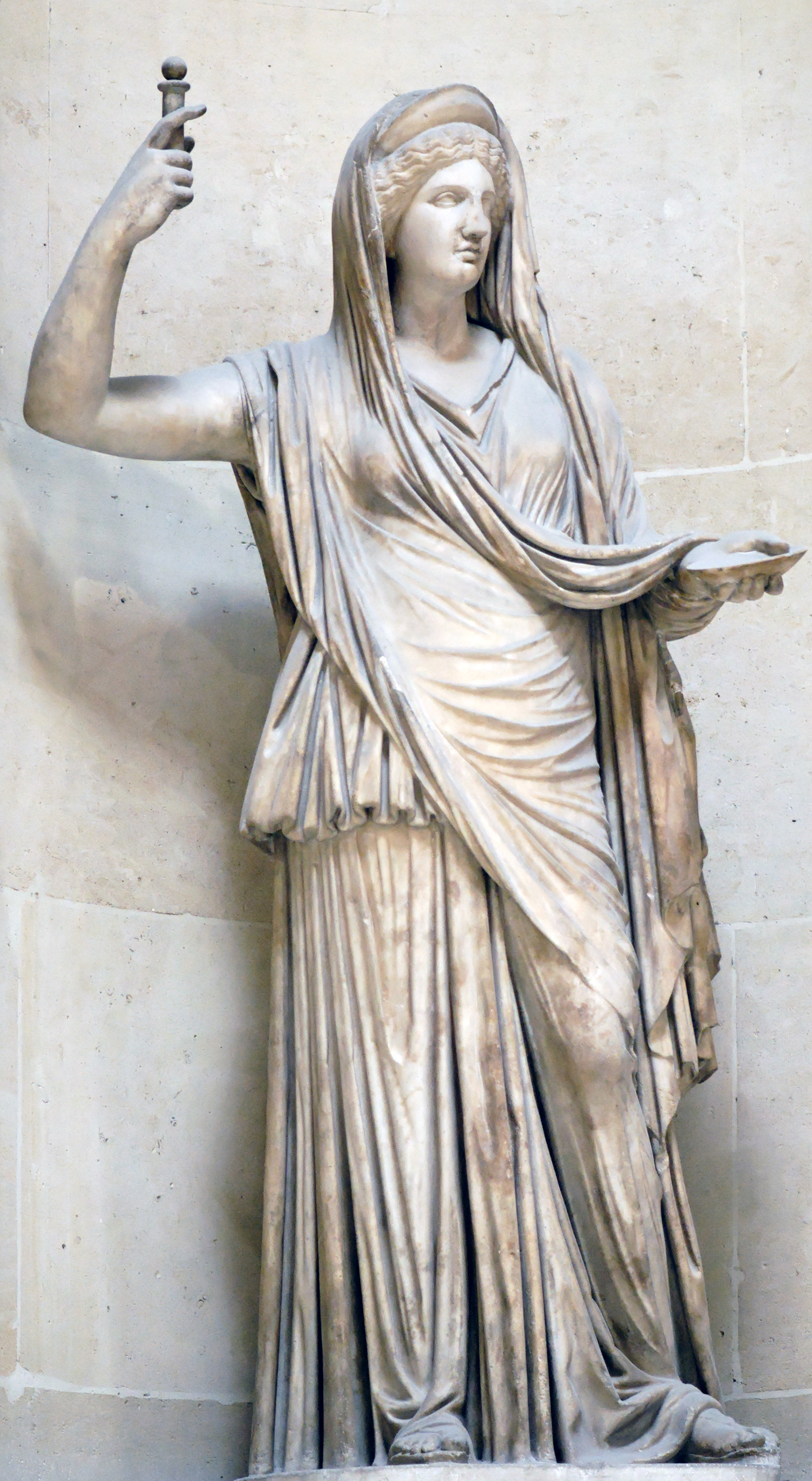

Homeric Hymns · Hymn 12
Hera of the Golden Throne
Ἥρα
Prayer and ritual
These hymns may be spoken as complete prayers to the Gods. Within the Temple’s practice, a ritual is a direct theurgical act; hymnody gathers the mind and turns it toward the Divine, helping the initiate enter reverent communion with the Gods.
Use a hymn on its own in place of another prayer, or add it to the prayer portion of a suitable ritual. Choose according to the deity addressed and the petition expressed in the hymn. When combining them, preserve the ritual’s prescribed sequence and let the hymn give voice to its purpose.
The petition of this hymn
Honour Hera’s divine queenship, splendour, and place beside Zeus.
Recite this hymn as an act of praise to Hera without needing to add a petition to the ancient text. It may accompany a rite concerning marriage, household dignity, or shared authority, drawing upon her explicitly named queenship and union with Zeus.
English hieratic rendering
Hymn 12 · An English rendering aligned with the Greek lines.
- I sing Hera of the golden throne, whom Rhea bore,
- Queen of the Immortals, whose beauty is surpassing,
- sister and wife of Zeus who thunders mightily,
- glorious, whom all the blessed ones throughout lofty Olympos
- revere and honour even as Zeus who delights in thunderbolts.
Ancient Greek & pronunciation
Read the English pronunciation spelling directly below each Greek line.
- Ἥρην ἀείδω χρυσόθρονον, ἣν τέκε Ῥείη,EE-reen ah-EE-dhoh khree-SOH-throh-nohn, EEN TEH-keh REE-ee,
- ἀθανάτων βασίλειαν, ὑπείροχον εἶδος ἔχουσαν,ah-thah-NAH-tohn vah-SEE-lee-ahn, ee-PEE-roh-khohn EE-dhohs EH-khoo-sahn,
- Ζηνὸς ἐριγδούποιο κασιγνήτην ἄλοχόν τε,zee-NOHS eh-reegh-DHOO-pee-oh kah-seegh-NEE-teen AH-loh-KHOHN teh,
- κυδρήν, ἣν πάντες μάκαρες κατὰ μακρὸν Ὄλυμπονkee-DHREEN, EEN PAHN-dehs MAH-kah-rehs kah-TAH mah-KROHN OH-leem-bohn
- ἁζόμενοι τίουσιν ὁμῶς Διὶ τερπικεραύνῳ.ah-ZOH-meh-nee TEE-oo-seen oh-MOHS dhee-EE tehr-pee-keh-RAHV-noh.
Short sound guide for English speakers
Every line beneath the Greek uses English pronunciation spellings. Say each hyphenated syllable in sequence and emphasize the syllable in CAPITALS. For example, οὐρανόθεν is oo-rah-NOH-thehn. Read adjacent vowels separately: theh-AH has two syllables; oo-rah-NEE-een has four. Hyphens guide the voice; they do not mark pauses.
| Spelling | Sound to make |
|---|---|
| ah · eh · ee · oh · oo | father · met · see · go without its final glide · moon. Keep these vowels clear in unstressed syllables too. |
| th · dh | The unvoiced th in thin · the voiced th in this. Thus DHEE begins with the sound in “thee.” |
| kh | The ch in Scottish loch or German Bach: let air pass at the back of the mouth, without closing it into a k. |
| hy | The breathy beginning of a carefully spoken Hugh. Raise the middle of the tongue toward the roof of the mouth and let air pass without voice. In shy, sound s followed by hy; do not use the English sh sound or the English word “shy.” |
| gh | Make the kh sound above, then add voice. Keep the passage open; this is a flowing sound, not a hard g. |
| y · g | y as in yes, with gentle friction · always a hard g as in get. |
| r | Tap the tongue lightly behind the upper teeth, or use a light roll. |
| ks · ps | Sound both consonants, even at the beginning of a word: ks as in backs, ps as in lips. |
| n-g · m-b · n-d | Sound the nasal and the following consonant. In AHN-geh-leh, the n-g group is like finger, with the g audible. |
Always sound s as in hiss, even at the end of DHEE-kees; z is voiced, as in zero. All other consonants have their usual English sounds. Initial consonant groups may be unfamiliar: sound every written consonant, without inserting an extra vowel. A word without capitals carries no written stress in the Greek. Where two syllables have capitals, both written accents are retained. An apostrophe marks a vowel already elided in the Greek; do not add it back. A hyphen at the end of a Greek verse joins the unfinished word to the next verse.
These spellings follow the Modern Greek liturgical reading used throughout this library. Breathings and iota subscripts are silent; separately pronounced vowels remain separate. The few Greek consonants without an exact English equivalent use the sound cues above. Ancient vowel length, pitch accent and metre are not reconstructed.
Hymn notes
Sacred meaning
Hera is presented through birth from Rhea, surpassing beauty, and her relationship with Zeus as sister and wife. The Gods honour her with the reverence given to Zeus. A devotional reading can dwell on the majesty of divine relationship and the dignity of the Goddess in her own right.
Text and attribution
Greek text: Hugh G. Evelyn-White, Hymn 12 To Hera (1914), Perseus Digital Library. Greek source. The English hieratic rendering and suggested devotional use are new editorial work. The applications are guidance for this library, not additional lines of the ancient poem.