The Three Protectresses of the Dead Power Ritual
Μερσετσεγέρ · Κεμπεχούτ · Σερκέτ · Silence, Cool Water, and the Guarded Body
Before you begin
These rites are for adults. Children and teenagers must not perform them. Pregnant women should not perform them.
Read this ritual in full before beginning, follow its instructions with care, and allow the intervening day its proper quiet.
This rite may be combined with the Ritual of Hades, the God who rules the underworld.
May Zeus bless this observance, and may the Great Chthonic Gods receive our devotion in friendship and honour.
Meretseger, Qebehut, Serqet, I greet you each in your own dignity.
Let the quiet mountain, the cooling water, and the watchful guardian be honored here.
I seek no spectacle and no power over the dead.
I seek a heart made more truthful, a hand made more gentle, and a promise kept.
Vibrate the runes in order
 Isax10
 Eihwazx10
 Tiwazx10
En hēsykhiai tēn alētheian timō.
In quiet I honor truth.
Meretseger, Lady of the Peak, receive my reverence.
Your mountain stood above the labor and tombs of the Theban west.
Workers raised stelae beneath your gaze and spoke of their faults and hopes.
Your silence is not emptiness to those who must answer for a deed.
Let me listen before I defend myself.
Let me name a wrong without making my confession a performance.
Let repair begin where words have injured and where deeds have failed.
Let the one I harmed keep the right to set their own boundary.
Let silence shelter the grieving without isolating them.
Meretseger, receive honor for watchfulness joined to truth.
May my next spoken word be worthy of the stillness that precedes it.
Bring to mind one truth that requires a careful action.
Vibrate the runes in order
 Laguzx10
 Berkanox10
 Gebox10
To psykhron hydōr anapausin pheretō.
Let cool water bring relief.
Qebehut, daughter of Anubis in the old funerary words, receive my greeting.
The text remembers you cooling and restoring the heart of the departed.
I will not use that image to silence a living person's sorrow.
Let grief be given water, rest, and company when company is wanted.
Let a thirsty person be offered water before I offer a speech.
Let relief be modest enough to be received.
Let a body in pain be treated with skill and patience.
Let the dead be remembered without haste or possession.
Qebehut, receive honor for the cooling mercy your name bears.
May I learn when to be present and when to withdraw.
May the simplest kindness be done well.
If a bowl is present, regard it as ordinary clean water and a reminder of practical care.
Vibrate the runes in order
 Algizx10
 Ehwazx10
 Mannazx10
Hē phroura meta eumeneias ginesthō.
Let guardianship be joined to goodwill.
Serqet, scorpion crowned protector, receive my reverence.
Ancient funerary art set your care near what was most vulnerable.
The gold of a royal coffinette cannot measure the worth of an ordinary life.
Let every person be treated as one whose body deserves protection.
Let the skill that guards against danger remain calm and exact.
Let those who keep watch have rest and help of their own.
Let fear of harm never become permission to harm first.
Let me seek the right remedy when a danger is real.
Serqet, receive honor for the vigilance carried by your image.
May watchfulness become service, never domination.
May a guarded body be free to live.
Think of a specific way to make someone safer without taking away their agency.
Vibrate the runes in order
Gebox10Algizx10Laguzx10Hēsykhia kai hydōr kai phroura tēn phrontida stērizetōsan.
Let silence, water, and guardianship sustain care.
Meretseger receives this prayer at the mountain of truthful quiet.
Qebehut receives it at the stream of relief.
Serqet receives it at the watch kept around a vulnerable body.
I name three goddesses and do not dissolve one into another.
These images meet in this rite because care needs more than one form.
Silence can hold a confession without humiliating the speaker.
Water can refresh without erasing memory.
Vigilance can protect without imprisoning.
Zeus, keep the force of every act within the measure of justice.
May those who mourn be met as persons, not as symbols.
May care remain a gift whose shape can be changed by those receiving it.
Hold the three images together while preserving their distinct purposes.
Vibrate the runes in order
 Dagazx10
 Jerax10Berkanox10
Eis ton bion epanerkhomai kai tēn phrontida prattō.
I return to life and put care into action.
The mountain, stream, and scorpion remain in the white field.
My own hands return to the room and to the people who live here.
I can apologize without demanding comfort in return.
I can bring water or food and accept a refusal graciously.
I can learn the right way to help before I offer help.
Meretseger, receive thanks for truthful silence.
Qebehut, receive thanks for the image of cooling relief.
Serqet, receive thanks for vigilant protection.
Zeus, let my intentions become deeds fit for human company.
May I finish the rite gently and begin the next good act plainly.
May reverence remain after the words end.
Choose one small act that answers a real need.
Zeus, let truthful speech, relief, and protection remain joined to goodwill.
I leave the sacred image complete and return to the living world in peace.
Choose an act of care suited to an actual person. Ask what they need if that is not yet known.
Short return if stopping early
Three protectresses, receive my thanks. I return to the present room and to the living. Hail Zeus.
On Meretseger
The British Museum's limestone stela of Paneb, EA273, depicts a workman kneeling before Meretseger in serpent-headed human form at Deir el-Medina. Her name is commonly rendered ‘She Who Loves Silence,’ and the Theban western peak was her sacred landscape. Neferabu's votive stela, translated in Miriam Lichtheim, Ancient Egyptian Literature, volume II, pages 107 to 109, witnesses the language of confession and divine response. The first station turns that heritage toward truthful repair in the living world.
On Qebehut
James P. Allen's translation of the Pyramid Texts, Pepi I spell 312, names Qebehut in connection with cooling and restoring the heart in Anubis's house. The name is glossed ‘She of the Cool Waters’ in Allen's glossary. The second station honors relief and restoration through newly written prayer; it does not reproduce a funerary utterance as a modern operative formula.
On Serqet
The Grand Egyptian Museum's canopic coffinette GEM 471 carries a protective spell voiced by Selket, another spelling of Serqet, beside one of Tutankhamun's preserved organs. The museum identifies her among four protective goddesses and associates her with guarding the intestines in this object. The station praises vigilance while translating its moral force into care for actual bodies and their freedom.
The Shenu and the five stations
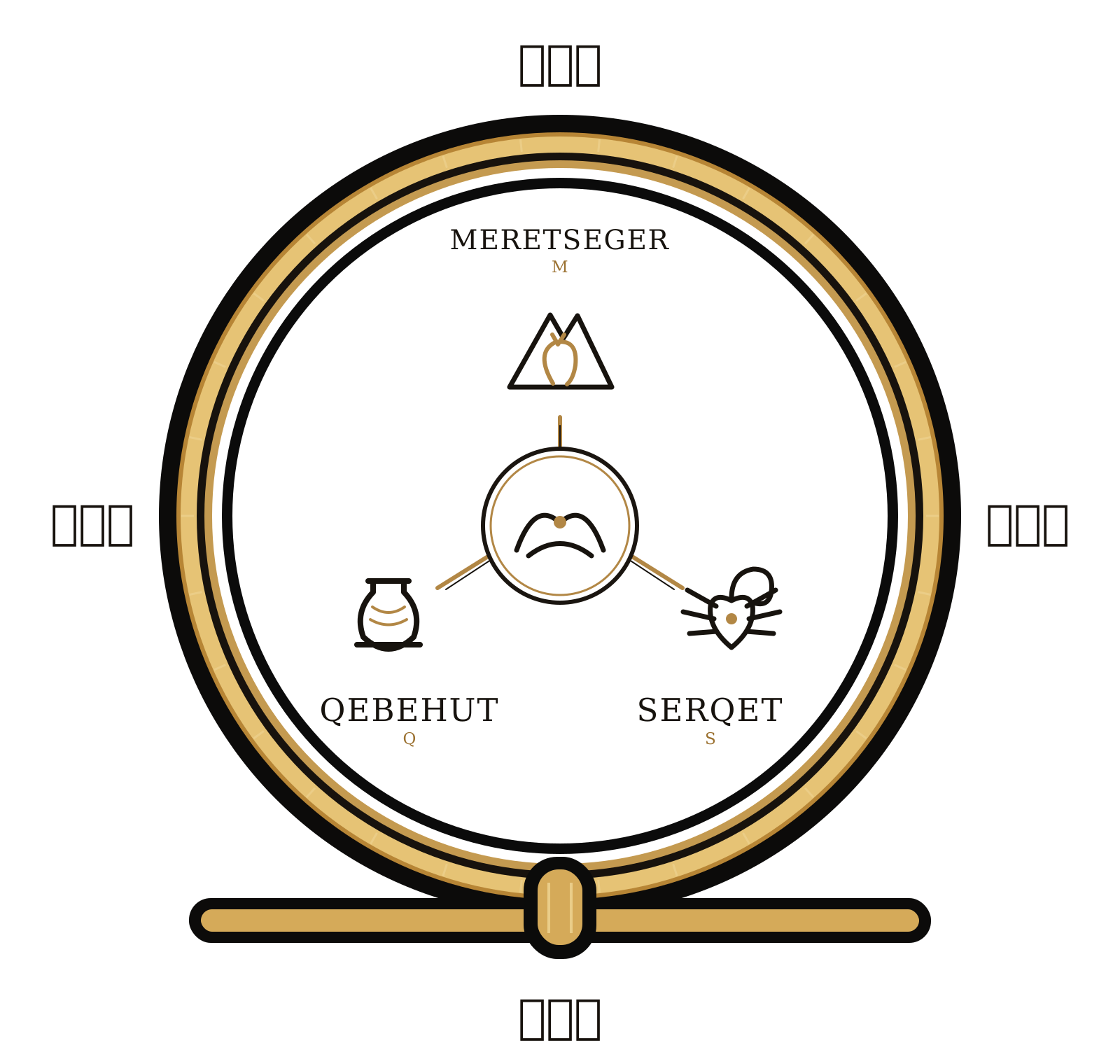
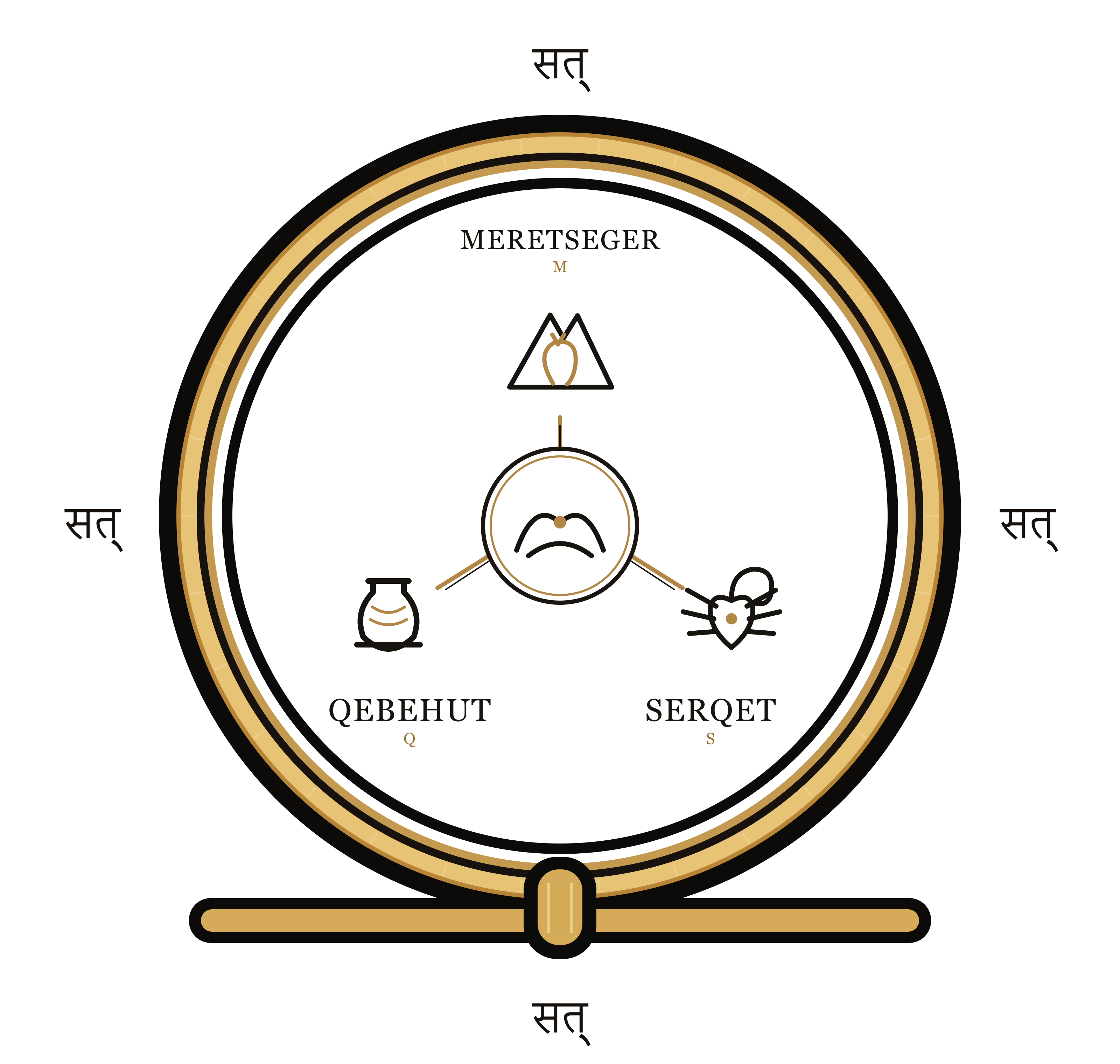
The peak and cobra identify Meretseger, falling water marks Qebehut, and the scorpion with an open protective arc marks Serqet. Their full names and the transparent initials M, Q, S remain separate around the common center. This is new devotional geometry, not an ancient three-goddess cult image. The stations move through truth, relief, vigil, convergence, and return. Rune and Greek-letter sequences are newly selected vocal aids, not historical emblems of these goddesses. Five newly composed Greek sentences each echo one complete thought in the English prayer. The station counts make 195 vibrations, followed by thirteen in the closing, for 208.
The Voices and the Return
ΜΕΡ recalls Meretseger's name; ΥΔΩ recalls Greek ὕδωρ, water; ΣΕΡ recalls Serqet; ΦΥΛ suggests keeping watch; and ΒΙΟ points toward living life. The rune triads provide rhythm for five different actions: confession, relief, vigil, common shelter, and return. They are newly selected aids to performance, not claims about Egyptian temple practice.
The five Greek sentences are newly composed in an Ancient Greek register, and each is mirrored by a complete English sentence inside its fuller prayer. The three goddesses are praised separately before the convergence station. Omega and Alpha are ordinary closing letter sounds. The rite ends in a specific, freely receivable act of care.
The Historical Image
The Museo Egizio stela C.1564 is dedicated by Pendua to Meretseger. Its CC0 photograph supplies an actual ancient object for the page. It is not a historical depiction of the three goddesses together; Qebehut and Serqet are represented only in the original Shenu.
Artwork and individual emblems
Limestone votive stela dedicated by Pendua to the cobra goddess Meretseger.
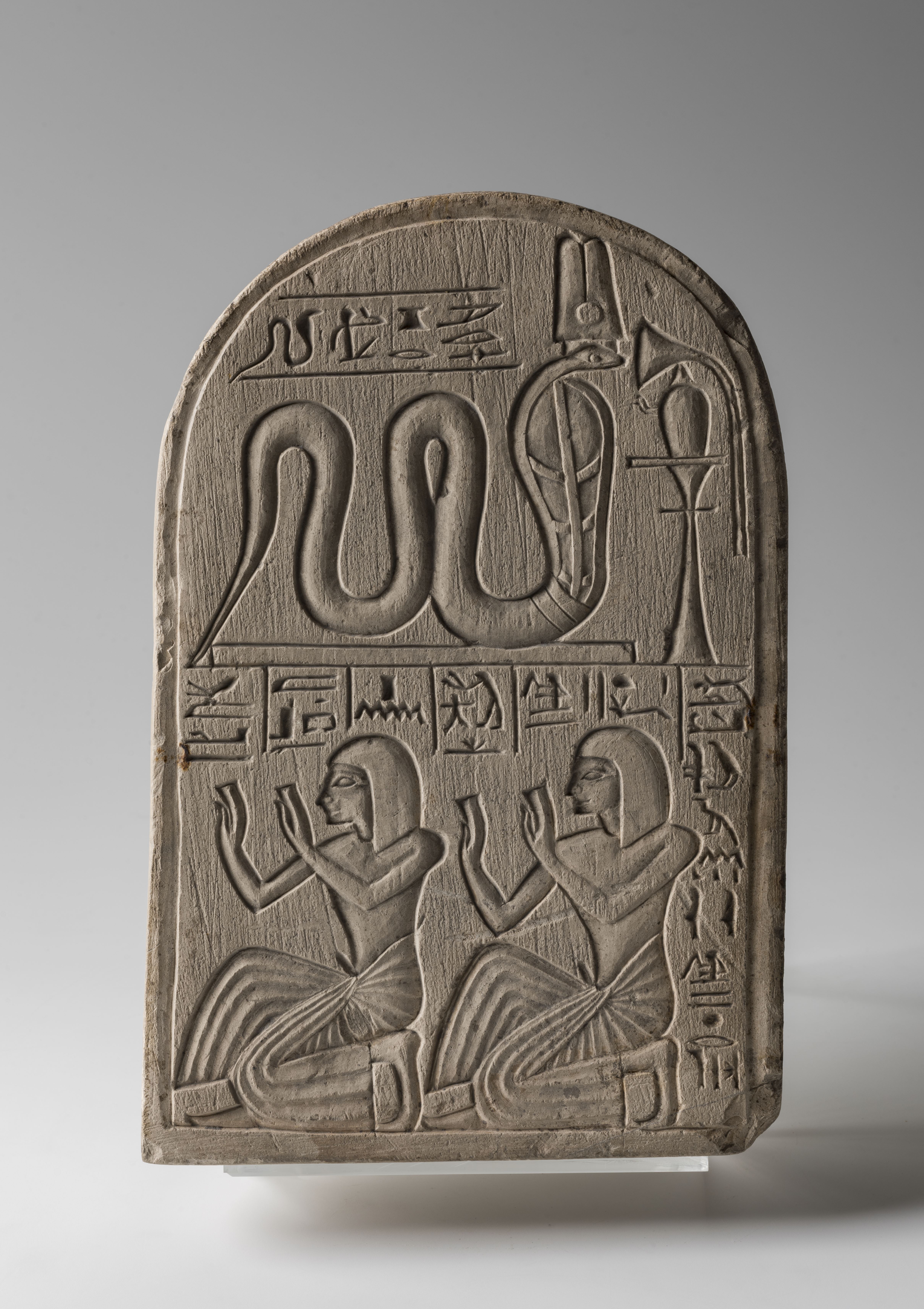
Votive stela dedicated by Pendua to Meretseger, New Kingdom Egypt, Museo Egizio, Turin, C.1564. CC0 image. The stela depicts Meretseger; Qebehut and Serqet are not shown. Source and reuse record.
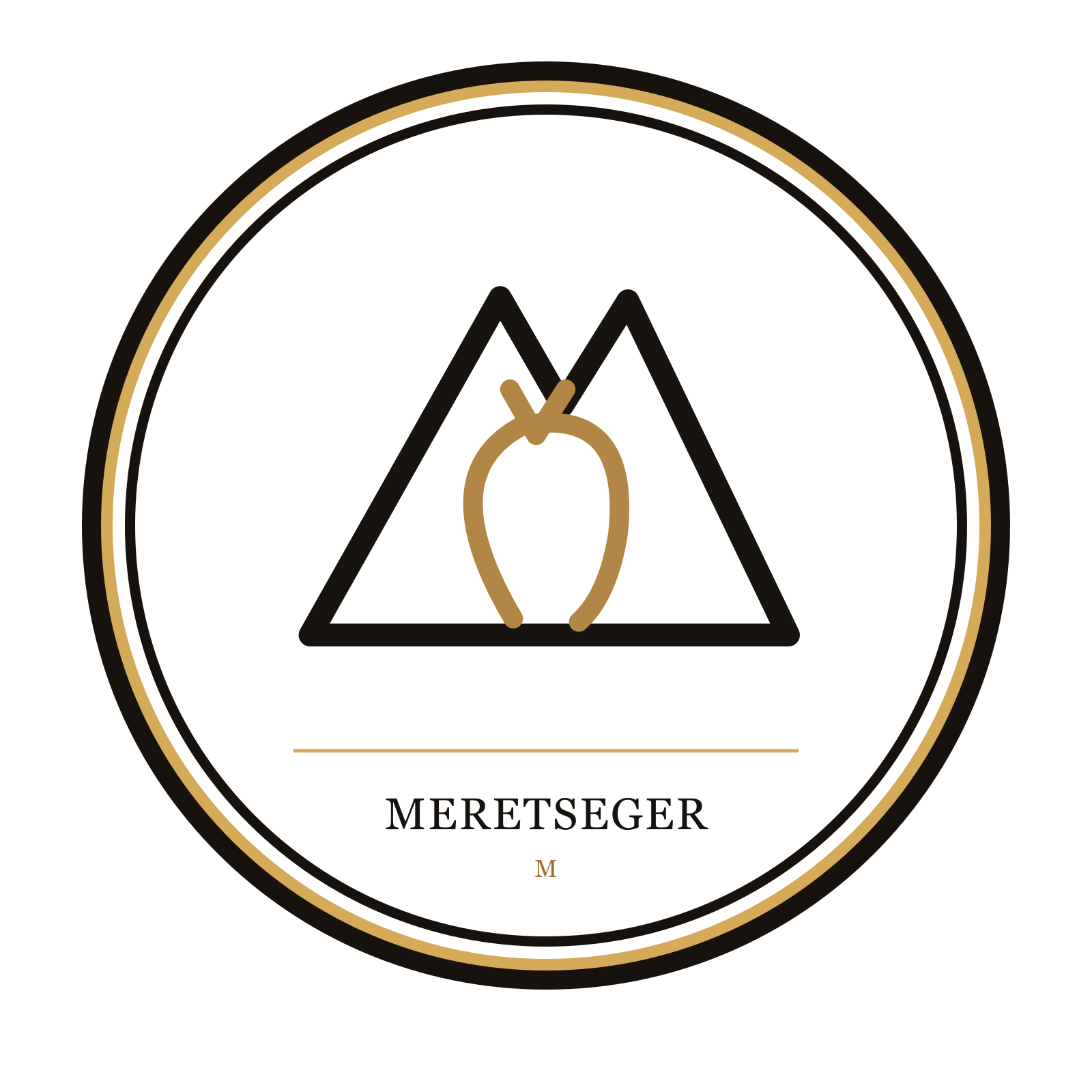
- Meretseger · Original emblem — Original devotional emblem for Meretseger; modern art, not a historical portrait.
- Qebehut · Original emblem — Original devotional emblem for Qebehut; modern art, not a historical portrait.
- Serqet · Original emblem — Original devotional emblem for Serqet; modern art, not a historical portrait.

Black and gold Shenu with a complete white center holding Meretseger's mountain cobra, Qebehut's waters, and Serqet's scorpion around open space. Open the Shenu SVG.