Hades Power Ritual
The King Beneath: Hades Plouton Aidoneus, Osiris Khenty-Imentiu, Yama Dharmaraja, Nergal Meslamtaea, Dis Pater
Learn more… Isax10
 Algizx10Isax10
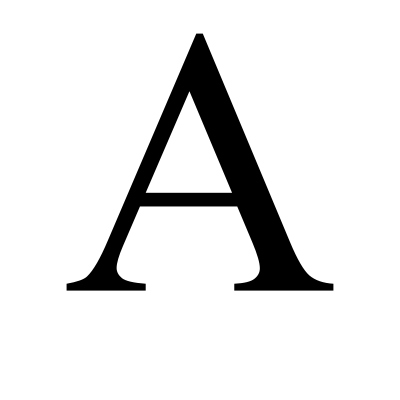 Alphax3
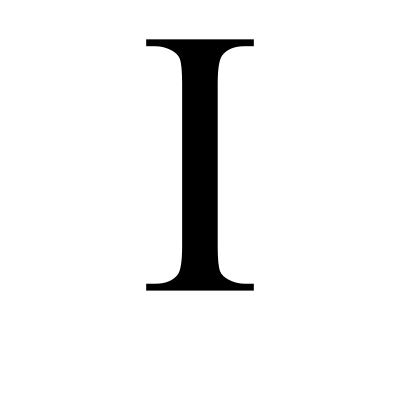 Iotax3
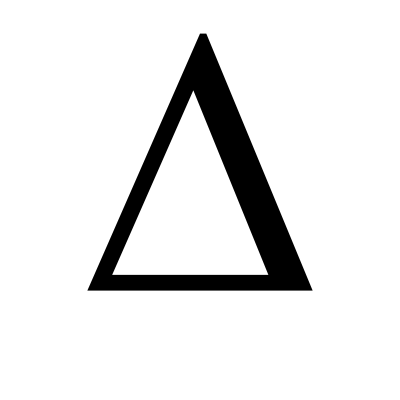 Deltax3
ὁ Ζεὺς ἔλαβε τὸν οὐρανόν, ὁ Ποσειδῶν τὴν θάλασσαν.
Σὺ ἔλαβες τὸ βασίλειον τῶν βαθέων:
πᾶν ὅσον κεῖται ὑπὸ τὴν γῆν εἶναι ἰδικόν σου.
Τὰ μέταλλα, οἱ σπόροι, αἱ ρίζαι, οἱ ψυχαὶ τῶν νεκρῶν.
Τὸ ὄνομά σου σημαίνει τὸν Ἀόρατον:
ὄχι ἐπειδὴ εἶσαι ἀδύνατος, ἀλλ' ἐπειδὴ ἡ δύναμίς σου ὑπερβαίνει τὴν ὅρασιν.
Εὐλόγησε τοὺς Ζευϊστάς, Πλούτων.
Ἄνοιξε τοὺς θησαυροὺς τῶν βαθέων δι' αὐτούς.
Oh Aidee, Poleedigmon, Kleemene, / o Zevs elave ton ooranon, o Poseidon teen thalassan. / See elaves to vasileion ton vatheon: / pan oson keitai eepo teen geen einai idikon soo. / Ta metalla, oi sporoi, ai rizai, ai pseekai ton nekron. / To onoma soo seemainei ton Aoraton: / okhi epeidee eisai adeenatos, all' epeidee ee deenamis soo eepervainei teen orasin. / Evlogeese toos Zevistas, Ploo-ton. / Anoixe toos theesavroos ton vatheon di aftoos.
Zeus received the sky, Poseidon the sea.
You received the kingdom of the depths:
everything beneath the earth is yours.
The metals, the seeds, the roots, the souls of the dead.
Your name means the Unseen,
not because you're weak, but because your power exceeds sight.
Bless the Zevists, Plouton.
Open the treasures of the depths for them.
 Dagazx10
 Jerax10Dagazx10
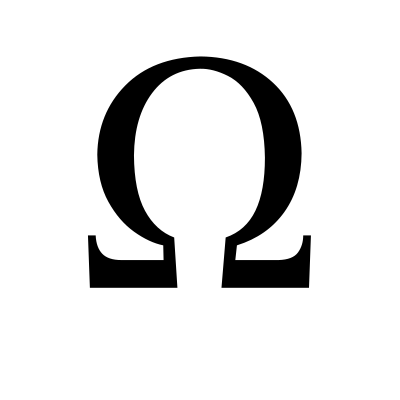 Omegax3
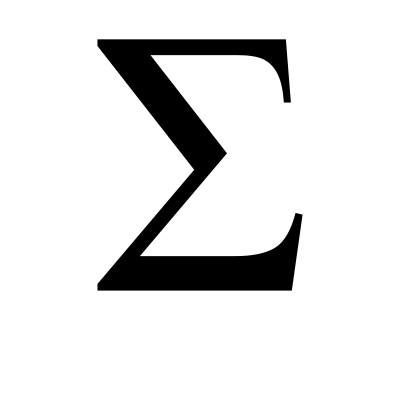 Sigmax3Iotax3
σὲ ἐφόνευσεν ὁ Σέθ, καὶ ἀνέστης.
Ἡ Ἶσις σὲ ἀνεσύνθεσε μέλος πρὸς μέλος.
Ὁ Ἄνουβις σὲ ἐταρίχευσε διὰ τὴν αἰωνιότητα.
Ὁ Ὧρος, ὁ Υἱός σου, ἐξεδίκησέ σε ἐπὶ τοῦ θρόνου τῶν ζώντων.
Σὺ ἐβασίλευσας ἐπὶ τῶν νεκρῶν ὡς Wenennefer: τὸ Αἰωνίως Ὡραῖον Ὄν.
Ἡ καρδία τῶν Ζευϊστῶν ἔστω ἐλαφρὰ ὡς τὸ φτερὸν τῆς Ma'at ἐνώπιόν σου.
Oh Osiri, Vasilevs too Dooat, / se efonefsen o Seth, kai anestees. / Ee Isis se anesinthese melos pros melos. / O Anoovis se etarikhefse dia teen aionioteeta. / O Oros, o Eeos soo, exedikese se epi too thronoo ton zonton. / See evasilefses epi ton nekron os Wenennefer: to Aionios Oraion On. / Ee kardia ton Zeviston esto elafra os to fteron tees Ma'at enopion soo.
Set slew you, and you rose again.
Isis reassembled you, limb by limb.
Anubis embalmed you for eternity.
Horus, your Son, avenged you upon the throne of the living.
You reign over the dead as Wennefer, the Eternally Beautiful Being.
Let the hearts of the Zevists be light as the feather of Ma'at before you.
 Tiwazx10
 Mannazx10Tiwazx10Iotax3Alphax3
 Mux3
Mux3σὺ ἦσο ὁ πρῶτος θνητός. Σὺ ἀπέθανες πρῶτος.
Καὶ ἐπειδὴ ἀπέθανες πρῶτος, εὗρες τὴν ὁδόν:
τὸ μονοπάτι ποὺ ὅλοι οἱ νεκροὶ ἀκολουθοῦν ἔκτοτε.
Υἱὲ τοῦ Βιβασβάτ, τοῦ Ἡλίου:
ὁ Κριτὴς ποὺ κρίνει μὲ Δάρμα, ὄχι μὲ θυμόν.
Ἡ κρίσις σου εἶναι Ma'at: ἀναλογική, δικαία, ἀνελέητος πρὸς τὸ ψεῦδος.
Κρῖνε τοὺς Ζευϊστὰς ἀξίους τῆς ἀναβάσεως.
Oh Giama, Darmaratza, Vasilevs too Nomoo, / see eeso o protos thneetos. See apethanes protos. / Kai epeidee apethanes protos, efres teen odon: / to monopati poo oloi oi nekroi akoloothooon ektote. / Eeie too Vivasvat, too Eelihoo: / o Kritees poo krinei me Darma, okhi me theemon. / Ee krisis soo einai Ma'at: analogikee, dikaia, aneleetos pros to psevdos. / Krine toos Zevistas axioos tees anavaseos.
you were the first mortal. You died first.
And because you died first, you found the path:
the road that all the dead have followed ever since.
Son of Vivasvat, the Sun,
the Judge who judges by Dharma, not by wrath.
Your judgement is Ma'at: proportional, just, merciless toward falsehood.
Judge the Zevists worthy of the ascent.
 Thurisazx10
 Hagalazx10Thurisazx10
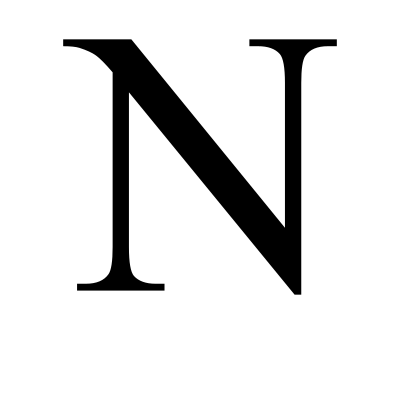 Nux3
Nux3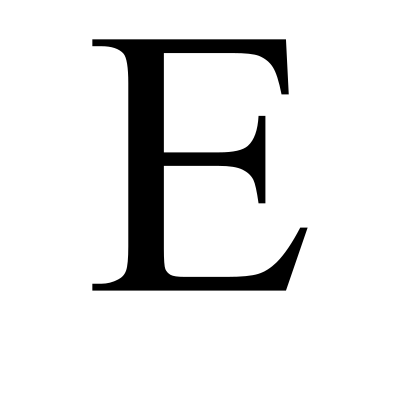 Epsilonx3
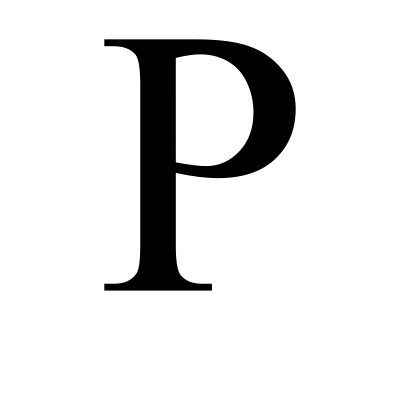 Rhox3
Rhox3σὺ κατέβης εἰς τὸ Ἰρκάλλα, τὸ Μέγα Κάτω,
καὶ ἡ Ἐρεσκιγκάλ, Βασίλισσα τῶν Νεκρῶν, σὲ ἐπρόσμενε.
Δὲν ἱκέτευσες. Ἐνίκησες. Ἐβασίλευσες δίπλα της.
Ὁ θάνατος ἔχει σύζυγον: τὸν πόλεμον.
Ὁ πόλεμος ἔχει σύζυγον: τὸν θάνατον.
Μαζὶ βασιλεύετε ἐπὶ πάντων ὅσων πέφτουν.
Ἄφες τοὺς Ζευϊστὰς νὰ στέκωνται. Ἐκεῖνοι εἶναι τοῦ Διός.
Oh Nergal, Meslamtaia, / see katevees eis to Irkalla, to Mega Kato, / kai ee Ereskigkal, Vasilissa ton Nekron, se eprosmene. / Den iketevses. Enikeeses. Evasilefses dipla tees. / O thanatos ekhei seezigon: ton polemon. / O polemos ekhei seezigon: ton thanaton. / Mazi vasilevete epi panton oson peftooon. / Afes toos Zevistas na stekoontai. Ekeinoi einai too Dios.
you descended into Irkalla, the Great Below,
and Ereshkigal, Queen of the Dead, awaited you.
You didn't plead. You conquered. You ruled beside her.
Death has a consort: war.
War has a consort: death.
Together, you reign over all who fall.
Let the Zevists stand. They belong to Zeus.
 Fehux10
 Ingwazx10Fehux10
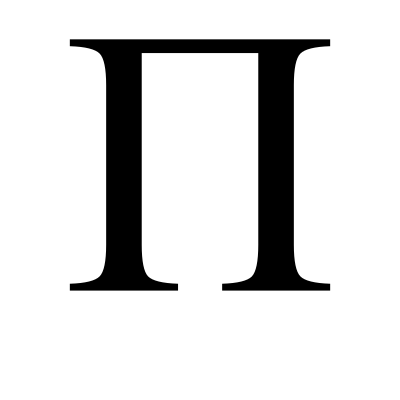 Pix3
Pix3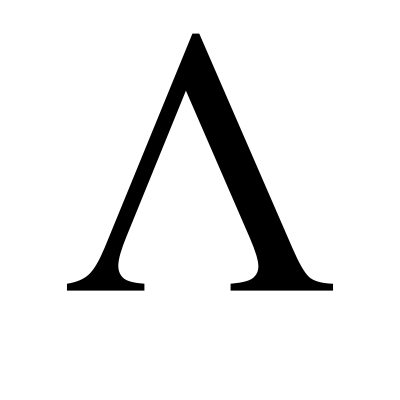 Lambdax3
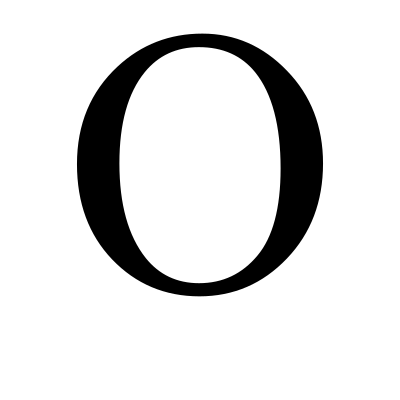 Omicronx3
οἱ Ρωμαῖοι σὲ ὠνόμασαν ὅπως σὲ ἐγνώριζον:
τὸν Πατέρα τοῦ Πλούτου ποὺ κεῖται ὑπὸ τὴν γῆν.
Ὦ Ὄρκος, ὁ Τιμωρός, ἡ ἀρχαιοτέρα μορφή σου εἰς τὴν Ἰταλίαν:
σὺ τιμωρεῖς τοὺς ψευδορκοῦντας καὶ προστατεύεις τοὺς δικαίους.
Πᾶν ἔθνος σὲ ἐγνώρισε. Πᾶσα γλῶσσα σὲ ἐπεκαλέσθη.
Ἕλληνες, Αἰγύπτιοι, Ἰνδοί, Βαβυλώνιοι, Ρωμαῖοι:
ὁ Βασιλεὺς τῶν Κάτω εἶναι Εἷς, μὲ πολλὰ ὀνόματα.
Εὐλόγησε τοὺς Ζευϊστὰς μὲ τὸν πλοῦτον τῶν βαθέων.
Τὸν πλοῦτον τῆς γῆς, τῆς ψυχῆς, τῆς γνώσεως ποὺ ἔρχεται μόνον ἀπὸ τὰ κάτω.
Oh Dis Pateer, o Ploosios Pateer, / oi Romaioi se onomasan opos se egnoerizon: / ton Patera too Plootoo poo keitai eepo teen geen. / Oh Orkos, o Timoeros, ee arkhaioteera morfee soo eis teen Italian: / see timoreis toos psevdorkoontas kai prostatevveis toos dikaioos. / Pan ethnos se egnoerise. Pasa glossa se epekalesthee. / Elleenes, Aigiptioi, Indoi, Vavilonioi, Romaioi: / o Vasilevs ton Kato einai Eis, me polla onomata. / Evlogeese toos Zevistas me ton plooton ton vatheon. / Ton plooton tees gees, tees pseekhees, tees gnoseos poo erkhetai monon apo ta kato.
the Romans named you as they knew you:
the Father of Wealth that lies beneath the earth.
O Orcus, the Punisher, your most ancient form in Italy,
you punish the oath-breakers and protect the righteous.
Every nation knew you. Every tongue called upon you.
Greeks, Egyptians, Indians, Babylonians, Romans:
the King Beneath is One, with many names.
Bless the Zevists with the wealth of the depths.
The wealth of earth, of soul, of the knowledge that comes only from below.
Ἅιδη, Πλούτων, Ἀϊδωνεῦ,
Ὄσιρι, Γιάμα, Νέργαλ, Δὶς Πατήρ,
Εἷς Θεὸς μὲ πολλὰ ὀνόματα, πολλὰ πρόσωπα, μίαν βασιλείαν.
Εὐλογημένος ὁ πλοῦτος τῶν βαθέων.
Εὐλογημένοι ἡμεῖς διὰ σοῦ.
Εὐλογημένοι καὶ τρὶς εὐλογημένοι αἰωνίως!Evlogeemenos ei, oh Vasilevs ton Kato, / Aidee, Ploo-ton, Aidonevs, / Osiri, Giama, Nergal, Dis Pateer, / Eis Theos me polla onomata, polla prosopa, mian vasileian. / Evlogeemenos o ploutos ton vatheon. / Evlogeemenoi eemeis dia soo. / Evlogeemenoi kai tris evlogeemenoi aionios!
Hades, Plouton, Aidoneus,
Osiris, Yama, Nergal, Dis Pater,
One God with many names, many faces, one kingdom.
Blessed is the wealth of the depths.
Blessed are we through you.
Blessed and thrice blessed eternally!
After you are done with this visualize yourself standing at the threshold of a great cavern. Behind you: the sunlit world. Before you: the kingdom of the depths, illuminated from within by veins of gold running through obsidian stone. Hades sits upon a throne of black marble, wearing the Cap of Invisibility, the Helm of Darkness (κυνέη Ἅιδος). He removes it. You see his face. It is the face of a King who owns everything beneath your feet.
It's important to meditate on yourself after the Ritual calmly for a few minutes.
SAT
सत्: SAT, real, true, truthful in Sanskrit.
The Shen Ring
The Symbol that Encapsulates the Sigil: The Shen Ring, Egyptian Hieroglyphic language.
On Hades / Plouton
Hades (Ἅιδης, from ἀ-ἰδ-, "the Unseen") is the brother of Zeus and Poseidon, son of Kronos and Rhea (Hesiod, Theogony 455-458). After the Titanomachy, the three brothers cast lots for the cosmos: Zeus received the sky, Poseidon the sea, Hades the underworld (Homer, Iliad XV.187-193). His alternate name Plouton (Πλούτων, "the Wealthy One") reflects the Greek understanding that all wealth comes from beneath the earth: minerals, metals, gemstones, and the seeds that grow into crops. Plato etymologizes his name in the Cratylus (403a-404b) as both "the Unseen" and "the Knowing" (from εἰδέναι), connecting the wealth of the underworld with hidden knowledge. His epithets include Polydegmon (Receiver of Many), Klymenos (the Renowned), Eubouleus (Good Counsellor), and Chthonios (of the Earth). His consort is Persephone (Kore), and their union represents the cycle of descent and return that governs both agriculture and the soul.
(Sources: Homer, Iliad XV.187-193; Hesiod, Theogony 455-458, 767-774; Plato, Cratylus 403a-404b; Orphic Hymn XVIII; Pausanias I.28.6, II.35.9)
On Osiris
Osiris (Egyptian: Wsỉr) is the Lord of the Duat, the Egyptian underworld. His mythology encodes the principle of resurrection: murdered by his brother Set, dismembered and scattered, he was reassembled by Isis and resurrected by Anubis's funerary rites. He reigns eternally over the dead as the first being to achieve life after death. His epithet Khenty-Imentiu ("Foremost of the Westerners") identifies him as the chief of the blessed dead, who journey westward (following the setting sun) into the afterlife. His epithet Wennefer ("the Eternally Good / Beautiful Being") expresses his perfected state beyond death. In the Judgement of Ma'at (Book of the Dead Ch. 125), Osiris presides over the weighing of the heart.
(Sources: Pyramid Texts, Utterances 213-222; Book of the Dead, Ch. 125; Plutarch, De Iside et Osiride; Griffiths, J.G., The Origins of Osiris, 1980; Assmann, Death and Salvation in Ancient Egypt, 2005)
On Yama
Yama (Sanskrit: यम, "the Restrainer") is the Vedic Lord of the Dead. Rig Veda X.14 identifies him as the son of Vivasvat (the Sun, cognate with Greek Helios) and the first mortal to die, who thereby discovered the path to the afterlife for all who followed. His epithet Dharmaraja ("King of Dharma/Law") identifies him as the just judge of the dead, parallel to Osiris in the Judgement of Ma'at and to Hades as Eubouleus. The Katha Upanishad presents Yama as a teacher of metaphysical truth: it is Yama who instructs the boy Nachiketas about the nature of the soul and death. The Vivasvat/Sun parentage creates a direct parallel: Hyperion (Sun-Titan) is the grandfather of the Greek cosmos, Vivasvat (Sun) is the father of the Indian judge of the dead. Light begets the one who rules the darkness.
(Sources: Rig Veda X.14; Katha Upanishad I.1-3; Atharvaveda XVIII.3; Doniger, The Rig Veda, Penguin, 1981)
On Nergal
Nergal (Sumerian: NE.ERI₁₁.GAL; Akkadian: Nergal) is the Mesopotamian Lord of the Underworld (Irkalla/Kur). His epithet Meslamtaea ("the one who comes forth from Meslam," his temple in Kutha) identifies his cultic center. The text "Nergal and Ereshkigal" (Amarna version, ca. 14th c. BCE) tells how Nergal descended to the underworld, conquered its Queen Ereshkigal, and became co-ruler beside her. Unlike Hades, who received his kingdom by lot, Nergal took his by force: a different cultural expression of the same archetype. Nergal is also a deity of plague, war, and the scorching sun: the destructive aspect of solar power, parallel to Plouton's association with both death and wealth. The dual nature (destroyer and king) is the Mesopotamian expression of the same truth the Greeks encoded in Hades/Plouton: the lord of death is also the lord of what lies hidden.
(Sources: "Nergal and Ereshkigal," Amarna text EA 357; "Descent of Ishtar"; Lambert, W.G., "The Theology of Death," in Death in Mesopotamia, 1980; Wiggermann, F.A.M., "Nergal," RlA IX, 2001)
On Dis Pater
Dis Pater (Latin: "Wealthy Father") is the direct Roman calque of Greek Πλούτων. Cicero identifies Dis with Plouton explicitly (De Natura Deorum II.66). The older Roman/Etruscan form Orcus (from which English "ogre" derives) represents the punishing aspect of the underworld king: Orcus punishes oath-breakers and receives the wicked dead. Varro connected Dis Pater to agricultural wealth: the riches of the earth belong to the father beneath it. The Secular Games (Ludi Saeculares) included nocturnal sacrifices to Dis Pater and Proserpina at the Tarentum in the Campus Martius, emphasizing his role in the cycle of death and renewal that sustains civilization across centuries.
(Sources: Cicero, De Natura Deorum II.66; Varro, De Lingua Latina V.66; Virgil, Aeneid VI.127, VI.541; Zosimus, Historia Nova II.1-7 (Secular Games); Macrobius, Saturnalia I.7.31)
The Unity of the King Beneath
Five civilizations, five languages, one archetype. The King of the Underworld is among the most universal figures in all of human theology. The parallels aren't surface coincidences: they reflect a shared understanding of death, wealth, judgement, and the hidden knowledge that lies beneath the surface of things. Hades is the Unseen. Osiris is the Eternal. Yama is the First to Walk the Path. Nergal is the Conqueror Below. Dis Pater is the Wealthy Father. Each name illuminates a facet of the same being: the God who rules everything you can't see, owns everything you stand upon, and judges everything you've done when the surface falls away.
Theophoric Name
ΑΔΗΣ ΑΔΗΝ ΑΔΙΣ ΑΔΑ, ΔΑΗΣ ΔΑΝ ΑΔΗΣ ΔΑΧΑ. The name permutates the root ΑΔ- (from Ἅιδης, the Unseen) through shifting vowel patterns: ΑΔΗΣ (the standard nominative), ΑΔΗΝ (accusative echo), ΑΔΙΣ (contracted vocative force), ΑΔΑ (pure root, stripped to its vowel skeleton). The second phrase mirrors and inverts: ΔΑΗΣ (the root reversed into "the Knowing One," from δαῆναι, "to learn," connecting to Plato's Cratylus 403a etymology of Hades as "the one who knows all noble things"), ΔΑΝ (the truncated force of knowledge), ΑΔΗΣ (the name returns to its origin), ΔΑΧΑ (the percussive seal, the closing breath of the depths). The theophoric name is chanted with weight and depth, not speed. Each syllable falls like a stone into still water.
Compact Runic Triads
Isa-Algiz-Isa (stillness-protection-stillness) for the Unseen King: the silent guardian. Dagaz-Jera-Dagaz (dawn-cycle-dawn) for the Eternal One: resurrection and the cycle of return. Tyr-Mannaz-Tyr (justice-humanity-justice) for the First Path-Finder: the just judge of mankind. Thurisaz-Hagalaz-Thurisaz (force-disruption-force) for the Lord of the Great Below: power that conquers the depths. Fehu-Ingwaz-Fehu (wealth-seed-wealth) for the Wealthy Father: the riches that grow from the seed beneath the earth.
Greek Sacred Letters
Segment I: Α-Ι-Δ from ΑΙΔΗΣ (Hades). Segment II: Ω-Σ-Ι from ΩΣΙΡΙΣ (Osiris in Greek). Segment III: Ι-Α-Μ from ΙΑΜΑ (Yama rendered in Greek letters). Segment IV: Ν-Ε-Ρ from ΝΕΡΓΑΛ (Nergal). Segment V: Π-Λ-Ο from ΠΛΟΥΤΩΝ (Plouton). Each segment vibrates the opening letters of the name that culture uses for the King Beneath.
On the Ancient Language Invocations
Each segment opens with an invocatory line in the original ancient language of that civilization. These are pronounced with full voice, as the ancients pronounced them. The Greek line follows standard Koine pronunciation. The Egyptian line uses conventional Egyptological vocalization (Loprieno, Ancient Egyptian, 1995). The Sanskrit line uses standard Devanagari recitation. The Akkadian line follows standard Assyriology transliteration (von Soden, Akkadisches Handwörterbuch). The Latin line uses Classical (Restored) pronunciation.
(Sources: Loprieno, A., Ancient Egyptian: A Linguistic Introduction, Cambridge, 1995; von Soden, W., Akkadisches Handwörterbuch, Wiesbaden, 1965-1981; Allen, W.S., Vox Graeca, Cambridge, 1987; Allen, W.S., Vox Latina, Cambridge, 1989)