Tartaros Power Ritual
Τάρταρος · The Deep Boundary and the Measure of Justice
Before you begin
These rites are for adults. Children and teenagers must not perform them. Pregnant women should not perform them.
Read this ritual in full before beginning, follow its instructions with care, and allow the intervening day its proper quiet.
This rite may be combined with the Ritual of Hades, the God who rules the underworld.
May Zeus bless this observance, and may the Great Chthonic Gods receive our devotion in friendship and honour.
The poets give your gulf a bronze threshold and name its vast measure.
May the contemplation of that limit make my own conduct more exact.
Zeus, let justice and return govern this hour.
 Isax10
 Eihwazx10Isax10
 Taux3
Taux3 Alphax3
 Rhox3
Rhox3Ō Tartare, to bathos sou en timēi theōrō.
Hesiod places you near the earth at the first naming of the cosmos.
Later he tells the immense distance from heaven to your floor.
O Tartaros, I behold your depth with honor.
No boast can make the deep small enough for vanity.
Let the knowledge of scale lend gravity to my choices.
Let me know the difference between courage and presumption.
I stand on living ground and honor what lies beneath it.
The Shenu holds the image while my body remains at rest.
Notice the floor beneath you and the limit marked by the sigil.
 Algizx10
 Tiwazx10Algizx10
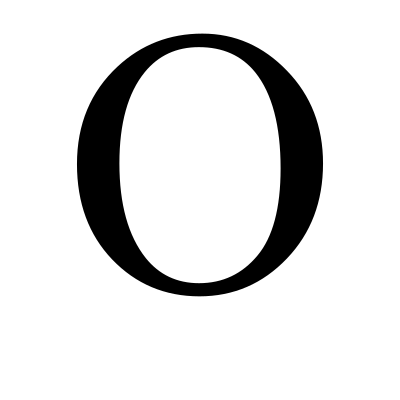 Omicronx3Rhox3
 Iotax3
Ō Tartare, horion dikaiosynēs phylassetai.
Hesiod's threshold is bronze, rooted where the deep places meet.
A boundary can protect a whole order from confusion.
O Tartaros, a boundary of justice is kept.
Let a promise have a clear edge and an answerable keeper.
Let power remain accountable to the harm it can cause.
Let the weak find an open hearing before judgment is closed.
I ask no privilege to cross a limit that is not mine to cross.
May my own boundaries be firm, fair, and intelligible.
Recall one boundary you can keep fairly today.
 Nauthizx10
 Mannazx10Nauthizx10
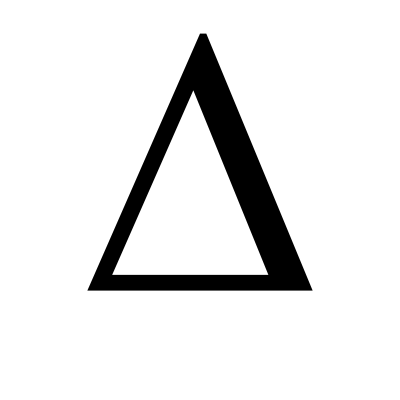 Deltax3Iotax3
 Kappax3
Ō Tartare, hē metanoia ergois phanera genesthō.
The account in Plato's Phaedo gives judgment a place in the underworld.
It also gives some wrongdoers a path that depends upon the people they harmed.
O Tartaros, let repentance become visible in deeds.
A spoken regret must be followed by changed action.
No prayer may erase another person's right to safety or refusal.
Let restitution be as concrete as the injury was real.
Let me ask what can be repaired before I praise my own intention.
May justice be served by truth, patience, and accountable hands.
Name a repair that requires an action, not a feeling alone.
 Raidhox10
 Dagazx10Raidhox10
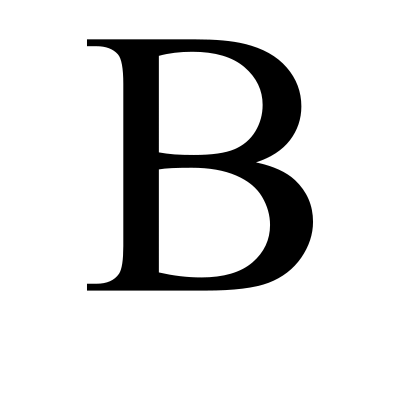 Betax3Iotax3Omicronx3
Ō Tartare, pros to phōs tou biou epanerkhomai.
The deepest image has been honored without making a home of it.
The living have work that cannot be done in thought alone.
O Tartaros, I return to the light of life.
I will keep a just limit and use the day granted to me.
Where a wrong is mine, I will begin its repair.
Where care is due, I will give it in a form another can receive.
I leave the abyss to its divine measure.
Zeus, guide my return to truth and humane action.
Stand, look at the light, and make the first practical move.
Zeus, let wisdom govern strength and let justice guide repair.
I return to the surface and to the human duties waiting there.
Take in three ordinary details of the room. Write down the one concrete act of repair or boundary you chose.
Short return if stopping early
Tartaros, receive my honor. I remain on living ground. Hail Zeus.
On Tartaros
Hesiod, Theogony 116 to 119, names Tartaros among the earliest realities of the cosmos. In the same poem, 720 to 819, the deep is described by distance, rushing winds, a bronze threshold, and the dwelling of powers set there after the divine struggle. The rite borrows the threshold and depth, while its instructions keep the participant plainly in the present room.
The primordial power and the region share one name in ancient literature. Plato, Phaedo 111e to 114c, speaks in a different philosophical register: rivers descend into Tartaros and souls receive judgment. The present prayer does not flatten Hesiod's cosmogony into Plato's later moral topography. It joins their images only in its own liturgical meditation on limit and responsibility.
Justice and Repair
In Phaedo 113d to 114b, Socrates describes wrongdoers whose possible release depends upon calling to those they injured. That image grounds the third station's insistence that repentance must become action and that harmed people retain their own will. The ritual does not promise automatic absolution or instruct anyone to contact another person against their wishes.
The second station regards boundaries as an aspect of justice. The fourth completes the movement on living ground: the participant identifies one honest obligation, and then acts in ordinary life. This return gives the rite its proper end.
The Shenu and Its Measures
The Shenu ring is complete and its center remains white. The inner motif is a bronze gate above descending lines. Its lines are this work's drawing, not a preserved ancient seal. ΤΑΡ recalls the addressed name; ΟΡΙ points to a boundary; ΔΙΚ to justice; ΒΙΟ to life. These station letters are aids to attention and are not presented as antique magical syllables.
Each of the four stations has three rune sounds voiced ten times and three Greek letter names voiced three times. The tenfold and threefold closing makes 169 repetitions. The newly composed Greek sentences are quoted from the ideas of the English prayers, each with a direct reading guide, and the final speech restores attention to the day.
The Historical Image
View the historical artwork and its reuse record. The black-figure scene places Sisyphus beside the Danaids, whose repeated labors became a durable picture of the underworld. It is an ancient image of inhabitants and actions associated with its deep realm, not a portrait of the primordial Tartaros. The rite takes its central gate from Hesiod's description of the deep rather than from the vase. The distinction matters: the artifact supplies historical visual context, while the Shenu interprets the poem in new devotional form.
