Phobos Power Ritual
Φόβος · The Fear Seen Clearly
I stand before the shield with a clear account of the matter before me.
I see fear truthfully and keep my judgment.
Let fear sharpen attention while judgment chooses the road.
 Isax10
 Algizx10Isax10
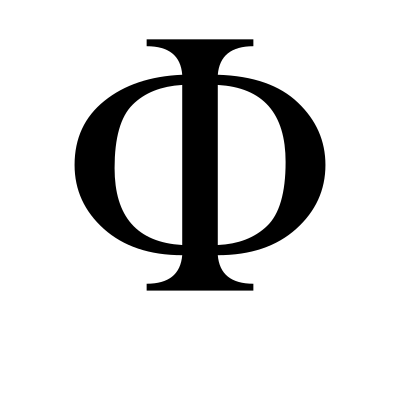 Phix3
Phix3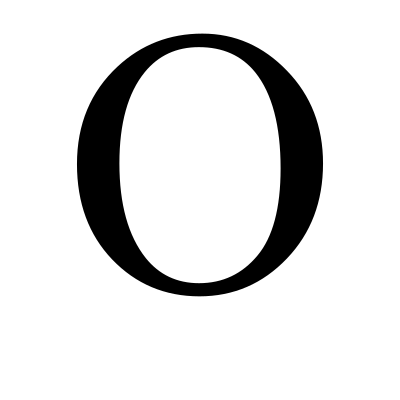 Omicronx3
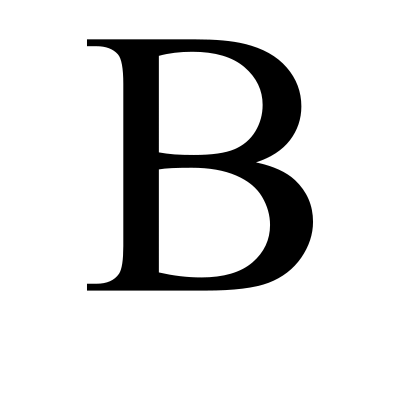 Betax3
Ō Phobe, tēn sēn dynamin en tēi prosengisei ginōskō.
O Phobos, I recognize your power in what approaches.
Beside the armed chariot, your presence makes the heart attend.
I see the matter before me clearly.
I name the matter without giving rumor the force of fact.
Ares arms himself, and you stand beside the chariot.
The sight of you beside Ares teaches the gravity of preparation.
I examine the actual scale of danger.
I will test distance, time, and consequence before I move.
Let the shield face what is present and leave imagined enemies unnamed.
State inwardly what is actually known. Leave guesses outside the shield.
 Kenazx10
 Ansuzx10Kenazx10
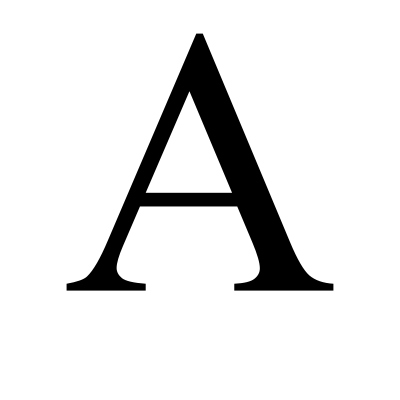 Alphax3
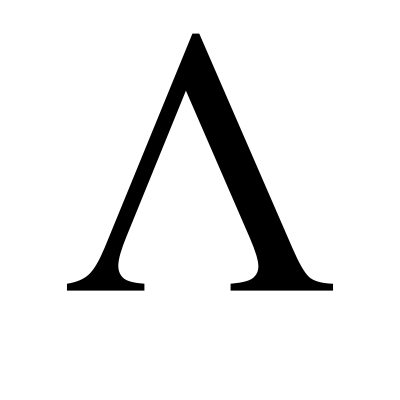 Lambdax3
 Etax3
Etax3Ō Phobe, dos moi diakrisin en tōi phobōi.
O Phobos, grant me discernment within fear.
Let the bright line through the shield divide evidence from dread.
I separate what is true from what I merely suppose.
I will ask for witnesses where witnesses may be found.
A guess does not overcome a true account.
A clear account gives the hands a task and the feet a road.
I ask what I know and what I do not know.
Keep my attention on what can be checked and answered.
Where knowledge ends, let patience hold its place.
Notice which part of the concern asks for care, which for preparation, and which is only conjecture.
 Tiwazx10
 Raidhox10Tiwazx10
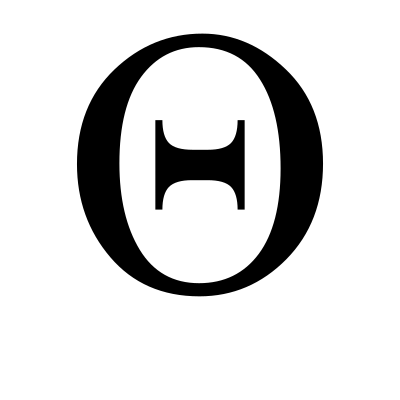 Thetax3Alphax3
 Rhox3
Rhox3Ō Phobe, to dikaion bēma nyn hairoumai.
I will act with courage and self-command.
I set one foot where duty can truly bear my weight.
O Phobos, I now choose the rightful step.
Let the step be measured to the danger and faithful to the good.
I do not choose courage without judgment.
Judgment gives courage its direction.
I prefer a small just deed to a great commotion.
I will do the necessary work before I ask for triumph.
Let action grow from discernment rather than alarm.
Name a real, lawful, measured step that belongs to you.
 Berkanox10
 Othalax10Berkanox10Etax3Rhox3
 Epsilonx3
Ō Phobe, tēn sēn parousian timō kai tēn kheira aniēmi.
O Phobos, I honor your presence and release my hand.
The shield may rest while the decision keeps its form.
I return to life with clear judgment.
I carry the chosen duty without rehearsing every possible wound.
The hand loosens; the decision remains.
The body may soften after the mind has judged.
When the right time comes, I will do the work.
I leave the next hour free for its own evidence.
Receive my honor, Phobos, as I return to ordinary work with steadier sight.
Unclench the hands. Retain the chosen step, and leave the rest until its proper time.
May my hands release their strain while my purpose remains firm.
Zeus, guard just judgment.
I will meet the next duty when its hour arrives.
See the gold line once more. Let the shield recede. Recall the one action chosen, feel your hands, and return to it at the right time.
Short return if stopping early
Phobos, receive my honor. I return with clear sight. Hail Zeus.
On Phobos
Phobos, Φόβος, is fear and panic in divine person. Hesiod's Theogony 933 to 937 names him with Deimos and Harmonia as children of Ares and Aphrodite. The poem says that Phobos and Deimos can disarray the close ranks of men in war. Their shared parentage and battle setting do not make them one being. This rite addresses Phobos separately.
Hesiod's Shield of Heracles 139 to 155 gives Phobos a striking visual place. Fear, fashioned at the center of Heracles' shield, stares outward with fiery eyes; Strife rises above his brow, while Pursuit and Flight appear elsewhere on the shield. This is a crafted image within a poem about arms, not a historical cult seal. The present sigil borrows the shield as its frame and deliberately leaves the center line clear, so that the practitioner can meet fear with attention rather than imitate the ancient image's violence.
The same poem places Phobos and Deimos beside Ares on a pictured chariot (Shield of Heracles 191 to 200). They are a pair in the scene, yet each has a separate name and a separate rite here. Phobos's four stations follow the instant fear becomes visible: approach, discernment, an act, and the release of needless tension after that act is chosen.
Fear, Judgment, and Courage
The Greek name also supplies the ordinary word for fear. The rite's second station separates a known danger from conjecture; that distinction is a present liturgical discipline rather than a sentence quoted from Hesiod or Homer. The third station then chooses a measured act. Courage is given a practical form: truthful assessment, proportion, and a task the speaker can actually perform.
The fourth station lets the body relax after a decision. Fear can signal a need for care without ruling every later thought. That movement is the rite's own theological and practical application of Phobos's office.
Homer's Iliad 15.113 to 142 supplies a second turn beyond the harnessing of Ares' horses. Ares, grieving for his son, calls Phobos and Deimos to prepare the chariot; Athena then stops him from rushing into a wider quarrel with Zeus. The poem does not make Phobos a teacher of prudence. It does show that the movement toward battle can be checked by judgment. The rite uses that interval to ask what is known, what is guessed, and what can rightly be done.
The shield's gold line is the station of distinction. At the next station the line becomes a chosen step, small enough to be carried out and bound by justice. In the last station the hand loosens without erasing the decision. That order keeps courage from becoming another name for haste and gives fear neither contempt nor rule over the whole day.
The Shield and the Four Stations
The dark shield and fiery eyes recall Phobos at the center of Heracles' shield in the Shield of Heracles 139 to 155. Four small circles outside the shield serve as watch points: they keep attention at its boundary rather than making the whole white field a face of fear. The gold axis through the shield is a new sign of clear sight through alarm. The Greek capitals ΦΟΒΟΣ name the addressee. No ancient seal for Phobos is claimed.
The runic triads and Greek letter groups are newly ordered for the four movements. The letters begin words central to the rite: ΦΟΒΟΣ, ΑΛΗΘΕΙΑ, ΘΑΡΡΟΣ, and ΗΡΕΜΙΑ. They are meditative sounds in this rite, not a reconstruction of an ancient Greek cult chant. The closing returns judgment and action to the order of Zeus.
The shield remains fully inside the Shenu, whose joined rope, base, and central knot are drawn as one enclosing shape. White space separates the shield from the ring, so the straight line remains clear. The form recalls the Egyptian shen ring described in the Metropolitan Museum of Art’s Art of Ancient Egypt: A Resource for Educators; the shield and line are contemporary ritual images for Phobos.