Melinoe Power Ritual
Μηλινόη · The Veil and the Kindly Face
Melinoe, I enter the quiet beneath your saffron veil.
I behold the changing appearance and seek a kindly presence.
Let each change of form pass within its own hour.
 Kenazx10
 Laguzx10Kenazx10
 Mux3
Mux3 Etax3
Etax3 Lambdax3
Ō Mēlinoē, krokōtōi peplōi en nykti phainēi.
O Melinoe, Persephone bore you beside Cocytus.
Beside the deep river, the hymn gives your arrival its own sacred place.
I honor your sacred descent.
I approach your lineage with care and speak your familiar name.
O Melinoe, you appear at night in a saffron robe.
Its bright color remains visible even amid the night.
Child of Persephone, you possess your own honor.
Let the veil tell of your presence without obscuring the room before me.
Melinoe, receive this quiet reverence beneath the saffron sign.
Honor the Goddess named in the hymn. Do not turn her lineage into a claim about every tradition.
 Perthrox10
 Isax10Perthrox10Mux3
 Omicronx3
 Rhox3
Rhox3Ō Mēlinoē, allote phanera, allote aphanēs phainēi.
O Melinoe, at times you appear plainly, at times unseen.
Your hymn allows the eye to meet more than one aspect of your form.
I regard the image and keep my judgment.
I will not hurry to force one image upon another.
In night, forms come and pass away.
The veil moves, yet the space between its folds remains clear.
Amid shifting appearances, I keep quiet within.
Let my attention rest where change can be seen without alarm.
Melinoe, grant composure as each appearance passes.
Let the contrast remain visible. Nothing must be explained by force.
 Algizx10
 Berkanox10Algizx10Etax3
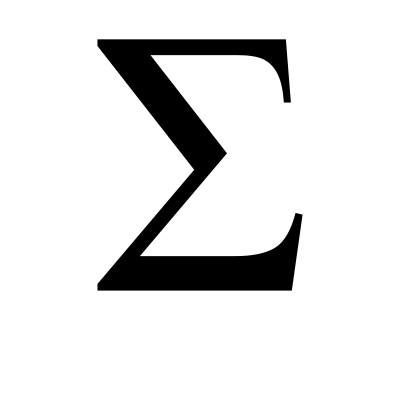 Sigmax3
 Upsilonx3
Ō Mēlinoē, ton taragmon tēs psykhēs apopempe.
O Melinoe, send the soul's turmoil away.
The hymn names the disturbance that can rise in the night.
Give quiet and clear composure.
Let stillness spread through thought and limb at an unforced pace.
I seek no apparition; I ask for your goodwill.
I remain before your sigil with the room and ground in view.
May the soul come from turmoil into rest.
May the darkness hold its own hour without swallowing the day.
Receive this prayer for peaceful rest and a clear waking.
Breathe naturally. Let darkness have its boundary and the room remain present.
 Gebox10
 Dagazx10Gebox10
 Epsilonx3Upsilonx3Mux3
Eumenes prosōpon deixon, ō thea.
Show a kindly face, O Goddess.
The old hymn closes by asking that your countenance be gracious.
I return to the light of present life.
Let the last image be one of welcome and completion.
Look kindly upon those who honor you.
Your favor is received with thanks, without grasping at a vision.
I receive sleep and waking in their proper order.
May the night's quiet accompany a steady return to daylight.
Melinoe, receive our honor; we rise and resume the work of life.
Feel the support beneath you and notice the actual room. The rite ends here.
May rest be peaceful and waking clear.
Zeus, guard the return to life.
I leave the night in its place and rise to the light before me.
Look once at the face between the veils. Then look away from the sigil. Name three ordinary features of the room and resume an ordinary task.
Short return if stopping early
Melinoe, receive my honor. I return to the room and the work of life. Hail Zeus.
On Melinoe
Melinoe, Μηλινόη, is the chthonic nymph addressed by the Orphic Hymn to Melinoe, numbered 71 in a common arrangement of the hymns. The poem calls her saffron robed and places her birth beside the streams of Cocytus through Persephone and Zeus, with Zeus appearing in the form of Plouton. This is the hymn's particular sacred narrative. The first station names only what that witness supports and does not merge Melinoe with Persephone, Nyx, or Hecate.
The ancient hymn's movement is compact and exact. It first names Melinoe as a chthonic nymph in a saffron garment, then gives the narrative of her birth beside Cocytus (Orphic Hymn to Melinoe 71.1 to 4). It next describes a twofold form and an appearance that can be plain, dark, or luminous by night (71.5 to 9). The final three lines turn from those unsettling forms to supplication: the Goddess is asked to send the soul's frenzy far away and show initiates a gracious, holy face (71.10 to 12). The rite follows this order rather than using the hymn as a collection of stray images.
The father in the hymn is Zeus, named as the son of Kronos and described as taking Plouton's form. This is the hymn's own account. The first station addresses Melinoe herself and gives neither Zeus nor Plouton a second speaking part. It keeps her distinct divine presence at the center while recognizing the lineage by which the ancient poem presents her.
The Four Movements
The Saffron Veil honors Melinoe's name and descent. The Changing Form regards the hymn's shifting visibility. Night Without Tumult turns to the hymn's petition for release from inward disturbance. The Kindly Face completes the sequence with a request for goodwill, followed by an unmistakable return to the actual room. The rite never asks for an apparition and gives no instruction to pursue one.
The Greek prayers are new liturgical composition. Their diction deliberately echoes the ancient hymn's saffron garment, shifting form, release from frenzy, and gracious face. The ancient hymn remains the source of the images; the performed lines are prayers for this rite.
The second station's two veils correspond to the hymn's change of visible form, not to two separate Goddesses. One divided face remains between them; its pale center gives the eyes a steady place while the appearance changes. The third station reaches the hymn's petition for the departure of inward turmoil. The fourth asks for a kindly face and returns to the actual room. The poetic passage itself supports the direction of prayer from distress toward gracious presence.
The hymn's last request speaks to initiates. This modern rite does not reproduce an ancient initiatory ceremony or claim one has taken place. Its short, direct petitions can be spoken as acts of reverence; the concluding ordinary task marks a completed return from the hymn's night imagery.
The Two Veils and the Sound
The two contrasting veils and the single face are new signs made for this rite. One side is dark and one is saffron gold, giving the hymn's changing appearance a visible counterpart without depicting two Goddesses. The pale middle keeps the face legible as one presence. The capitals ΜΗΛΙΝΟΗ name the Goddess. This is not a recovered Orphic seal.
The rune triads and Greek letter groups are newly ordered around descent, form, quiet, and goodwill. The letter groups begin ΜΗΛΙΝΟΗ, ΜΟΡΦΗ, ΗΣΥΧΙΑ, and ΕΥΜΕΝΕΙΑ. The repetitions are printed so that the rite can be performed without guesswork. The final contemplation restores ordinary orientation.
No ancient source cited here supplies a Shenu or a sequence of rune sounds for Melinoe. The veils, divided face, Greek letters, and repetitions are the present rite's formal language. The face is a symbol for the hymn's change of form, not an apparition to be sought. The prayer seeks goodwill and composure, with the Divine name written plainly above the emblem.
The two veils occupy the white field within one joined Shenu rope. A central knot binds the ring to its horizontal base, while the pale face remains clear between dark and saffron folds. The surrounding shape takes the Egyptian shen ring as its formal source, described in the Metropolitan Museum of Art's Art of Ancient Egypt: A Resource for Educators. Its conjunction with Melinoe's changing form is a present liturgical design.