Makaria Power Ritual
Μακαρία · Blessed Reception and the Gentle End
Before you begin
These rites are for adults. Children and teenagers must not perform them. Pregnant women should not perform them.
Read this ritual in full before beginning, follow its instructions with care, and allow the intervening day its proper quiet.
This rite may be combined with the Ritual of Hades, the God who rules the underworld.
May Zeus bless this observance, and may the Great Chthonic Gods receive our devotion in friendship and honour.
I honor the possibility of dignity at the mortal threshold.
Let my praise also bless the living who accompany one another in grief.
Zeus, order this hour toward mercy and truth.
 Wunjox10
 Laguzx10Wunjox10
 Mux3
Mux3 Alphax3
 Kappax3
Ō Makaria, to makarion onoma sou timō.
A lexicon keeps your name where longer tales have not survived.
That small witness is enough for a careful act of honor.
O Makaria, I honor your blessed name.
I will not invent a lost temple or make certainty out of silence.
Let the word blessed be spoken tenderly, without denying loss.
Let every human end be met with the dignity of a whole life.
The laurel is an offering of regard, not a prize imposed upon the bereaved.
Receive this praise in the measure the sources allow.
Hold one word of blessing without forcing a feeling of happiness.
 Eihwazx10
 Algizx10Eihwazx10
 Pix3
Pix3 Upsilonx3
 Lambdax3
Ō Makaria, hē pylē en eirēnēi anoigesthō.
The threshold in the Shenu has no figure blocking it.
It speaks of reception, not a command to hasten a journey.
O Makaria, let the gate open in peace.
May those who tend the dying offer quiet, consent, and human presence.
May those who mourn be given time and trustworthy company.
Let a difficult passage be met with every ordinary care available.
I honor divine mystery while keeping my duty to the living plain.
May peace be a gift, never a performance required of grief.
Think of care at a threshold without imagining or seeking death.
 Othalax10
 Mannazx10Othalax10Mux3
 Nux3
Nux3 Etax3
Etax3Ō Makaria, holon ton bion en timēi mnēmoneuō.
No person is only the manner of an ending.
A life contains labor, friendship, failures repaired, and gifts freely given.
O Makaria, I remember a whole life with honor.
Let memory hold more than one scene and more than one voice.
Let those who remain speak truthfully and with kindness.
May an unfinished sentence be allowed its silence.
I honor the dead by caring for the stories entrusted to the living.
The star shines over a passage, not over an erasure.
Recall a living quality of someone departed, or honor all the departed in silence.
 Berkanox10
 Dagazx10Berkanox10
 Zetax3
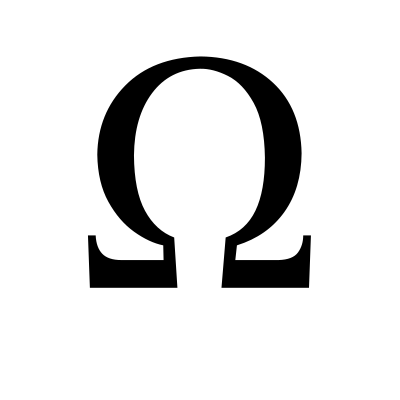 Omegax3Etax3
Ō Makaria, tois zōsi paramythian eukhomai.
A blessing at death must not forget the hands left empty afterward.
The living need shelter, meals, remembrance, and the freedom to mourn.
O Makaria, I pray for consolation for the living.
Let me offer help in a form that is welcome, not merely impressive.
Let grief be met without a demand for quick resolution.
Let gratitude and sorrow share the same honest room.
I thank you for the gentle name carried through a sparse record.
Under Zeus, I return to the duties of compassionate life.
Choose an ordinary act of consolation that respects another person's wishes.
May the departed be remembered whole and the living receive patient care.
Zeus, bless the house where grief is welcomed with kindness.
I return to life and to those who need me.
Notice the room's light and the support under your feet. Take the chosen caring action in its proper time.
Short return if stopping early
Makaria, receive my honor. I return to the living in peace. Hail Zeus.
On Makaria
The Suda, entry mu 51, a Byzantine lexicon of the tenth century, briefly calls Makaria a daughter of Hades. The same entry discusses the word and proverb connected with blessedness and death. It gives no detailed cult, iconography, or account of her mother. The public prayer therefore honors the name while naming its own expanded imagery as new composition.
Makaria of Hades is not silently merged with the maiden in Euripides' Children of Heracles. The latter belongs to a different narrative of human self-sacrifice. This rite makes no request for sacrifice and no prediction of death. Its chosen office is a reverent Temple reading of blessed reception, not a verbatim function assigned in the lexicon.
Blessing and Consolation
The word blessed can be heard as a euphemism for the dead in the lexicon's explanation. Here it is used with care: the rite does not claim that grief should feel pleasant or that a loss requires thanks. The first station blesses the name; the second asks for peace at a threshold; the third honors a whole life; the fourth returns to those who remain.
The open gate, laurel, and star belong to this page's symbolic construction. They picture reception without claiming an ancient Makaria seal. The third station's emphasis on a life held whole protects remembrance from shrinking a person to the manner of death.
Letters and Ritual Measure
The Shenu is an unbroken black and gold ring with a white center. Its gold passage remains open; the laurel grows beside it. ΜΑΚ, ΠΥΛ, ΜΝΗ, and ΖΩΗ serve the stations of name, gate, memory, and living care. These are readable Greek letter groups, not esoteric names of power.
The four rune triads and four letter triads yield 156 voiced repetitions; the closing adds 13. The Greek sentence at each station repeats the strongest thought of its English prayer in a short, newly written form. The return looks outward to a specific act of consolation under Zeus.
The Historical Image
View the historical artwork and its reuse record. The Locrian terracotta pinax shows Hades and Persephone enthroned. It is a genuine ancient image of the underworld court, and thus a fitting setting beside a rite addressed to a daughter of Hades. Yet the Suda's short Makaria entry names no mother, and this plaque neither depicts nor identifies Makaria. The page does not turn Persephone's presence in the image into a genealogy. Its gate, laurel, and words of consolation are newly composed devotional imagery.
