Kronos Power Ritual
Κρόνος · King of the Isles of the Blessed
We contemplate your later kingship among the blessed beneath the order of Zeus.
We honor the sovereignty of Zeus and your kingship among the blessed.
With reverence and a clear mind, we begin this sacred work.
May the Orphic petition guide us toward a life well lived and an end without reproach.
pempois euolbou biotou telos aien amempton.
 Othalax10
 Sowilox10Othalax10
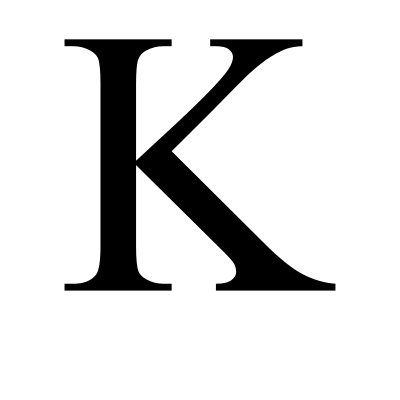 Kappax3
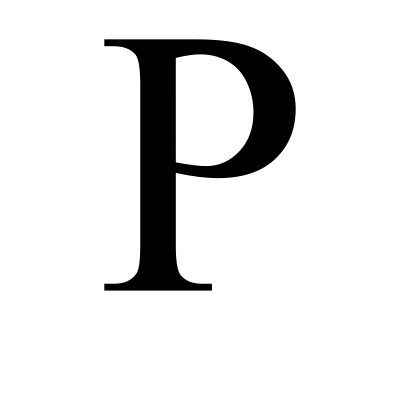 Rhox3
Rhox3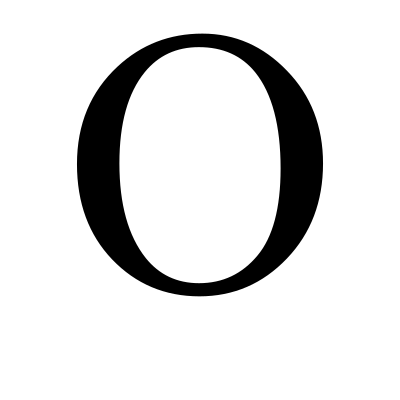 Omicronx3
Ō Krone, en nēsois makarōn basileueis.
O Kronos, you reign in the Isles of the Blessed.
At the edge of earth, the waters of Ocean keep the blessed realm apart.
Zeus gave the heroes a dwelling at the farthest edge of earth.
Their dwelling was granted within the sovereignty now held by Zeus.
There your honor has its place in the order of Zeus.
Your throne receives its due honor in that peace.
We acknowledge your kingship with reverence.
We lift our sight from the former strife to the kingdom entrusted to you.
Kronos, receive the reverence of those who seek a life worthy of its end.
Look into the white field of the sigil. Imagine the still center of an island beyond Ocean, with a throne beneath an open sky.
 Jerax10
 Ingwazx10Jerax10
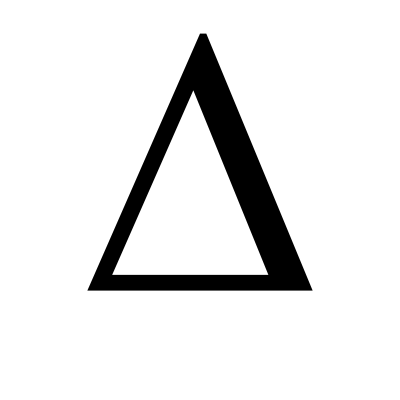 Deltax3Rhox3
 Epsilonx3
Ō Krone, dos tois ponois hēmōn karpon dikaion.
For the blessed, the earth bears sweet fruit three times in a year.
The field gives again because season and labor meet in right proportion.
As the farmer reaps ripe grain, we discern the right time for our work.
Let my hands know when to tend and when to gather.
O Kronos, you know the growth and waning of the world.
The curved blade points downward toward ripe grain and finished work.
The sickle gathers the ripened fruit.
May nothing useful be severed before its hour.
O Kronos, grant a just fruit to our labors.
Gather what our labor has earned and leave seed for the season to come.
Trace the curved blade with your eyes. Think of a task that has ripened, and of the care required to finish it well.
 Eihwazx10
 Mannazx10Eihwazx10
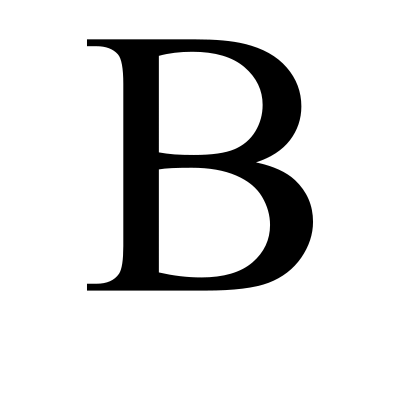 Betax3
 Iotax3Omicronx3
Ō Krone, en eusebeiai zōmen, hina to telos hēmōn amempton genētai.
The golden face reminds us of mortal life.
The face in the Shenu bears the dignity of a life that has limits.
The present day is a gift, and we receive it with gratitude.
Let gratitude be shown in the use I make of this hour.
O Kronos, may we live with piety so that our end may be blameless.
The Orphic petition asks for a blessed life and a blameless end.
We keep memory of those before us and do the work of the living.
May memory make my dealings gentler and my choices more exact.
Kronos, let the measure of mortality guide us toward worthy conduct.
Rest your gaze on the golden face without haste. Let the thought of mortality sharpen your care for the present day.
 Kenazx10
 Algizx10Kenazx10
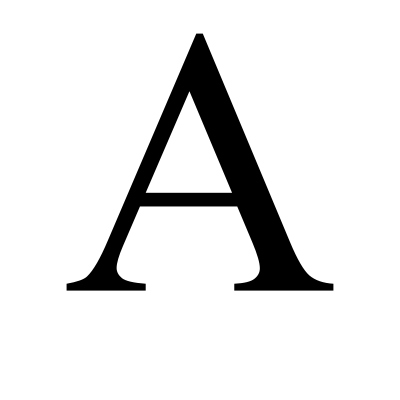 Alphax3
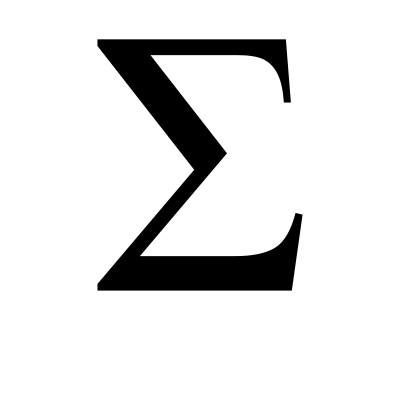 Sigmax3
 Taux3
Taux3Ō Krone, dikaiosynēn askoumen, kai to phōs en hēsykhiai atenizomen.
A star shines above the mortal form.
Its eight rays gather the eye above the golden visage.
The road of Zeus leads toward the tower of Kronos.
Let the road be read through justice rather than fear.
Breezes of Ocean blow around the islands.
The winds move over water toward a realm of stillness.
O Kronos, we practice justice and contemplate the light in stillness.
Give my sight a steady point while I walk the earthly road.
Kronos, may the star call us to live well beneath the heaven of Zeus.
Look from the golden face to the star. See the star as a point of orientation above the road, not as a promise about any one person’s fate.
 Laguzx10
 Gebox10Laguzx10
 Mux3Alphax3Kappax3
Ō Krone, tēn galēnēn kai tēn dikaiosynēn tēs khōras tautēs timōmen.
Ocean flows about the islands, and golden flowers bloom.
The bloom does not need our possession in order to be beautiful.
Some grow upon trees, and some are nourished in the waters.
Let tree and water keep their own abundance.
Rhadamanthys judges justly, while you reign over the blessed.
Under rightful judgment, the blessed dwell in peace.
O Kronos, we honor the peace and justice of that realm.
May the thought of that realm increase justice in this one.
Receive our honor for your kingship amid Ocean and the golden flowers.
Imagine the ocean breeze and the golden flowers described by Pindar. Let the scene remain whole for a few quiet breaths.
 Dagazx10
 Raidhox10Dagazx10
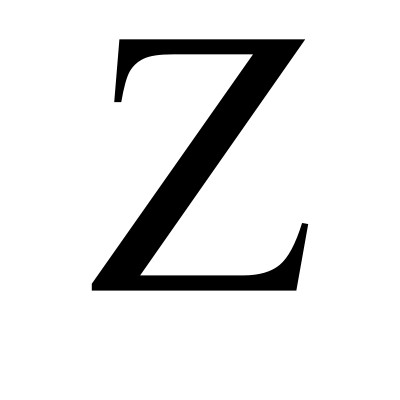 Zetax3
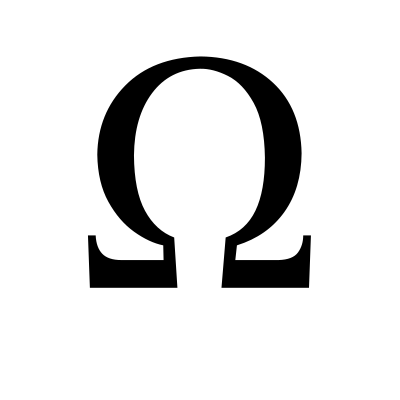 Omegax3
 Etax3
Etax3Ō Krone, bion dikaion kai karpophoron zēn proairoumetha.
O Kronos, receive our honor.
The star remains above the isle as I lower my eyes to the present room.
We keep the Isles of the Blessed in reverent memory.
Let their peace instruct my conduct without drawing me from my duties.
We return to our homes and the work of the living.
There are homes to tend and promises to answer here.
O Kronos, we choose to live a just and fruitful life.
May the labor of this day carry both measure and gratitude.
Hail, Kronos, in the order of Zeus.
Receive this completed prayer, O Kronos, and let us return with steadfast hearts.
Hail Zeus, whose order gives each divine office its place.
Lower your gaze from the star to the room around you. Let the sigil remain where it is as you turn to the next work of the day.
The earth bears fruit, and Ocean breathes around the islands.
Let the harvest teach gratitude for what has ripened in its season.
We know the measure of mortal life and choose just action.
We honor you in the order of Zeus.
We turn from the distant isles to the just tasks of this day.
Hail, Kronos. Hail, Zeus.
Look at the star, the golden visage, and the curved sickle once more. Remember the Orphic petition for a blessed life and an unblemished end. Then let the image of the distant isles settle. Rest your hands, notice the room, and name one just task you will do today.
Short return if stopping early
Kronos, receive my honor. I return to the work of the living. Hail Zeus.
On Kronos
Kronos, Κρόνος, is a Titan born of Gaia and Ouranos and father of Zeus through Rhea. Hesiod names these relations in Theogony 133 to 138 and 453 to 458. His divine life belongs to the elder order; Zeus's later sovereignty is not erased when this rite honors his father. The present prayer concerns Kronos's blessed kingship after the establishment of Zeus's order. It does not treat him as the primordial figure Chronos, Time, who belongs to a different strand of ancient cosmological writing.
In Works and Days 109 to 126, Hesiod remembers the Golden Race living in the time when Kronos ruled in heaven: toil and misery had no mastery over their lives, and the earth gave its fruits generously. The poem then turns to later generations and, at lines 166 to 173, to the heroes given a dwelling at the ends of the earth by Zeus. The Isles of the Blessed stand beside Ocean, and the soil bears a sweet harvest three times each year. The rite's sickle gathers this image of ripeness and right season. It is not used here to reenact Kronos's earlier conflict.
In one transmitted form of Works and Days 166 to 173, Kronos rules those blessed heroes. The longer papyrus form also tells of Zeus releasing his father. These lines are not transmitted uniformly, so the rite gives the tradition its proper weight without treating every copy of Hesiod as identical. Zeus grants the heroes their dwelling, and Kronos receives kingship among them. This is the ancient ground for the rite's honored, later reign.
Pindar's Olympian 2.61 to 77 gives the blessed landscape a moral approach. He praises those who keep their oaths, then describes those who have kept their souls from injustice three times taking the road of Zeus toward Kronos's tower. Around the Isles of the Blessed blow the breezes of Ocean. Golden flowers grow on land and in water, while Rhadamanthys gives just counsel near the father of Zeus. The rite's road, flowers, and final choice of just action answer these particular images; the star is its own contemplative sign.
Homer's Odyssey 4.561 to 569 names the Elysian Plain at the world's edge, where Rhadamanthys dwells and Ocean sends the West Wind. Homer does not place Kronos there in that passage. The Homeric plain and the Isles in Hesiod and Pindar are related visions, with different details in each poet. This rite follows the witnesses that name Kronos's blessed rule while allowing Homer's Elysium to illuminate the older landscape of ease and Ocean air.
The Orphic Petition
The Orphic Hymn to Kronos praises the mighty Titan as a child of Earth and starry Sky. It speaks of generation, change, and the course of mortal life, then ends with the petition πέμποις εὐόλβου βιότου τέλος αἰὲν ἄμεμπτον, asking for the blameless end of a blessed life. That line alone is quoted in the performed opening. The other Greek prayers here are newly composed. They draw on the hymn's petition and on the blessed landscape of Hesiod and Pindar, without presenting new words as ancient verses.
The petition gives the golden visage its meaning. Its human features face the mortal term, and the prayer asks that the life lived before it be worthy. The sixth station returns to the duties, homes, and relationships of the living.
The Shenu, Sat, and the Three Inner Signs
The surrounding loop follows the Egyptian shen form, a rope ring associated with encircling and protection in the Metropolitan Museum of Art's Art of Ancient Egypt: A Resource for Educators. Its use with Kronos is a present liturgical construction. The black and gold ring recalls the Hades Shenu, while the white interior keeps the signs of this rite distinct.
The four outer inscriptions read सत्, sat. The Monier-Williams Sanskrit-English Dictionary, under sat, gives senses that include being, real, and true. Their position at the four sides is a new choice for this sigil. They direct the rite toward truthful attention, not toward a claim of an ancient Greek and Sanskrit ritual union.
The sickle is an inherited image of Kronos: Hesiod's Theogony 175 to 182 puts a curved blade in his hand. In this design the handle stands at the right and the blade descends to the left. Its edge turns toward the harvest of the blessed land in Works and Days 172 to 173. The smaller golden visage is a new image for the human life whose end the Orphic hymn blesses. ΚΡΟΝΟΣ is inscribed above the face in Greek capitals, with an eight pointed star above the name. White space gives the name its own place between star and visage. The star directs the eye toward the blessed horizon.
The Six Stations
The Throne establishes the scene and honors Kronos within the order of Zeus. The Sickle turns the blade toward the labor and timing of a rightful harvest. The Mortal Measure makes the Orphic wish for a blameless end personal. The Star lifts the eyes to the road of Zeus and the ocean breeze. The Isles rests with Pindar's flowers and Rhadamanthys's just decision. The Return carries the chosen virtue back into daily work.
Runes and Greek Letters
The runic triads are meditative groupings for this rite. Othala–Sowilo–Othala frames the honored dwelling in light. Jera–Ingwaz–Jera holds the year and seed around the harvest. Eihwaz–Mannaz–Eihwaz sets human life within endurance. Kenaz–Algiz–Kenaz holds the star's light around watchful care. Laguz–Gebo–Laguz sets the gift of the blessed land amid Ocean's waters. Dagaz–Raidho–Dagaz marks the path back into the living day. These sequences serve the present rite; they are not claimed as an ancient Greek or Orphic practice.
The Greek letters are sounded by their full names. The clusters Κ–Ρ–Ο, Δ–Ρ–Ε, Β–Ι–Ο, Α–Σ–Τ, Μ–Α–Κ, and Ζ–Ω–Η begin ΚΡΟΝΟΣ (Kronos), ΔΡΕΠΑΝΟΝ (sickle), ΒΙΟΣ (life), ΑΣΤΗΡ (star), ΜΑΚΑΡΩΝ (of the blessed), and ΖΩΗ (life). The sequence follows the six stations from his throne to the living day.
The Closing
The spoken prayer closes where the rite began, with Kronos honored in the order of Zeus. The repeated sounds and the final contemplation give the ceremony an audible and visible ending. The last act is a chosen just task, so that the prayer's concern for a good life is carried into conduct.
The Orphic Petition and the Station Invocations
The petition from the Orphic Hymn to Kronos remains an inherited Greek line. Each station then gives one newly composed Greek invocation, with a reading guide and an English meaning, before a fuller English prayer. The ancient petition asks for the blameless close of a blessed life; the station prayers carry that wish through kingship, harvest, mortal measure, the star, the isles, and the return to just work.