The Keres Power Ritual
Κῆρες · The Sisters at the Mortal Boundary
Before you begin
These rites are for adults. Children and teenagers must not perform them. Pregnant women should not perform them.
Read this ritual in full before beginning, follow its instructions with care, and allow the intervening day its proper quiet.
This rite may be combined with the Ritual of Hades, the God who rules the underworld.
May Zeus bless this observance, and may the Great Chthonic Gods receive our devotion in friendship and honour.
The old poets place you near battle and the mortal limit.
Let this hour honor the dead and strengthen care for those still living.
Zeus, guide every word toward justice and peace.
 Isax10
 Eihwazx10Isax10
 Kappax3
 Etax3
Etax3 Rhox3
Rhox3Ō Kēres, to peras en semnotēti horō.
The daughters of Night stand in Hesiod's genealogy near Death and Doom.
Poetry of battle gives your presence a fierce visible form.
O Keres, I behold the limit with reverence.
I will not make a spectacle of another person's last hour.
Let the knowledge of frailty deepen the care owed to each life.
Let pride release its hunger for a contest that harms the innocent.
The wings in the Shenu are folded, for this prayer asks for restraint.
Receive honor without any wish for injury.
Hold the folded wing as an image of restraint.
 Othalax10
 Laguzx10Othalax10
 Mux3
Mux3 Nux3Etax3
Ō Kēres, tous tethneōtas en timēi mnēmoneuō.
The shield poem shows grief on the walls while battle remains outside.
A household is more than the violence that interrupts it.
O Keres, I remember the dead with honor.
Let a person be recalled by a life, a voice, and a kindness, not by the scene of an ending.
Let mourning have room to speak without being turned into command.
Let those whose names are unknown receive the dignity owed to human beings.
I offer no forced image of the departed; I keep a truthful remembrance.
May memory call the living to gentler conduct.
Remember one good deed of someone lost, or hold a quiet universal remembrance.
 Algizx10
 Berkanox10Algizx10
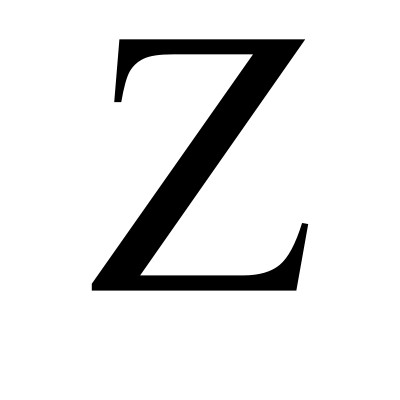 Zetax3
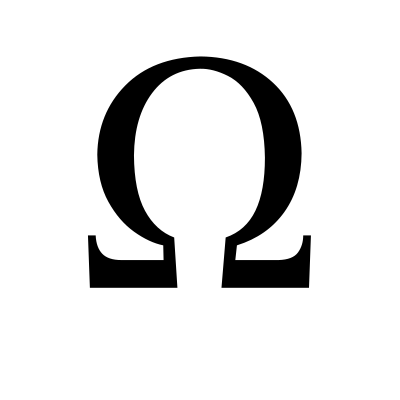 Omegax3Etax3
Ō Kēres, tōn zōntōn tēn asphaleian proteron timō.
Where conflict has left its mark, someone must tend the wounded and guide others away.
The living body needs shelter more urgently than a grand explanation.
O Keres, I honor the safety of the living first.
Let my hand choose aid before accusation.
Let me recognize when distance, a healer, or another person's help is needed.
Let bravery be judged by the life it protects.
The branch asks for a peace that includes safety and truth.
Receive my prayer for all who still may be brought home.
Identify one way to protect life in the ordinary world.
 Raidhox10
 Wunjox10Raidhox10
 Epsilonx3
 Iotax3Rhox3
Ō Kēres, apo polemou pros eirēnēn epistrephō.
The old image of strife has been witnessed, not invited into this room.
The dead have received honor and the living a pledge of care.
O Keres, I turn from war toward peace.
Let my speech cease feeding a needless quarrel.
Let any necessary defense be bounded by justice.
Let peace be built with protection and credible repair.
I thank you for the grave lesson of the mortal boundary.
Under Zeus, I carry the olive branch back into life.
Choose a peaceful action that is safe and within your power.
May the dead be remembered and the living protected.
Zeus, bless peace joined to justice.
I return to life and to care.
Notice the room, the air, and your own supported body. Complete the practical action you chose.
Short return if stopping early
O Keres, receive my honor. I turn toward the living. Hail Zeus.
On the Keres
Hesiod, Theogony 211 to 217, places the Keres in the dark genealogy of Night. Shield of Heracles 237 to 267 represents dark Fates struggling over fallen warriors on an elaborate shield. These poetic scenes are the ancient witnesses. The rite's olive branch and folded wings are new decisions that turn contemplation toward care and peace without altering the witnesses.
The Keres are honored here as a collective. This avoids treating the plural figures as one named Goddess or giving each an invented biography. The rite is also distinct from the collective Erinyes/Eumenides ritual: that earlier work concerns oath, wrong, and the pacified name, while this one concerns mortality amid battle and the duties that follow it.
The Shield and the City
In the Shield 237 to 270, the fighters, grieving women, elders, dark Fates, and a subsequent city of marriage and festivity occupy consecutive parts of the design. The rite does not claim that the ancient shield teaches a four-stage ceremony. It draws a present sequence from the contrast between danger and civic life: witness the limit, remember the dead, protect the living, and return to peace.
The third station is deliberately practical. It asks for shelter, a healer, or help where those are needed. The closing is not a declaration that every conflict has ended. It gives the participant one action toward safety or peace that can actually be taken.
The Shenu and Spoken Measure
Three folded black and gold wings meet above an olive branch inside the continuous Shenu, whose white field stays open. The memorial stone at the center is not an archaeological emblem of the Keres. It is the rite's sign of remembrance. The clusters ΚΗΡ, ΜΝΗ, ΖΩΗ, and ΕΙΡ recall Keres, memory, life, and peace.
The rune and letter sounds are liturgical measures for the present page. Their 156 station repetitions and 13 closing repetitions total 169. One newly written Ancient Greek sentence is set within each longer English prayer, with its reading guide directly beneath it. The final return intentionally leaves the battle image for the ordinary duty of care.
The Historical Image
View the historical artwork and its reuse record. The image reproduces a Kerostasia scene in an 1894 scholarly work: death fates are weighed while armed men face a mortal outcome. It brings the Keres into the visual history of Greek fate language, but does not supply a portrait of each member of the collective. Hesiod's account of Night's children and the Shield of Heracles remain the page's textual ground. The three wings within the Shenu are a new sign for the collective presence honored here.
