The Hundred-Handed Three Power Ritual
Βριάρεως · Κόττος · Γύης · Strength Recalled to the Order of Zeus
Before you begin
These rites are for adults. Children and teenagers must not perform them. Pregnant women should not perform them.
Read this ritual in full before beginning, follow its instructions with care, and allow the intervening day its proper quiet.
This rite may be combined with the Ritual of Hades, the God who rules the underworld.
May Zeus bless this observance, and may the Great Chthonic Gods receive our devotion in friendship and honour.
Briareus, Kottos, and Gyes, I greet you with reverence.
I bring no demand for violence and no wish to command your strength.
Let the story of your release teach me that power becomes noble in right relation.
Let my hands remain my own, ready for work that is just and useful.
Vibrate the runes in order
 Uruzx10
 Berkanox10
 Jerax10
Ō treis paides Gēs, tēn iskhyn hymōn meta aidous timō.
O three children of Earth, I honor your strength with reverence.
Briareus, your name rises first in my voice without diminishing your brothers.
Kottos, I honor the force that the old singer gave your many arms.
Gyes, I honor the firmness with which your name completes the three.
Earth bore you beneath the broad roof of Sky; no small measure can contain that birth.
Yet I will not confuse vastness with goodness simply because it is vast.
Teach my courage to begin with honest knowledge of its own reach.
Let each power in me answer to a purpose I can state in daylight.
May I lift no burden merely to be seen lifting it.
May the work that is mine be carried faithfully to its end.
I greet three beings, not a single nameless force.
Their names remain distinct in the unity of this prayer.
Recall a difficult duty that needs strength and discernment together.
Vibrate the runes in order
 Nauthizx10
 Dagazx10
 Ehwazx10
Ek desmōn eis phōs hē dynamis hymōn ēlthen.
From bonds into light your strength came.
Hesiod remembers a long confinement under the earth.
He remembers Earth advising Zeus that your release would answer an unfinished struggle.
A hidden gift can become a grief when it is denied every worthy use.
A freed gift can become a danger when no principle governs its use.
Let neither captivity nor reckless escape rule my understanding of strength.
Where another is unjustly restrained, let me recognize the wrong.
Where I am able to help, let my help be careful and lawful.
Where a boundary protects the vulnerable, let me keep it intact.
Briareus, Kottos, Gyes, receive honor for the passage the poet records.
Zeus, let wise counsel open only the doors that should be opened.
Let gratitude follow every release that leads to life.
Name one capacity you can use responsibly today.
Vibrate the runes in order
 Tiwazx10
 Mannazx10
 Algizx10
Zeu, hē iskhys meta dikaiosynēs badisatō.
Zeus, let strength walk with justice.
The war in Hesiod is terrible, and the poem does not soften its thunder.
It gives the three brothers a place beside the Olympians when the long contest turns.
I honor the alliance, not the ruin that any war brings to living hearts.
Let me learn the moment when cooperation is more powerful than solitary pride.
Let me distinguish loyalty from obedience to an unworthy command.
May the strong hear counsel before they act.
May the weak be heard before decisions are sealed.
Let my own hands join others in a task whose end can be defended.
Briareus, Kottos, Gyes, mighty allies, receive my deliberate praise.
Zeus, keep power intelligible to the justice it claims to serve.
May firmness and restraint dwell together in my conduct.
Consider whose counsel would improve a hard decision.
Vibrate the runes in order
 Isax10
 Eihwazx10Algizx10
Ō phylakes, to horion en pistotēti tēreite.
O guardians, you keep the boundary in fidelity.
The ancient gates are not an ornament placed before an empty dark.
Hesiod gives them a wall, a threshold, and those entrusted to watch.
I do not ask to pass beyond the gate.
I honor the labor of staying when watchfulness is difficult.
Let patience be counted among the forms of strength.
Let a promise have a keeper who remembers why it was made.
Let an entrusted boundary protect rather than flatter the one who holds it.
Kottos, Gyes, and Briareus, receive honor in the several places the song assigns.
May I neither abandon a rightful post nor claim a post that is not mine.
May the vulnerable sleep because a faithful hand remains awake.
May my own doors be opened and closed with discernment.
Think of one trust that requires steady attention rather than force.
Vibrate the runes in order
Jerax10 Gebox10Dagazx10
Tas emas kheiras eis agathon ergon epagō.
I bring my own hands to good work.
The poet's hundred hands belong to the sons of Earth; these two are mine.
I cannot carry the weight of a cosmos, but I can carry an honest share.
I can repair what I have damaged and ask help where I need it.
I can build, defend, lift, write, and release with care.
Let the memory of the three brothers enlarge my courage without swelling my pride.
Let the gate remain in its place and my dwelling remain in mine.
Briareus, Kottos, and Gyes, receive thanks for the image of loyal strength.
Zeus, keep my labor proportionate to justice and time.
May the first task after this rite be small enough to begin.
May it be worthy enough to finish.
I turn to the living day with both hands free.
Choose and begin one concrete task after the closing.
Zeus, receive the work of my hands within the measure of your order.
The bronze gate remains closed; I return to the light and duties of the living.
Set down one task, one person whose counsel matters, and one boundary that keeps the task just. Then begin the task.
Short return if stopping early
Three sons of Earth, receive my thanks. The gate remains closed. Zeus, guide my return to the living day.
On Briareus
Hesiod, Theogony 147 to 153, names Briareus among the three sons of Earth and Sky and describes the prodigious arms and heads of each. In lines 617 to 628, he is released on Earth's counsel so that Zeus may gain allies. Homer, Iliad 1.396 to 406, preserves a separate story in which the figure called Briareus by the gods, Aegaeon by men, supports Zeus. The rite honors the strength and allegiance in these witnesses without treating their different episodes as one event.
On Kottos
Kottos stands with his brothers in Theogony 147 to 153 and 713 to 735, where three hundred stones are hurled in the struggle against the Titans. At 807 to 819, Hesiod locates Kottos and Gyes at the foundations of Ocean. His station at the gate therefore speaks of trusted watch, while the prayer does not claim every brother occupied an identical post in every ancient telling.
On Gyes
Gyes is the third named son in Hesiod's genealogy and struggle. Theogony 713 to 735 calls the brothers trusted warders of Zeus after the bronze gate is fixed. The rite gives Gyes an individual greeting and then joins the three in the labor of keeping a just limit.
The Shenu and the five stations
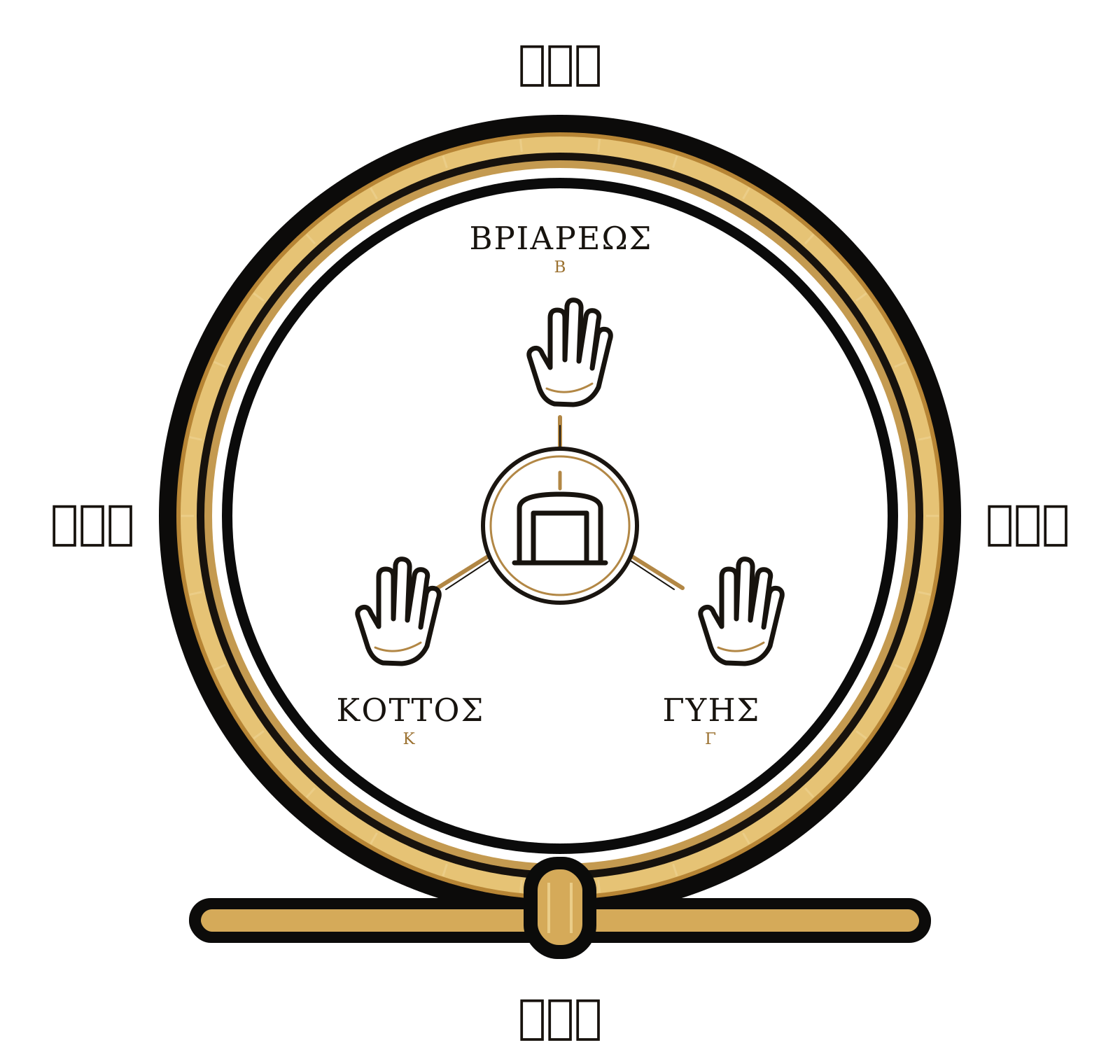
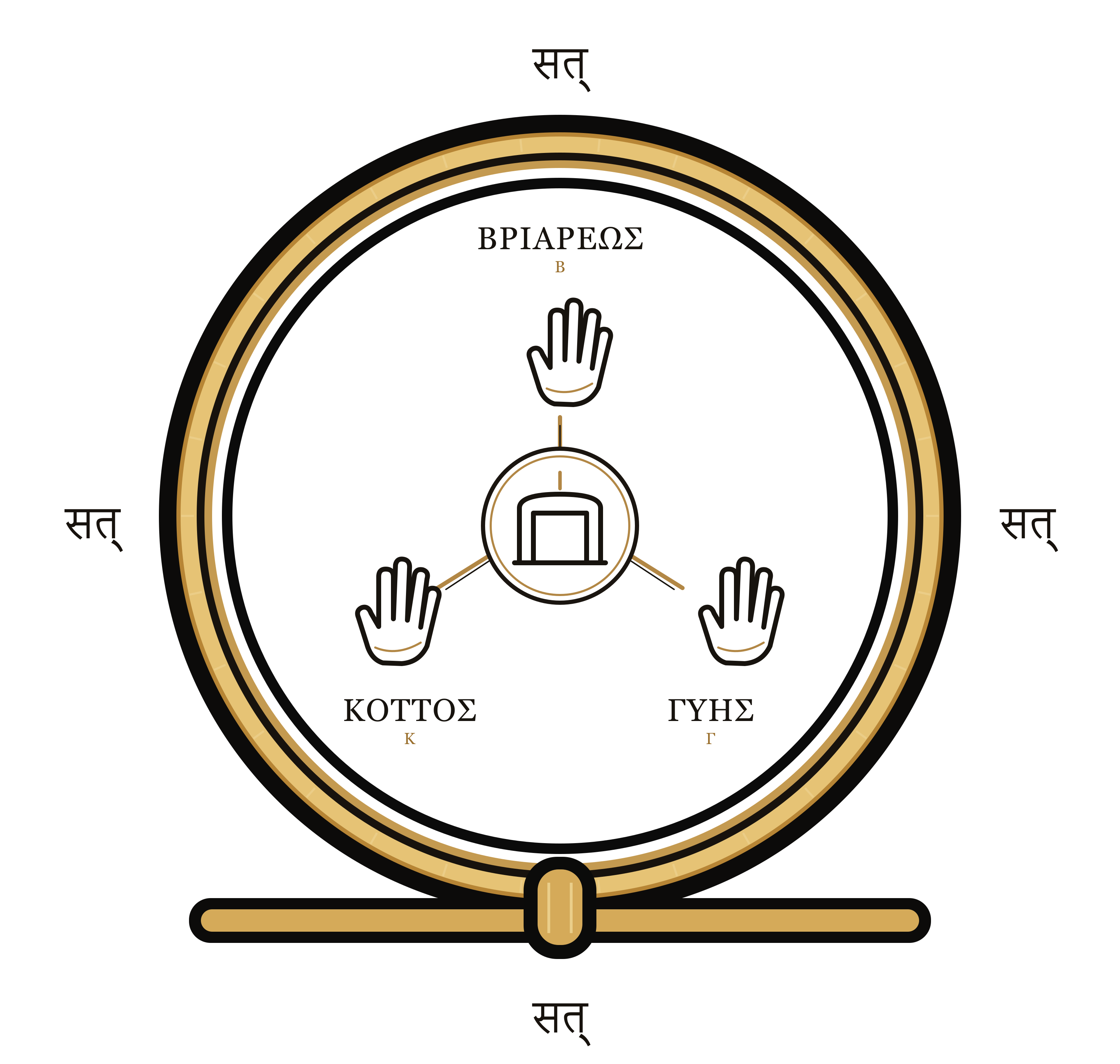
The Shenu's black circumference is unbroken and its white field carries three distinct names. The three hands converge over a closed gate. This is a new devotional emblem, not a claimed ancient seal. The stations move through origin, release, alliance, guardianship, and return. Rune triads and Greek letters organize attention and voice; they are present liturgical choices, not historical attributes of the Hekatoncheires. Each station contains one newly composed Greek sentence drawn from its English prayer, with a reading guide and its English meaning. Five groups of thirty-nine vibrations and a thirteenfold seal make 208 voiced repetitions.
The Voices and the Return
The first letter cluster ΓΗΝ recalls Earth; ΛΥΣ suggests release; ΔΙΚ justice; ΦΥΛ guardianship; and ΕΡΓ work. They are ordinary Greek mnemonic fragments voiced letter by letter, never secret names. The rune sequence changes with the action: Uruz begins in strength, Nauthiz marks the bonds, Tiwaz accompanies alliance, Isa slows the watch, and Jera carries the return into completed labor. These are new ritual choices rather than ancient attributes of the three brothers.
The English prayers speak to Briareus, Kottos, and Gyes with separate names before they address their shared work. Each Greek sentence condenses one statement that also appears in its station's English prayer. The closing sounds are the ordinary Greek letters Omega and Alpha, not another divine name; the final words return the worshipper to an actual duty.
The Historical Image
The engraving by Tommaso Piroli after John Flaxman pictures Thetis summoning Briareus in the Iliad. It was made in 1795, long after antiquity. It does not portray Kottos or Gyes. The photographed file is credited to H.-P. Haack under CC BY 3.0; the artwork itself is public domain.
Artwork and individual emblems
Engraving after John Flaxman showing Thetis summoning Briareus while Zeus sits above.
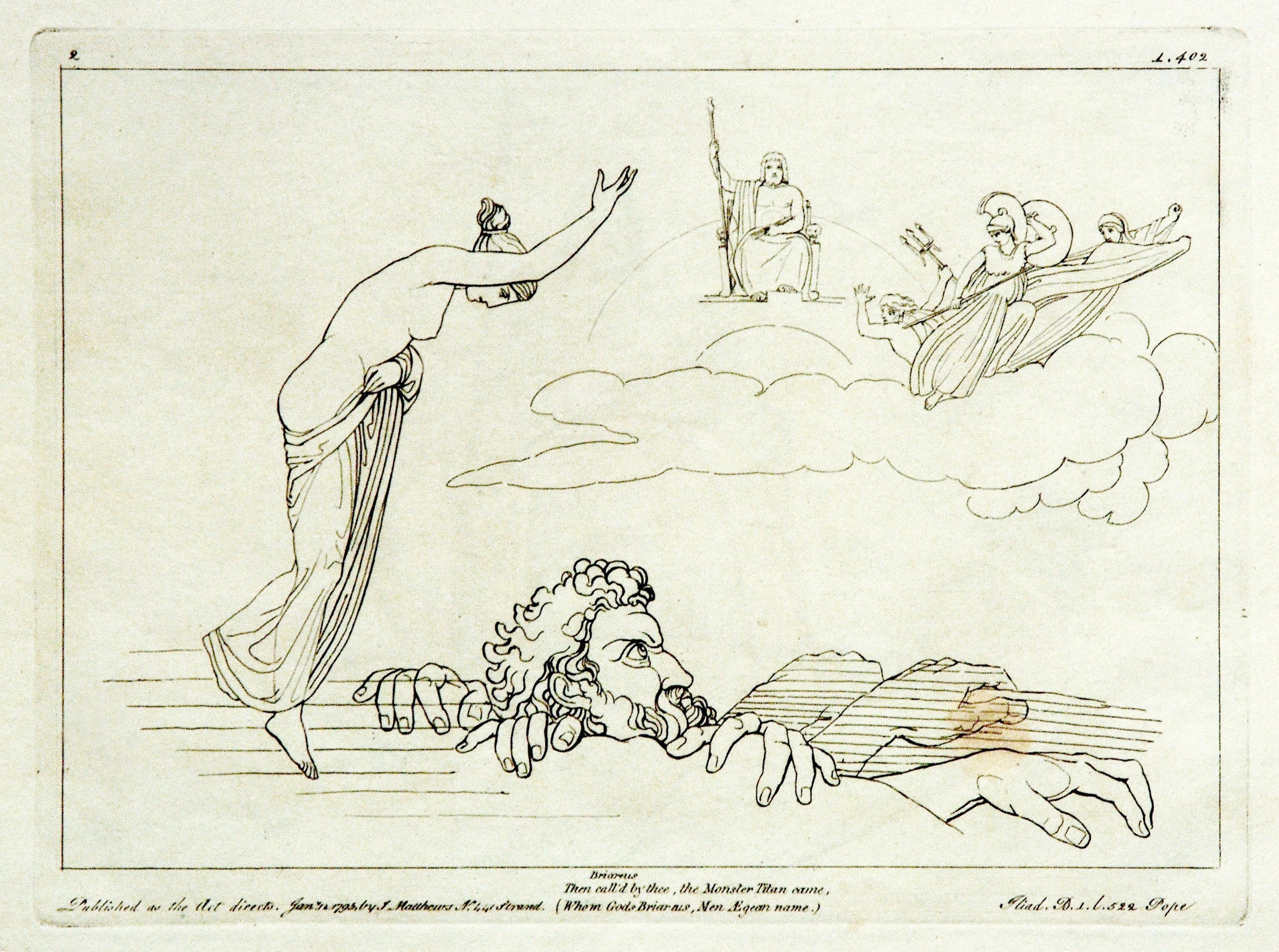
Thetis calling Briareus, engraved by Tommaso Piroli after John Flaxman, 1795. Photograph by H.-P. Haack, CC BY 3.0. A later illustration of Iliad 1.401, not ancient art. Source and reuse record.
- Briareus · Original emblem — Original devotional emblem for Briareus; modern art, not a historical portrait.
- Kottos · Original emblem — Original devotional emblem for Kottos; modern art, not a historical portrait.
- Gyes · Original emblem — Original devotional emblem for Gyes; modern art, not a historical portrait.
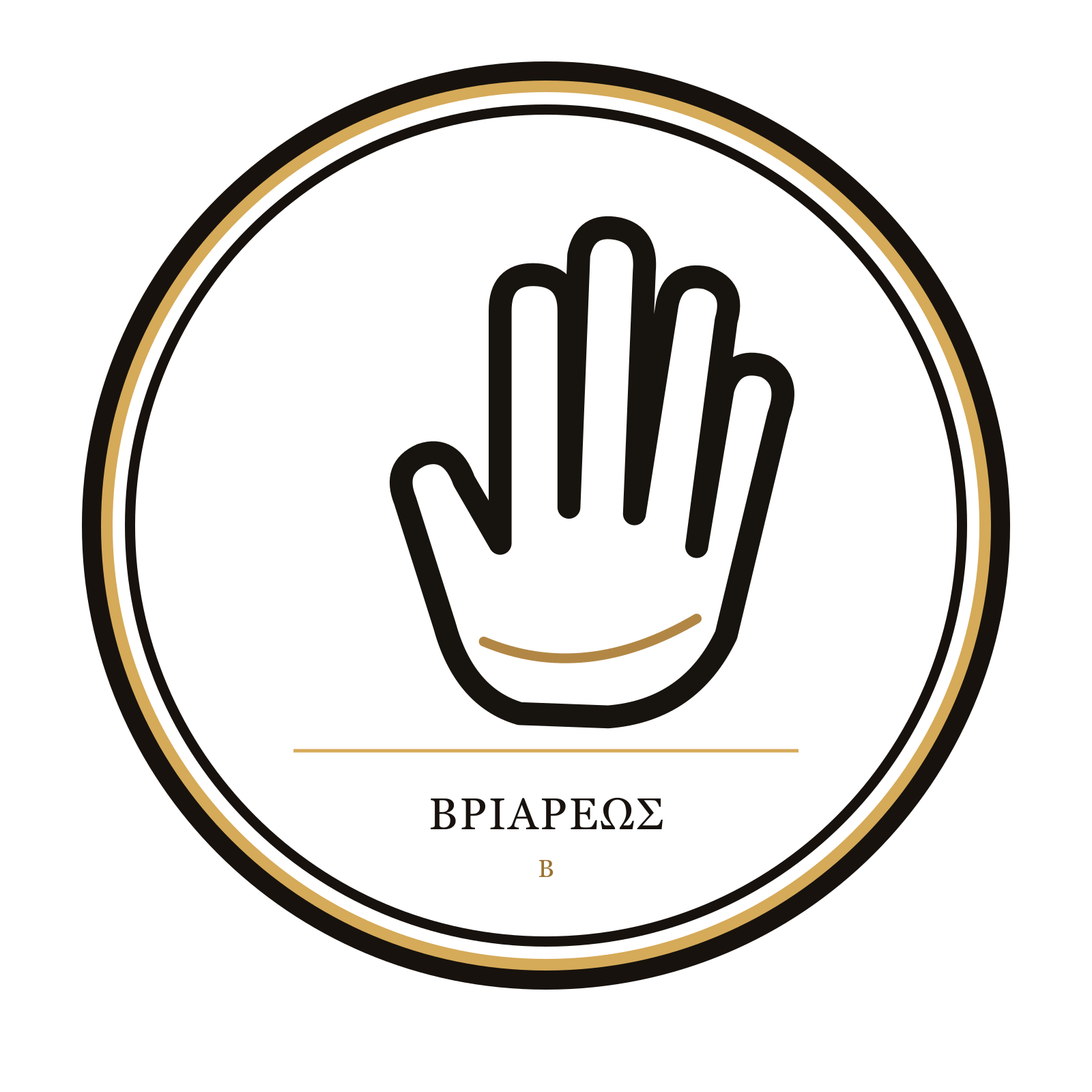
Black and gold Shenu with a white center, three named hands meeting above a closed bronze gate. Open the Shenu SVG.