The Hidden Oracles Power Ritual
Τροφώνιος · Ἀμφιάραος · Ῥῆσος · Memory, Dream, and the Word Beneath Earth
Before you begin
These rites are for adults. Children and teenagers must not perform them. Pregnant women should not perform them.
Read this ritual in full before beginning, follow its instructions with care, and allow the intervening day its proper quiet.
This rite may be combined with the Ritual of Hades, the God who rules the underworld.
May Zeus bless this observance, and may the Great Chthonic Gods receive our devotion in friendship and honour.
Trophonios, Amphiaraos, Rhesus, I greet each of you by name.
I come with one question and a willingness to be corrected by truth.
Let memory serve understanding, and let understanding ripen into good conduct.
I keep my body here among the living while my thought turns reverently to your ancient stories.
Vibrate the runes in order
 Ansuzx10
 Laguzx10
 Perthrox10
Ō Trophōnie, tēn mnēmēn pros alētheian age.
O Trophonios, lead memory toward truth.
Pausanias describes two waters before the old consultation at Lebadeia.
One bears the name of Forgetfulness; the other bears the name of Memory.
I do not imitate the descent or claim the vision of those ancient petitioners.
I receive the image of a mind that must release distraction and preserve what matters.
Let me remember a promise without turning it into a chain.
Let me remember a kindness without claiming ownership of its giver.
Let me remember a wound truthfully and choose a just response.
Keep me from polishing memory until it resembles my wishes.
May the question I brought become simpler and more honest.
Let the lamp show the page before me, not a hidden world I pretend to possess.
Let recollection make my next act more lucid.
State your question in one plain sentence.
Vibrate the runes in order
 Berkanox10
 Eihwazx10Ansuzx10
Ō Amphiarae, en hēsykhiai sophian zētō.
O Amphiaraos, I seek wisdom in quiet.
The earth opened in the old account, and the seer entered it with his chariot.
A sanctuary at Oropos later received those who sought an answer in sleep.
I borrow no ancient procedure by repeating its name.
I ask instead for the discipline of pausing before judgment.
Let the mind cease inventing signs to flatter its own preference.
Let a difficult answer be welcome when it is supported by truth.
Let a needed rest be honored before I call exhaustion revelation.
May healing begin with accurate attention to the body and the person beside me.
May I distinguish care from control when I would advise another.
Amphiaraos, receive my reverence for the knowledge sought at your ancient shrine.
Let quiet make room for the words I should hear in waking life.
Pause for several natural breaths without trying to force an answer.
Vibrate the runes in order
 Raidhox10
 Kenazx10
 Ehwazx10
Ō Rhēse, to kekrymmenon meta semnotētos akouō.
O Rhesus, I listen to what is hidden with reverence.
The drama that bears your name ends with a mother's grief and a strange promise.
She speaks of a hidden dwelling and a prophetic presence in the Thracian mountain.
I will not erase the grief because the ending speaks of a sacred future.
Let me hear the human loss within every grand story of destiny.
Let no desire for marvel make me neglect the living person before me.
Let the cave remain a poetic boundary, not an invitation to wander blindly.
If a thought arises, I will weigh it when I return to ordinary light.
If no thought arises, silence is still an honest offering.
Rhesus, receive honor in the form the ancient drama preserves.
May truth be sought with tenderness where sorrow has passed.
May I carry neither borrowed certainty nor theatrical fear from this station.
Allow the question to rest without demanding an answer.
Vibrate the runes in order
 Gebox10
 Mannazx10Ansuzx10
Mnēmē kai hēsykhia kai eleos tēn alētheian therapeuetōsan.
Let memory, quiet, and compassion serve truth.
Trophonios gives this rite its image of a remembered encounter.
Amphiaraos gives it the patient space of rest before speech.
Rhesus gives it the sorrow that must not be excluded from an oracle.
These are separate ancient presences, joined here only by a new prayer.
I ask no sign that would relieve me of thinking.
I ask for the courage to test what I think I have learned.
Let a claim face evidence, and let a judgment leave room for correction.
Let the question change if its first form was unkind or confused.
Let a helpful answer be shareable in ordinary words.
May the three paths meet at a lamp that illuminates conduct.
May no person be made subject to a private vision they did not request.
Rewrite the question more fairly if the prayer has changed it.
Vibrate the runes in order
 Jerax10
 Dagazx10Mannazx10
Eis to phōs epanerkhomai kai to khrēsimon graphō.
I return to the light and write what is useful.
Pausanias saw the tablets of those who came back from Trophonios.
I have not visited that shrine, and this paper bears no oracle's authority.
Yet writing can keep me accountable to what I truly thought today.
I will record the question, the uncertainty, and the next sound step.
I will check any factual matter in the world where evidence can be found.
I will seek qualified human help where the question requires it.
I will let rest remain rest and silence remain silence.
Trophonios, Amphiaraos, Rhesus, receive my thanks in your distinct names.
Zeus, guide my return from contemplation to responsible action.
The lamp is enough; the room is here; the day continues.
I leave the hidden places in peace.
Write one possible action and one fact that still needs checking.
Zeus, let what is true become useful, and let what remains uncertain be named honestly.
I return to the present room, to the living, and to the work that follows.
Write the question and a practical next step. If the matter concerns someone else, leave their judgment and freedom intact.
Short return if stopping early
Three hidden witnesses, receive my thanks. I am in the present room. Zeus, guide my return.
On Trophonios
Pausanias, Description of Greece 9.39.5 to 14, describes the consultation at Lebadeia, the waters of Forgetfulness and Memory, the constructed opening, and tablets dedicated by those who returned. The rite invokes memory as a moral discipline. It does not recreate the ancient descent or claim that modern contemplation yields an oracle.
On Amphiaraos
Pausanias, Description of Greece 1.34.1 to 5, records the sanctuary at Oropos and the tradition that the earth received Amphiaraos and his chariot. Herodotus, Histories 8.134, distinguishes consultation at Trophonios from sleep at Amphiaraos's shrine. The second station honors quiet, rest, and discernment in light of these separate practices.
On Rhesus
In the ancient play Rhesus 960 to 973, attributed in antiquity to Euripides, the Muse describes her son's continued presence in a mountain cave and his prophetic place among the Bacchic powers. The text is a dramatic speech, not a preserved manual of worship. The station therefore holds together the mother's lament, the cave image, and reverent uncertainty about the future.
The Shenu and the five stations
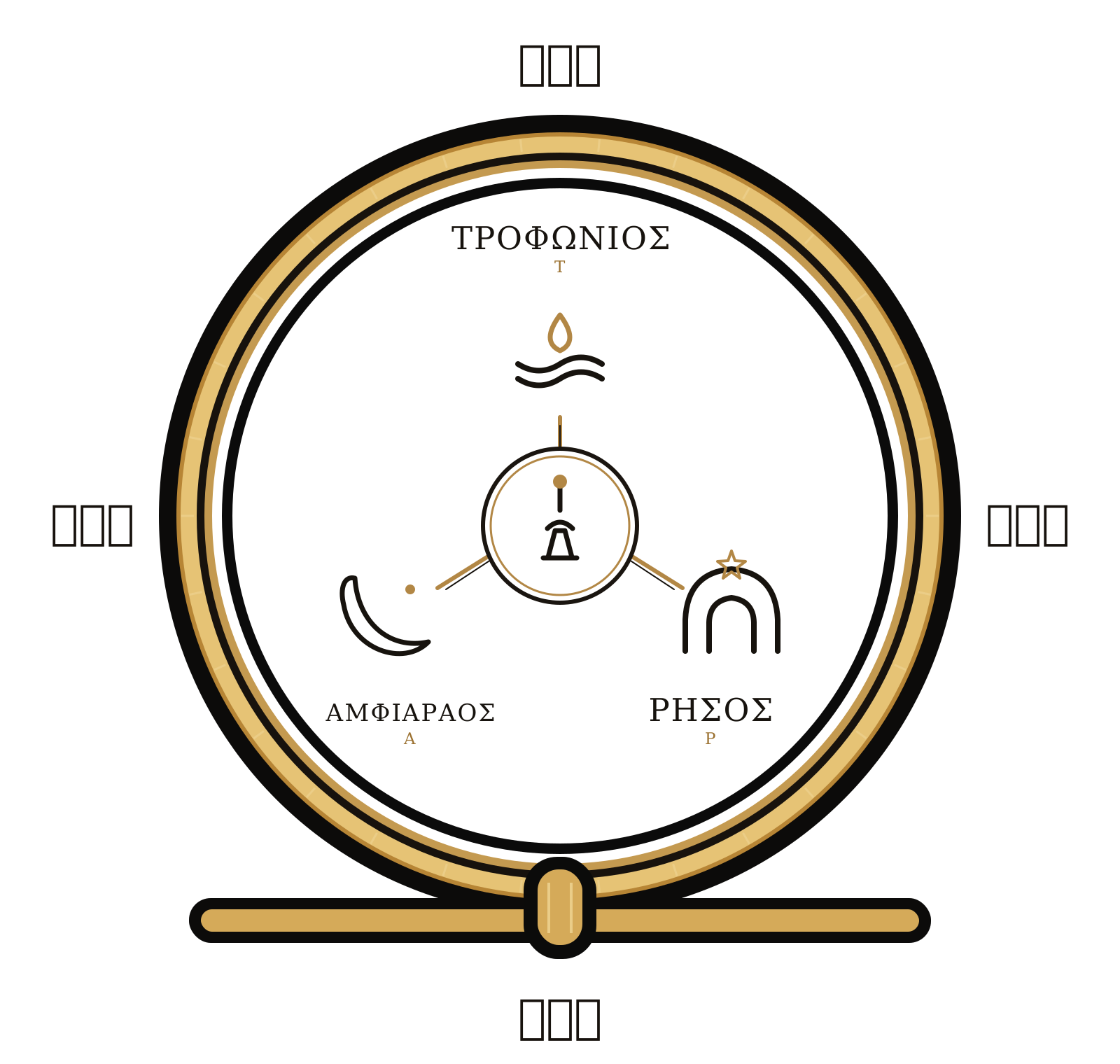
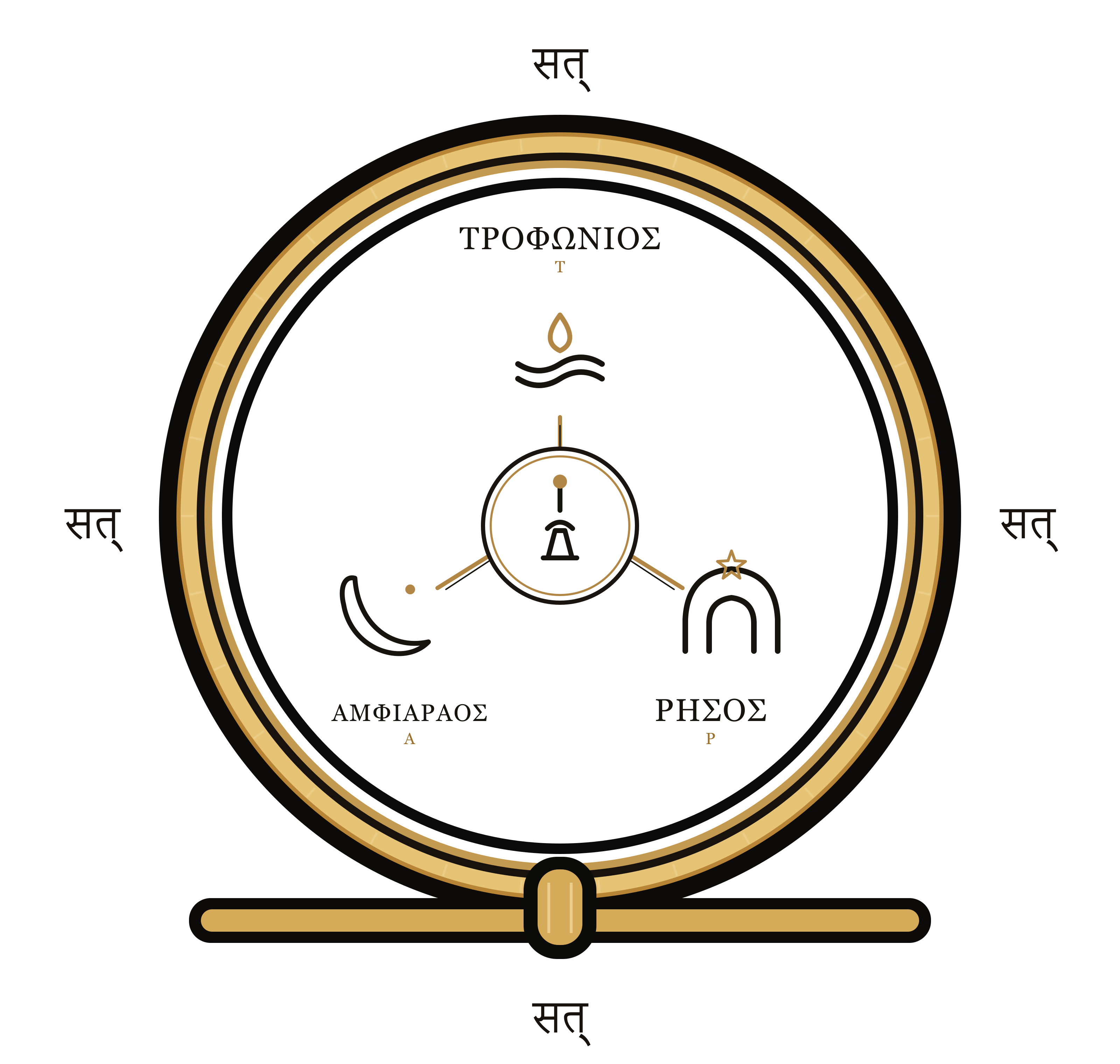
Three paths meet under a lamp: a paired water sign for Trophonios, a resting crescent for Amphiaraos, and a cave star for Rhesus. Their names remain separate in the white field. The grouping and Shenu are new devotional art, not a claim to an ancient triadic cult. The rite moves through memory, quiet, lament, convergence, and an accountable return. Rune and letter sequences are contemporary aids to attention. The five stations contain one newly composed Greek sentence each, aligned with the English prayer and a reading guide. Their 195 station vibrations and the thirteenfold seal total 208.
The Voices and the Return
ΜΝΗ holds the beginning of memory, ΙΑΣ points toward healing, ΡΗΣ recalls the name Rhesus, ΑΛΗ begins the word for truth, and ΦΩΣ spells light. These are transparent letter cues, pronounced separately, not recovered syllables from any ancient oracle. The rune triads are newly chosen pacing devices: Ansuz gives way to Laguz at the waters, Eihwaz steadies the quiet station, Kenaz marks the cave star, and Jera closes in daylight.
The prayer makes no promise of prophecy. One Greek sentence is given at each station with a direct reading guide and a matching English statement within the wider prayer. The final tablet is simply a present-day written account of a question and a next step. Omega and Alpha close the voice before the participant looks at the room.
The Historical Image
The ancient Amphiaraos krater shows the seer departing by chariot. The page displays a later documentary plate of that object, distributed as a CC0 scan. It is an image of Amphiaraos alone, not evidence that Trophonios and Rhesus shared a cult or a single artwork.
Artwork and individual emblems
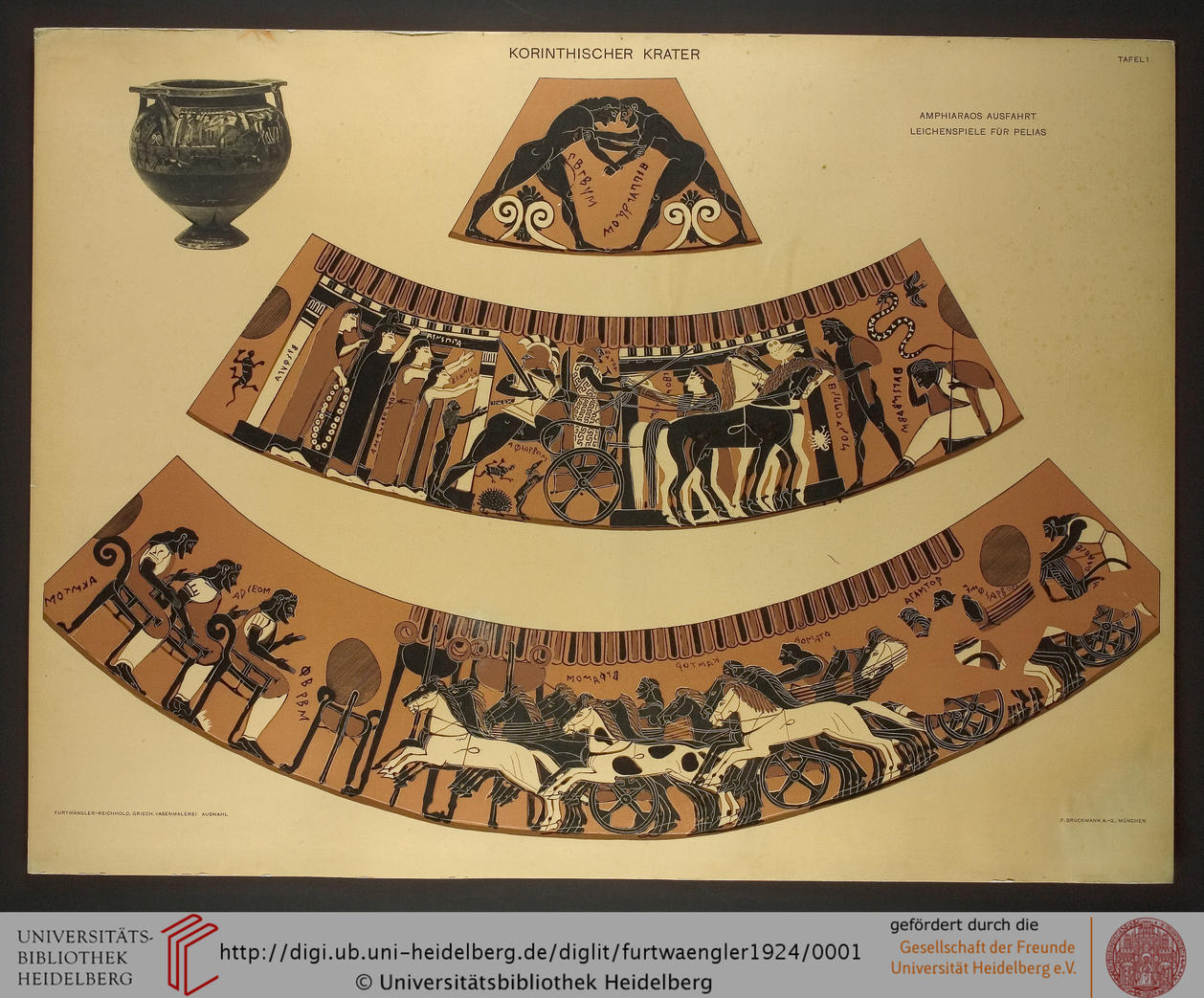
The Amphiaraos krater, ancient Corinthian pottery, ca. 570 to 560 BCE, reproduced in an early twentieth-century plate. The illustrated figure is Amphiaraos; the other two members of this rite are not depicted. CC0 scan. Source and reuse record.
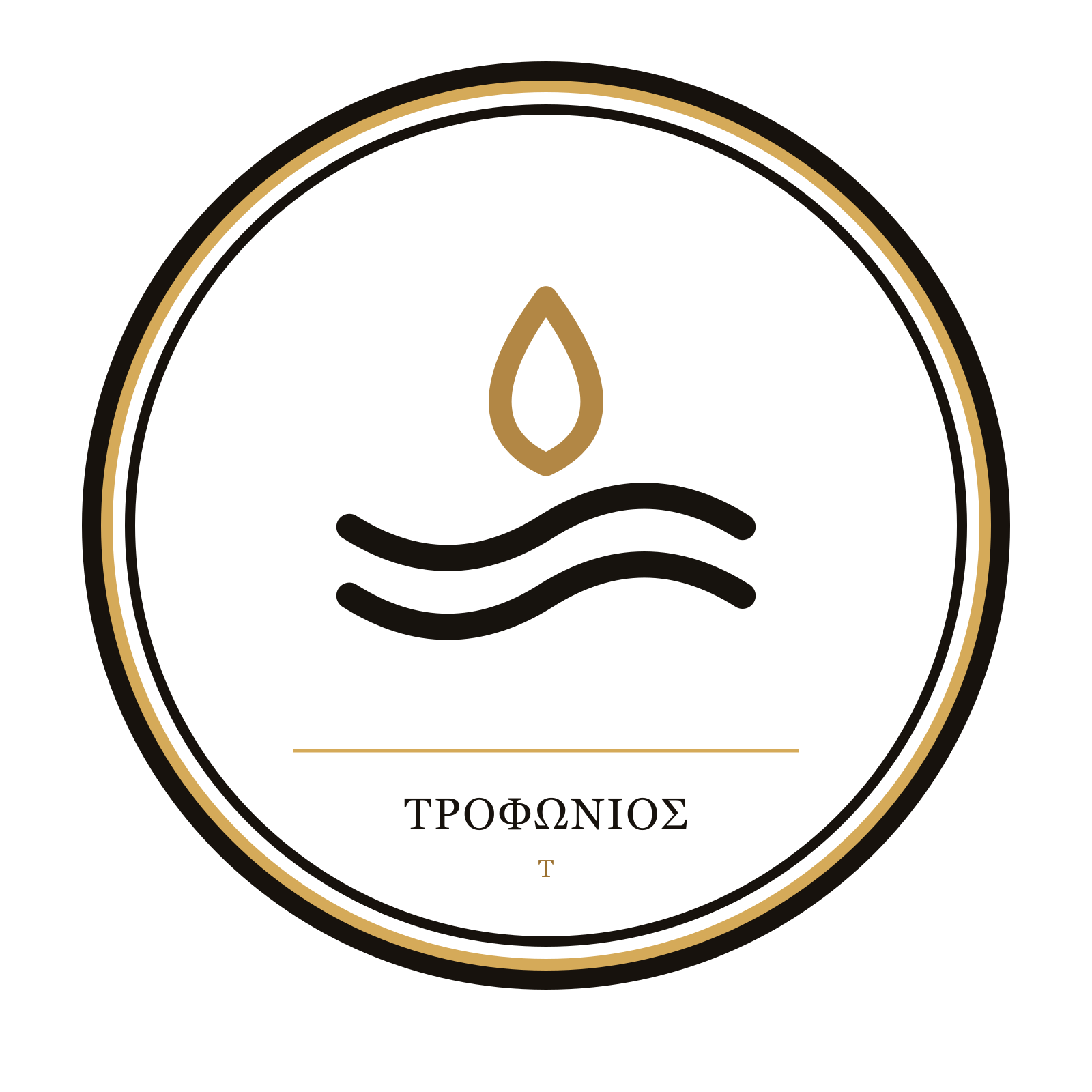
- Trophonios · Original emblem — Original devotional emblem for Trophonios; modern art, not a historical portrait.
- Amphiaraos · Original emblem — Original devotional emblem for Amphiaraos; modern art, not a historical portrait.
- Rhesus · Original emblem — Original devotional emblem for Rhesus; modern art, not a historical portrait.
Black and gold Shenu with three named paths, water, crescent, and cave star meeting under a central lamp. Open the Shenu SVG.