The Etruscan Gate Power Ritual
Βανθ · Κούλσου · Τουχούλχα · The Torch, the Door, and the Far Interior
Before you begin
These rites are for adults. Children and teenagers must not perform them. Pregnant women should not perform them.
Read this ritual in full before beginning, follow its instructions with care, and allow the intervening day its proper quiet.
This rite may be combined with the Ritual of Hades, the God who rules the underworld.
May Zeus bless this observance, and may the Great Chthonic Gods receive our devotion in friendship and honour.
Vanth, Culsu, Tuchulcha, I name you with reverence and in your separate places.
Let the torch be seen, the door be honored, and the deep interior remain deep.
I seek no passage for myself and no command over those beyond my sight.
Let this rite teach attention to the dead and responsibility to the living.
Vibrate the runes in order
 Kenazx10
 Raidhox10
 Algizx10
To phōs en tēi hodōi meta aidous timō.
I honor the light on the road with reverence.
Vanth, winged witness of Etruscan funerary art, receive my greeting.
Your torch is not the sun; its value is that it shines near a hard passage.
On the urn and tomb wall you are present where human stories reach their limit.
I will not make you a servant of every wish I call guidance.
Let my own light be enough to help one person take the next step.
Let me accompany without claiming to know their whole road.
Let me speak of the dead by their names and their actual deeds.
Let sorrow remain worthy of honest company.
Vanth, receive honor for the vigilance your image carries.
May I hold a lamp when one is needed, and put it down when it is not.
May reverence sharpen kindness instead of turning it theatrical.
Think of an act of accompaniment that does not take another's place.
Vibrate the runes in order
 Isax10
 Eihwazx10
 Tiwazx10
Tēn thyran hōs horion timō.
I honor the door as a boundary.
Culsu, named beside an Etruscan doorway, receive my greeting.
One old carved scene preserves more than a hundred invented legends could.
I will stay close to what the image gives: a threshold and a named presence.
I will not assign you a speech that no surviving inscription records.
Let a boundary teach me to request entry rather than seize it.
Let a refusal be heard without resentment.
Let my own door open freely for the guest I can truly receive.
Let it close firmly against harm without delight in exclusion.
Culsu, receive honor where the visible path meets its limit.
May I practice the courtesy due at every human threshold.
May I know when the rightful act is to remain outside.
Recall a boundary you can honor without fear or resentment.
Vibrate the runes in order
 Nauthizx10Algizx10Isax10
 Khi (Χ)x3
To endon meta semnotētos aphiēmi.
I leave the interior in reverent peace.
Tuchulcha, the painted figure of the Tomb of Orcus, receive my address.
The ancient image gives you wings and serpents in a scene of restraint.
I will not soften that witness into a promise it does not make.
Nor will I cultivate fear as though fear were worship.
Let the painted interior keep its own gravity.
Let me meet a difficult truth without running toward spectacle.
Let restraint be recognized as a sacred skill.
Let no person be threatened in your name.
Tuchulcha, receive reverence at the limit of my understanding.
The gate remains closed and my place remains among the living.
I carry from this image the courage to stop where I should stop.
Let the inward image remain beyond the gate; do not pursue it.
Vibrate the runes in order
 Gebox10
 Mannazx10Algizx10
Phōs kai thyra kai horion en taxei menetōsan.
Let light, door, and boundary remain in order.
Vanth is named with the torch of witness.
Culsu is named at the door.
Tuchulcha is named beyond it, in the image's deeper chamber.
The three are gathered here by new composition, not by an ancient text of worship.
Let the difference among them be preserved rather than blurred for effect.
A lamp is useful because a road may be seen by it.
A door is meaningful because passage requires a decision.
An interior retains dignity because not everything is for immediate approach.
Zeus, let clear measure order my relation to every sacred boundary.
Let my care for the dead be expressed in truthful remembrance.
Let my care for the living be expressed in acts they can freely receive.
Hold the three named functions without treating them as identical.
Vibrate the runes in order
 Dagazx10
 Jerax10
 Ehwazx10
Tēn hodon tōn zōntōn palin badizō.
I walk the road of the living again.
The torch stays in its image; my hands are free.
The door stays closed; my home is here.
The painted interior remains an ancient witness, not a place I must enter.
Vanth, receive thanks for the sign of light kept near a hard road.
Culsu, receive thanks for the boundary of the door.
Tuchulcha, receive thanks for the lesson of reverent restraint.
Zeus, receive my return to what I can know and do.
I can tend a grave, preserve a name, or sit beside someone in grief.
I can meet a promise today and make another person's path less lonely.
I can let the ancient image remain ancient while new prayer ends here.
I depart in peace and begin the next good act.
Choose one act of remembrance or companionship that belongs to ordinary life.
Zeus, let light, boundary, and restraint keep their proper measure.
The gate remains closed; I return to the road of the living in peace.
Name one person or deed to remember accurately. Then return to the day's ordinary responsibilities.
Short return if stopping early
Vanth, Culsu, Tuchulcha, receive my thanks. The gate remains closed. Zeus, guide me home.
On Vanth
The Metropolitan Museum of Art's Etruscan alabaster cinerary urn 96.9.225a, b, of the third century BCE, places Vanth at the edge of its battle scene. Etruscan tomb painting and sculpture often give her a torch and wings. These objects show presence beside death and the journey to it; they do not preserve a spoken liturgy. The first station honors the visible torch as witness and careful accompaniment.
On Culsu
The Hasti Afunei sarcophagus from Chiusi identifies a female figure emerging from a doorway as Culsu. Ingrid Krauskopf, ‘Gods and Demons in the Etruscan Pantheon’ in The Etruscan World (2013), pages 521 to 523, explains the link between the name and gateway imagery while warning against multiplying fixed offices from sparse inscriptions. The rite keeps her at the door and refrains from claiming a recovered invocation or a certain object in her hand.
On Tuchulcha
The fourth-century BCE painting in the Tomb of Orcus at Tarquinia depicts Tuchulcha in the interior scene with Theseus and Pirithous. The Enciclopedia dell'Arte Antica, ‘Tuchulcha,’ describes the wings, birdlike face, and serpents. The painting is forceful and its full religious meaning is not recoverable from one scene. The third station honors the figure's gravity without assigning a benevolent speech or urging a journey into the tomb.
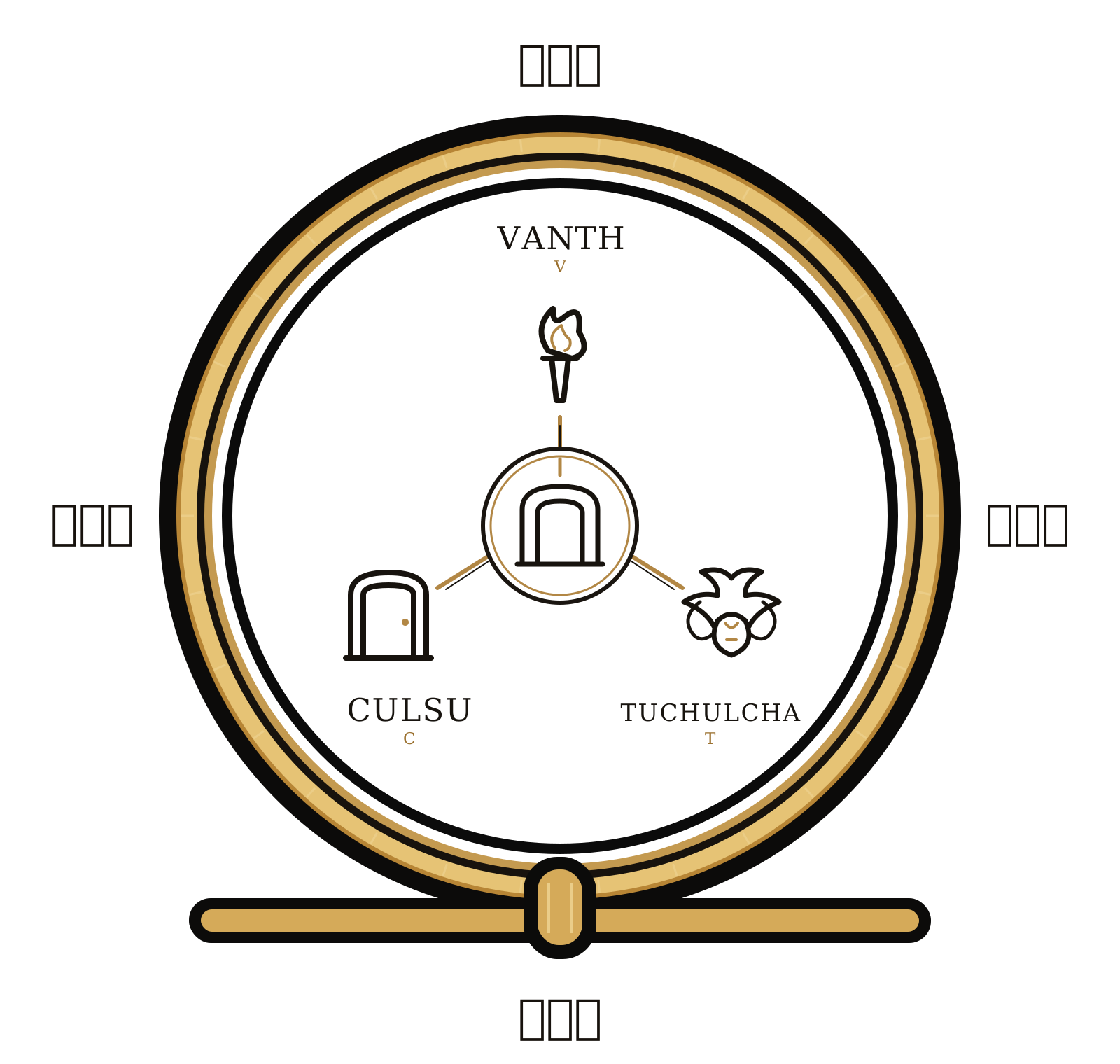
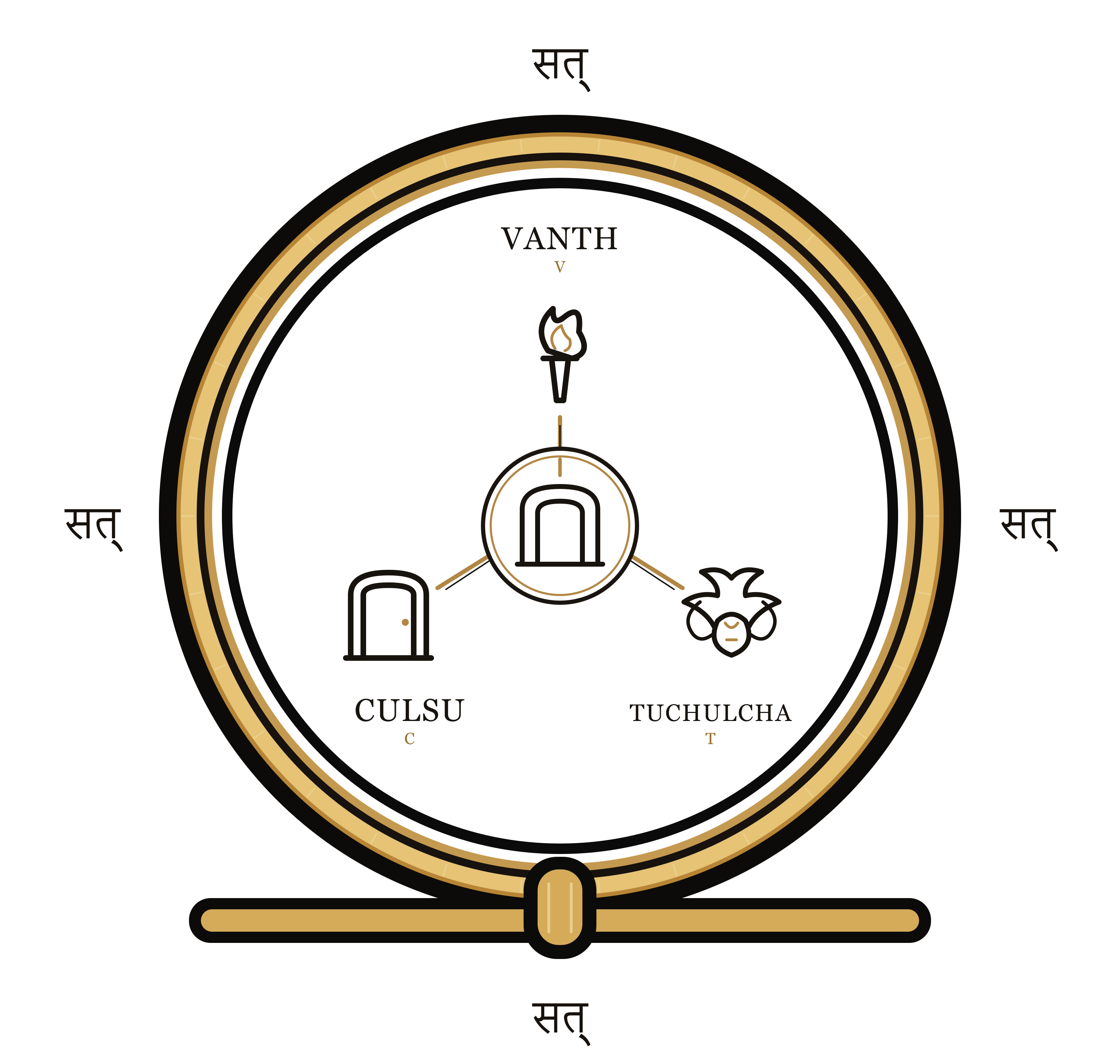
The Shenu and the five stations
A torch for Vanth, a closed gate for Culsu, and a winged serpent sign set beyond it for Tuchulcha form this newly composed Shenu. Their names and initial codes V, C, T are legible and separate in the white field. The ancient images are historical witnesses; the grouping and ritual are new. The sequence passes through witness, threshold, restraint, convergence, and return. Rune triads and Greek letters are contemporary vocal choices, not Etruscan formulas. Each station carries one newly composed Greek sentence from the wider English prayer, with a reading guide and meaning. Five sets of thirty-nine repetitions plus thirteen at the close total 208.
The Voices and the Return
ΒΑΝ, ΚΥΛ, and ΤΥΧ recall the three names in Greek letters; ΟΔΟ suggests a road and ΒΙΟ living life. They are mnemonic fragments, not Etruscan inscriptions or recovered names of power. The rune triads pace the torch, the door, the interior limit, the threefold view, and the return; they claim no Etruscan antiquity.
The Etruscan witnesses preserve images more fully than speech. For this reason the five Greek sentences are openly new liturgical compositions, one per station, each aligned with an English sentence in the larger prayer. Their use does not imply that an Etruscan worshipper spoke Greek at these tombs. Omega and Alpha conclude the counted sounds, and the gate remains closed when the speaker returns.
The Historical Image
The Metropolitan Museum of Art identifies Vanth at the right of the frieze on Etruscan urn 96.9.225a, b. The image documents Vanth, not Culsu or Tuchulcha. The Shenu joins three separate Etruscan witnesses into a new rite without claiming an ancient triadic scene.
Artwork and individual emblems
Etruscan alabaster cinerary urn with the named underworld figure Vanth at the edge of its frieze.
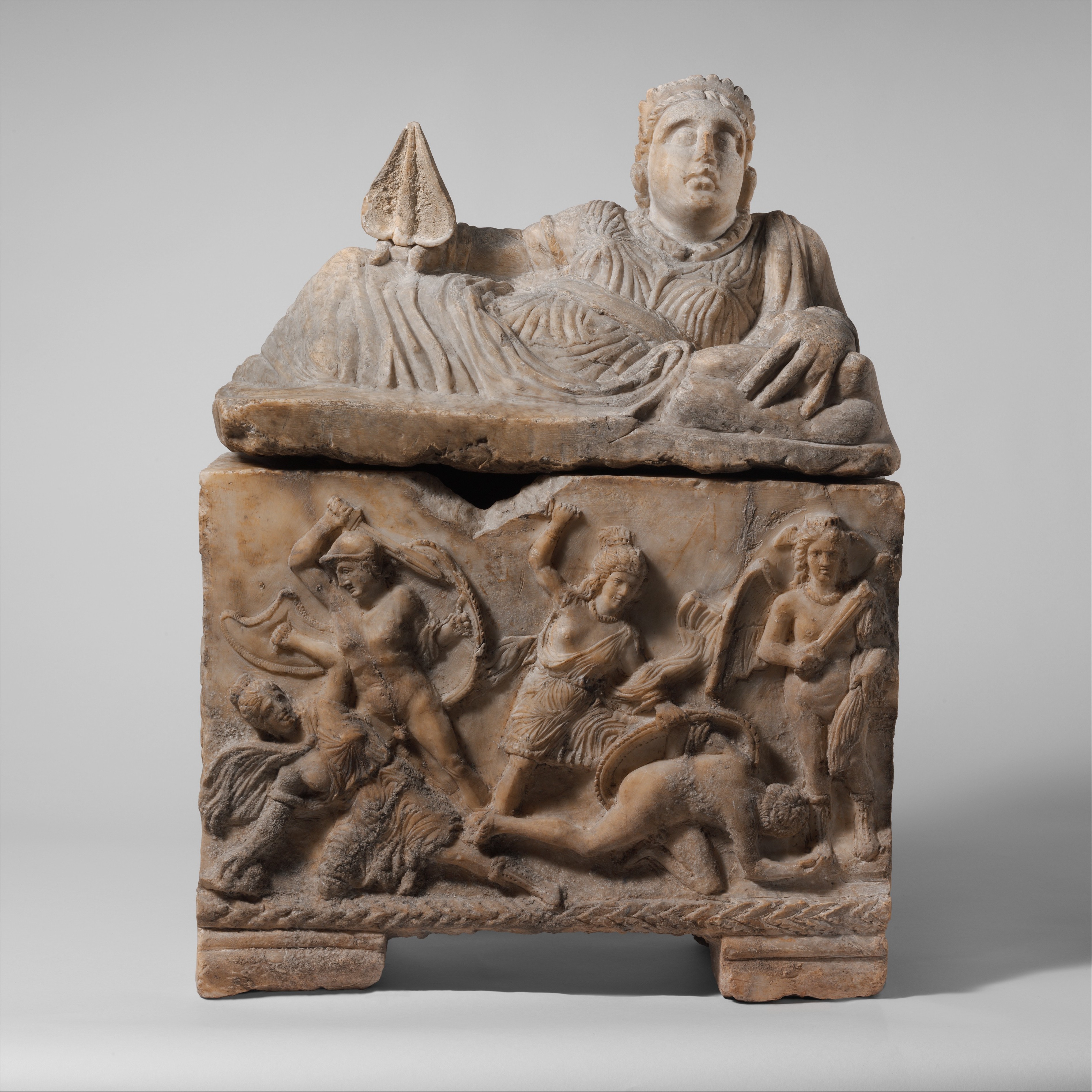
Etruscan alabaster cinerary urn, third century BCE, The Metropolitan Museum of Art 96.9.225a, b. Vanth appears at the right of the frieze. Public domain image. Source and reuse record.
- Vanth · Original emblem — Original devotional emblem for Vanth; modern art, not a historical portrait.
- Culsu · Original emblem — Original devotional emblem for Culsu; modern art, not a historical portrait.
- Tuchulcha · Original emblem — Original devotional emblem for Tuchulcha; modern art, not a historical portrait.


Black and gold Shenu with a white center and the named Etruscan signs of torch, closed gate, and winged serpent. Open the Shenu SVG.