Eris Power Ritual
Ἔρις · Strife Turned Toward Worthy Work
I see the two branches and ask for the one that bears fruit.
I choose worthy contest and keep the justice of Zeus.
Let rivalry call forth labor, truth, and skill.
 Isax10
 Kenazx10Isax10
 Epsilonx3
 Rhox3
Rhox3 Iotax3
Ō Eri, dyo erides epi gaiēs eisin; tas hodous diakrinō.
O Eris, two Strifes are upon the earth; I distinguish their paths.
The branch that withers and the branch that bears grain stand before us.
I leave the harmful path.
I refuse the appetite that feeds on another person's ruin.
One Strife breeds harm; the other rouses us to work.
The neighbor's skill may awaken my own labor.
Zeus set the good Strife in the roots of earth.
I will seek the rooted strength Zeus gave to fruitful striving.
Eris, let the energy of contest become a worthy deed.
Name inwardly the kind of quarrel that consumes time without creating anything good.
 Jerax10
 Ingwazx10Jerax10Epsilonx3Rhox3
 Gammax3
Ō Eri, ho agōn ho kalos pros ergon me kineī.
O Eris, worthy contest moves me toward work.
A furrow is opened by a hand that returns to it day after day.
I will do the work carefully.
Let care, practice, and correction strengthen what I make.
Potter vies with potter, and singer with singer.
Another craftsperson's excellence can call my own craft forward.
I turn emulation toward craft and fruit.
May envy lose its hold as the work gains shape.
Receive the labor that makes rivalry answerable to a harvest.
Choose one craft, duty, or repair that can receive this energy.
 Tiwazx10
 Ansuzx10Tiwazx10
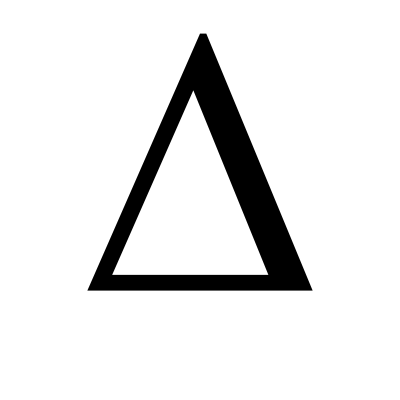 Deltax3Iotax3
 Kappax3
Ō Eri, ton agōna pros dikaiosynēn age.
Zeus, make judgment straight.
O Eris, lead contest toward justice.
Let my words be exact enough to bear examination.
I speak truth and seek what is just.
I will give each claim its measure and each person a fair hearing.
I do not seek a marketplace of empty quarrels.
Let no hunger for applause bend the line of judgment.
I keep the measure of justice in my actions.
May Zeus guard the order in which truth can be spoken.
Eris, let contention end where justice has found a clear path.
Where another person is involved, favor a fair process and truthful words over victory for its own sake.
 Mannazx10
 Othalax10Mannazx10
 Pix3Rhox3
 Alphax3
Ō Eri, en ergōi katharōi hē eris karpophorei.
O Eris, receive the fruit of worthy contest.
The field receives the seed through work, not through argument.
I return to my work.
I will finish the portion that belongs to my hands.
I entrust the seed to earth and its fruit to time.
May time test the work and ripen what has been sown.
O Eris, in honest work, Strife bears fruit.
Let the good Strife move me onward when comfort asks me to stop.
Receive the fruit of disciplined effort and send me back to the task.
Name the first physical or written step. Begin it after the rite.
May justice govern the contest and patient hands finish the work.
Zeus, guard straight decisions.
I go to the field of my own duty.
See the dark branch end and the gold furrow continue. Let the names of rivals fall away. Keep the chosen task and take the first step in ordinary life.
Short return if stopping early
Eris, receive my honor. I choose worthy work and straight judgment. Hail Zeus.
On Eris
Eris, Ἔρις, is Strife in divine person. Hesiod's Theogony 211 to 225 places her among the children of Nyx. At lines 226 to 232 it names painful offspring of destructive Strife, including fighting, quarrels, false speech, lawlessness, and oath-breaking. Homer's Iliad 4.439 to 445 shows Eris enlarging amid battle until her head reaches heaven while she walks on earth. The first station refuses to trivialize that force.
The divine name must retain the weight of both ancient descriptions. In Iliad 4.439 to 445, Strife begins small and grows until her head is in heaven while her feet remain on earth. In the Shield of Heracles 139 to 155, she hovers above the terrible image of Fear and appears again amid battle, flight, and tumult. These images establish the destructive path that the first station recognizes and leaves behind. The divided furrow is a choice made in full view of that magnitude.
Hesiod's Works and Days 11 to 26 does more than praise competition. It gives the second Strife an origin as an elder daughter of Night and says Zeus placed her at the roots of the earth. A neighbor's prosperous field stirs another to plough, sow, and order his house. The potter and singer enter the same pattern. The second station therefore names an actual work and a craft to be improved. It asks for no triumph over a person.
From Quarrel to Work
The petition for straight judgment belongs under Zeus, as Hesiod's proem and counsel place justice in his order. The rite seeks no injury or humiliation for a rival. It asks the speaker to make contention answerable to truth and useful labor.
The poem's address to Perses sharpens the ritual's third station. At Works and Days 27 to 41, Hesiod warns against lingering around disputes instead of securing one's livelihood. He calls for straight judgment from Zeus while recounting a quarrel over the division of an inheritance and criticizing judges who accept bribes. Fairness here is not a decorative addition to rivalry; it is the condition under which effort may bear good fruit.
The fourth station ends with a deed because Hesiod's contrast is practical. The speaker can put a tool to work, write an honest page, repair an obligation, or use a fair procedure in a real dispute. The dark branch of the sigil ends before the grain; the gold branch reaches it. That last look makes the choice visible before the rite closes.
The New Sigil and Sound
This new sigil gives Hesiod's two Strifes two paths from one root. The dark thorn stops at closed circles; the gold branch bears grain. A small divided diamond at the fork marks the moment of choice, not a hidden name or inherited magical character. The capitals ΕΡΙΣ name the Goddess. The arrangement serves the first and last stations and is not presented as a recovered ancient emblem.
The rune groups and Greek letters follow the movement from ἜΡΙΣ through ἔργον, δίκη, and πρᾶξις. They are newly ordered meditative sounds. The Greek prayers are new composition shaped by the cited Hesiodic and Homeric passages. The closing returns the practitioner's attention to a real task.
The two branches stand in the white interior of a joined Shenu rope. Its central knot connects loop and base, holding destructive and fruitful paths in one field while keeping them distinct. The surrounding form follows the Egyptian shen ring described in the Metropolitan Museum of Art’s Art of Ancient Egypt: A Resource for Educators; the branching furrow is this rite’s own image of Hesiod’s two Strifes.