Erinyes and Eumenides Ritual
Ἐρινύες · Εὐμενίδες · One Rite of Ancient Claim and Honored Settlement
Ancient Ones, I approach with an honest account of my own deeds.
I seek truth and honor justice in proper order.
Let hearing, ordered judgment, and honor prepare the way for blessing.
 Isax10
 Eihwazx10Isax10
 Epsilonx3
 Rhox3
Rhox3 Iotax3
Ō Erinyes, to palaion dikaion ou lanthanei.
O Erinyes, the ancient claim does not go unseen.
The blood that fell upon Earth gave your ancient office a voice.
I examine my own actions in truth.
I will name my part without concealing it beneath accusation.
Earth received the blood and brought you forth.
Let the record remain clear even when it is painful to face.
I do not turn from truth through fear.
Grant the courage to repair what my own hands have harmed.
Ancient Ones, receive an honest account and a measured heart.
Attend to your own responsibility. Do not turn this station into a sentence against another.
 Ansuzx10
 Mannazx10Ansuzx10
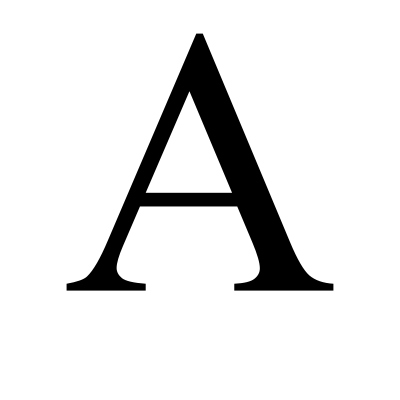 Alphax3
 Kappax3Rhox3
Ō Erinyes, logon hekastou akouō prin krinein.
O Erinyes, I hear each account before judging.
Athena called the case into an ordered place where voices could be heard.
I separate what is clear from what is unknown.
I will leave room for testimony that differs from my own.
Athena gathered the judges.
A judgment formed too early may burden the innocent.
Let hearing come before the vote.
Let uncertainty be admitted where the record is incomplete.
May patient hearing prepare the ground for a just decision.
Acknowledge any fact you do not yet possess. Leave judgment open where evidence is absent.
 Tiwazx10
 Algizx10Tiwazx10
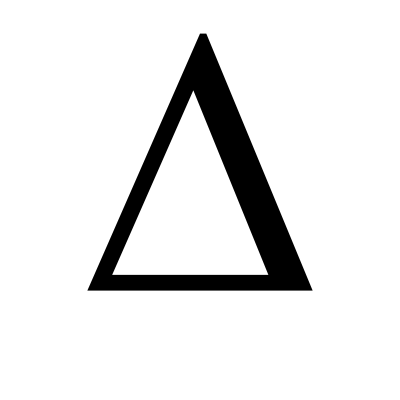 Deltax3Iotax3Kappax3
Ō Erinyes, tēn dikaian krisin zētō, ou tēn idian orgēn.
Athena established judgment and honored the vote.
The vote belongs to a court, where reasons meet before a common order.
O Erinyes, I seek just decision, not my own anger.
I will seek correction through fair means and proportionate acts.
Equal votes released Orestes.
The equal ballots ended the pursuit of Orestes in the play.
Let judgment proceed by a shared order, never by my anger.
Let the force of grievance answer to justice rather than fury.
May truth guide the decision and mercy attend its consequence.
Where action is needed, let it be evidence based, proportionate, and lawful.
 Othalax10
 Gebox10Othalax10
 Taux3Iotax3
 Mux3
Mux3Ō Eumenides, timēn en tēi polei lambanete.
O Kindly Ones, you receive honor within the city.
Athena offered a place of worship within the city you would protect.
Ancient power remains within a just order.
Let ancient honor receive a dwelling and an enduring voice.
Athena promised you seats within the city.
Your dignity remains present in the order of the community.
Your honor was not taken away; it received a place.
May the seat become a pledge that power and justice can dwell together.
Kindly Ones, receive the reverence of those who seek concord.
Honor remains real when anger is given a lawful place and a limit.
 Berkanox10
 Jerax10Berkanox10Epsilonx3
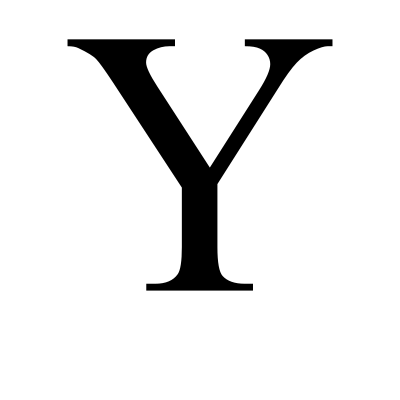 Upsilonx3Mux3
Ō Eumenides, tēi gēi eumeneian didote.
O Kindly Ones, give goodwill to the land.
From the honored seat, let blessing pass into field and household.
May our works grow in peace and justice.
May peace give labor the room in which it can flourish.
May crops rise from earth and people live in peace.
Let the land yield its fruit without the poison of endless feud.
We preserve ancient honor within renewed concord.
May a truthful repair become the first seed of renewed trust.
Receive our thanks as we return to the work that sustains the city.
Choose one restorative act within your reach: a correction, a fair hearing, or an honest repair.
May the Kindly Ones be honored and the city have peace.
Zeus and Athena, guard justice and peace.
I will carry one fair and restorative act into the day.
Let the three flames become still above their seat. Take one unforced breath, then turn toward the restorative act you named. The judgment of others remains outside this rite.
Short return if stopping early
Erinyes and Eumenides, receive my honor. I return to truth, lawful judgment, and peace. Hail Zeus.
On the Erinyes and the Eumenides
The Erinyes, Ἐρινύες, are ancient powers of retribution for grave wrong. Hesiod's Theogony 185 places their birth from the blood of Ouranos received by Gaia. Aeschylus's Eumenides calls them daughters of Night at 780 to 792. These are distinct ancient poetic accounts. The rite need not force them into a single genealogy in order to recognize the Goddesses' claim to honor.
Εὐμενίδες, the Kindly Ones, is the reverential name through which this rite attends the honored settlement of their power. The ritual moves between Erinyes and Eumenides within one collective address. It does not multiply them into two unrelated trios or imply that a modern name formula has been recovered.
The two ancient genealogies serve different poetic settings. Hesiod gives the Erinyes a place in the aftermath of the injury to Ouranos (Theogony 183 to 187); in Aeschylus, the chorus repeatedly calls Night their mother (Eumenides 321 to 334 and 780 to 792). The rite honors the Goddesses across these witnesses without inventing a resolution that either poet did not make. The three flames are a collective emblem of their presence, not a claim that all ancient accounts fixed their number at three.
The prosecution in Eumenides concerns Orestes' killing of his mother, Clytemnestra. Apollo supports Orestes; the Erinyes press the claim of the slain mother. The gravity of that claim explains why the rite begins with one's own responsibility and proceeds to a hearing. It does not use the myth to assign guilt to anyone named by a participant.
The Trial and the Honored Settlement
Athena's intervention has several stages. She declares the matter too grave for a solitary judgment, establishes a sworn court, and calls for witnesses and arguments (Eumenides 470 to 489). After the votes are cast, Orestes is acquitted on an equal tally (735 to 753). The Erinyes then protest that younger Gods have deprived them of ancient honor (778 to 792). Athena answers that the equal vote has not defeated them and offers a lasting, honored place in the city (794 to 807, 848 to 891). The five stations preserve this order rather than leaping from accusation to consolation.
The closing scene gives the settlement a public form. The Goddesses pray for good fruit from the earth and concord among citizens; Athena and a torchlit escort lead them toward their dwelling beneath the city (Eumenides 900 to 1047). The fifth station's branch and the final request for peace come from that scene. Blessing follows a heard claim and accepted honor, not the disappearance of the Goddesses' power.
Oath, Truth, and Restraint
The prayer to Zeus and Athena at the close keeps the movement within ordered justice. Real wrongs require appropriate human processes; the rite asks the practitioner to undertake one honest restorative act within their own responsibility.
At Works and Days 802 to 804, Hesiod says the Erinyes attended the birth of Horkos, the Oath whom Eris bore to trouble a false swearer. The image makes truthful testimony fitting to the hearing station. The rite itself swears no oath and confers no authority to punish. Its one outward charge is a fair act within the speaker's own power: an honest correction, a proper hearing, or a repair already owed.
The Three Flames and the Five Stations
The three flames, winding paths, shared seat, and olive branch form a newly composed collective sigil. The flames make the plurality visible without claiming that every ancient source fixes their number at three. The paths descend toward one seat, recalling the public honor Athena grants in Aeschylus' Eumenides; the olive branch answers the play's closing blessings. A single arch gathers the three without making them one Goddess. Both familiar collective names appear in Greek capitals above the emblem. This is not an ancient Athenian seal.
The rune and Greek letter groups follow the five movements. Their letters begin ἘΡΙΝΥΕΣ, ἀκρόασις, δίκη, τιμή, and Εὐμενίδες. These are new liturgical sound choices. Every Greek prayer above is newly composed from the named ancient scenes. The last contemplation completes the descent into a grave claim by returning to repair and peace.
The three flames, honored seat, and olive branch remain separate signs within a white Shenu field. A single rope loop joins its horizontal base at a central knot. The enclosing shape recalls the Egyptian shen ring described by the Metropolitan Museum of Art in The Art of Ancient Egypt: A Resource for Educators; the inner signs are newly composed for this one rite to the collective Goddesses.