Erebos Power Ritual
Ἔρεβος · The Hidden Depth and the Birth of Day
Before you begin
These rites are for adults. Children and teenagers must not perform them. Pregnant women should not perform them.
Read this ritual in full before beginning, follow its instructions with care, and allow the intervening day its proper quiet.
This rite may be combined with the Ritual of Hades, the God who rules the underworld.
May Zeus bless this observance, and may the Great Chthonic Gods receive our devotion in friendship and honour.
Night stands beside you in the first genealogy, and Day comes forth from your union.
May this work honor the breadth of that mystery and return me to useful light.
Zeus, keep my speech and conduct in good order.
 Isax10
 Perthrox10Isax10
 Epsilonx3
 Rhox3
Rhox3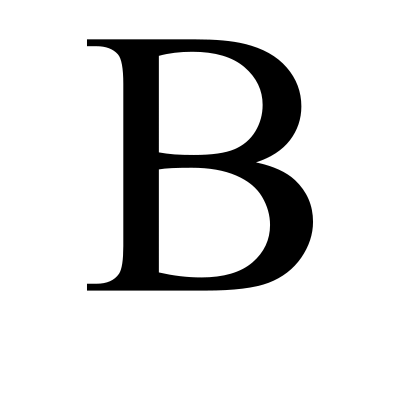 Betax3
Ō Erebe, to bathos sou en timēi theōrō.
Before any measured path, Hesiod names Chaos and then the first great presences.
You arise with Night from that beginning, neither a mistake nor an absence.
O Erebos, I behold your depth with honor.
The eye cannot command all that lies below its reach.
Let humility keep me from pretending that every hidden thing is mine to possess.
Let quiet be wide enough for a truthful thought to form.
I set no demand upon the unseen; I offer attention and praise.
May the depth teach patience before the first word is spoken.
Rest in the distinction between what is hidden and what is known.
 Laguzx10
 Dagazx10Laguzx10
 Nux3
Nux3 Etax3
Etax3 Mux3
Mux3Ō Erebe, ek tou bathous sou phōs anateiletō.
Night and Erebos meet in the old song; Aether and Day are born from them.
The dark holds a beginning that the morning alone cannot explain.
O Erebos, let light rise from your depth.
Let a difficult hour yield one honest understanding.
Let rest prepare the hand for work and the mind for counsel.
I will not force the coming of insight or call a delay defeat.
When the hour opens, I will meet it with gratitude.
Receive praise for the hidden ground from which a clear day may come.
Name one insight that became possible only after patient waiting.
 Eihwazx10
 Ansuzx10Eihwazx10
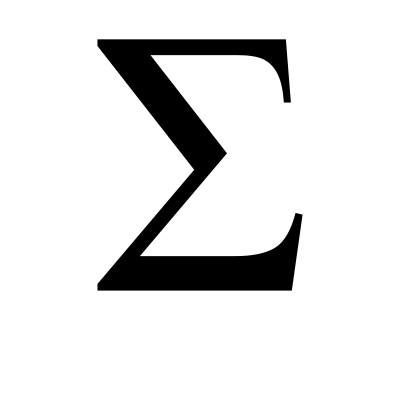 Sigmax3
 Iotax3
 Gammax3
Ō Erebe, en sigēi tēn alētheian akouō.
In the deep house of Night, the old poem sets a threshold for Day.
A threshold is honored by restraint as well as passage.
O Erebos, in silence I hear truth.
Let me hear the answer of conscience before I seek a louder voice.
Let what belongs to another remain safely theirs.
Give my speech a pause in which it can become accurate and kind.
I do not confuse silence with neglect; I use it to prepare care.
May the unseen portion of life be met with reverence.
Let one unnecessary word fall away.
 Raidhox10
 Sowilox10Raidhox10
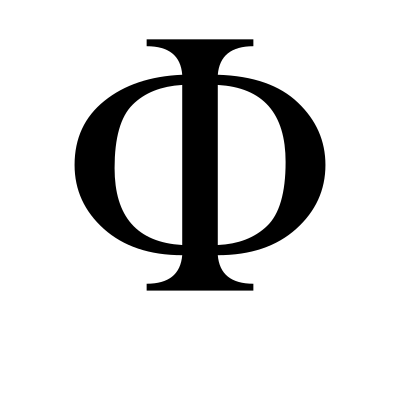 Phix3
Phix3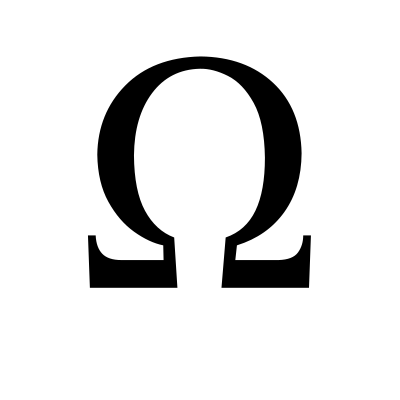 Omegax3Sigmax3
Ō Erebe, ek skias epanerkhomai kai phōs tois zōsi pherō.
The rite has dwelt in depth without making depth a prison.
Day now calls for hands, speech, and the keeping of promises.
O Erebos, I return from shadow and carry light to the living.
Let me honor what I learned by acting well where others can see.
Let a person who needs company receive it without spectacle.
Let the work before me be small enough to begin and worthy enough to finish.
I thank you for the hidden hour and leave it in peace.
May Zeus guide the return into just and generous action.
Choose one task that will carry the rite's attention into daylight.
Night and Day keep their appointed course; I keep the duties appointed to me.
Zeus, bless the return with clear judgment and goodwill.
I leave the Shenu and attend to the living world.
See the room's light, feel the ground, and begin the chosen ordinary task within the day.
Short return if stopping early
Erebos, receive my honor. I return to the light of the present. Hail Zeus.
On Erebos
Hesiod, Theogony 116 to 125, places Erebos and Night among the first divine presences from Chaos. Their union brings forth Aether and Day. The prayer's turn from obscurity toward usable light comes from that exact sequence. It does not make Erebos a figure to be banished; the rite honors depth as one part of an ordered cosmos.
Hesiod uses Erebos also as a place of deep darkness when he tells of Menoetius at Theogony 514 to 520. The divine name and the underworld region can overlap in ancient usage. This rite speaks to Erebos as a primordial power, while its doorway and lamp are new liturgical images rather than recovered rites of an ancient shrine.
The Threshold of Night
At Theogony 744 to 757, Night and Day meet at a bronze threshold and alternate their journeys. The poem's threshold is a cosmological image, not a direction for private summoning. The third station takes from it a discipline of silence: pause before speech, recognize what remains hidden, and let another person's boundary stand.
The small light in the instructions is a sign of return. The rite remains fully performable by reading the printed words and looking at the Shenu. No darkness, exhaustion, sensory deprivation, or forced vision is asked of the participant.
Shenu, Letters, and Return
The joined Shenu ring encloses a white field. Its inner doorway holds a narrow gold seam, showing that depth is bounded and the way back remains visible. ΕΡΒ at the first station recalls the name; ΝΗΜ joins Night and Day; ΣΙΓ attends to silence; ΦΩΣ names light. These clusters are present liturgical arrangements, not fragments of an ancient incantation.
The rune triads measure attention. Their use, the four brief Greek lines, and the 169 printed sound repetitions are newly composed for this rite. Each Greek line carries one sentence from its longer English prayer. The final speech and contemplation return the speaker to an actual task among the living.
The Historical Image
View the historical artwork and its reuse record. The Sappho Painter's lekythos names and shows Nyx, Eos, and Helios moving across the cycle of night and dawn. This funerary vessel gives the page a Greek image close to Hesiod's genealogy, where Erebos and Nyx bring forth Aether and Day. Erebos himself is absent from the pictured scene. The ancient names on the pot are evidence for its figures; the rite's doorway, lamp, and direct address are new liturgical choices.