Deimos Power Ritual
Δεῖμος · Dread and the Honored Return
I honor the power that brings dread into sight.
I see what is dreadful; I seek judgment and the way back.
Let the wheel teach a measured halt, a wise return, and the recovery of ground.
 Isax10
 Eihwazx10Isax10
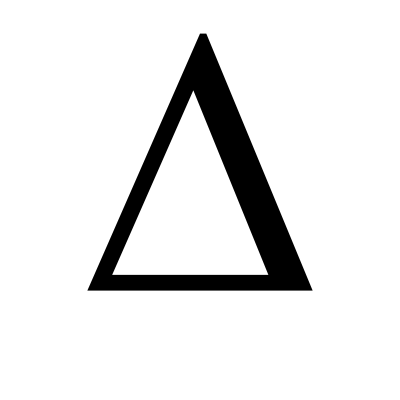 Deltax3
 Epsilonx3
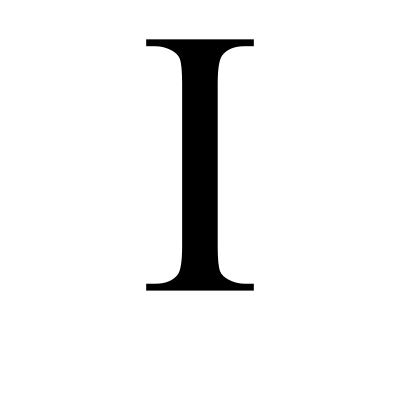 Iotax3
Ō Deime, to megethos tou kindynou ginōskō.
O Deimos, I recognize the magnitude of danger.
Your name marks the force that scatters order in a battle line.
I keep clear reason amid the noise.
I will give the threat its true size and no greater dominion.
In war, you and Phobos disturb the ranks of men.
The chariot's wheel calls for a course, not for helpless haste.
I will not magnify a threat with empty words.
Let each person near me be seen as a life to protect.
Hold my speech to what is known while the ground seems uncertain.
Identify the real scale of the concern without enlarging it through imagination.
 Nauthizx10
 Algizx10Nauthizx10
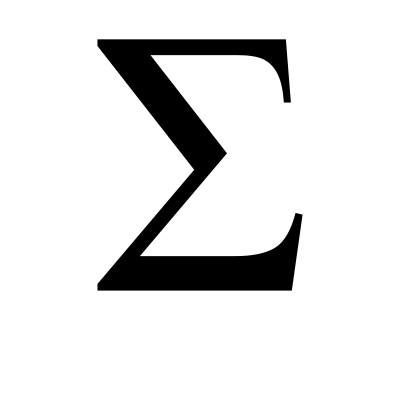 Sigmax3
 Taux3
Taux3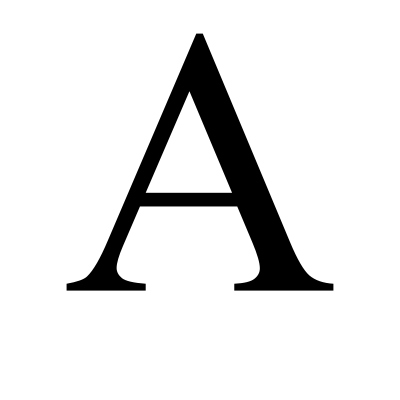 Alphax3
Ō Deime, tēn asphaleian tōn zōntōn proteron timō.
I may stop and look.
A pause can preserve the judgment that motion would scatter.
O Deimos, I honor the safety of the living first.
Let care for the living determine the order of my actions.
The halt makes room for judgment.
I will listen for the sound beneath the uproar.
I bring the mind from clamor into quiet.
May this still point allow a safer road to appear.
When it does, I will move deliberately and without shame.
Let stopping be an act of judgment, not a failure of courage.
 Raidhox10
 Othalax10Raidhox10Taux3
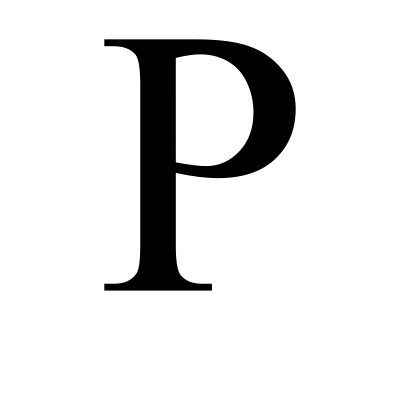 Rhox3
Rhox3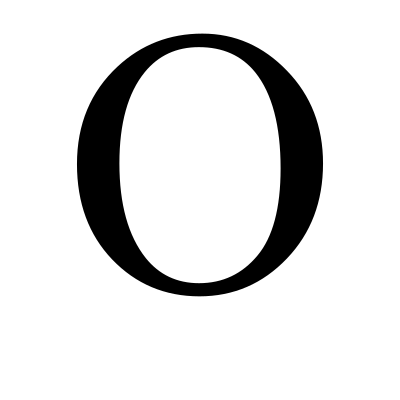 Omicronx3
Ō Deime, hē epistrophē timēn ekhei.
You and Phobos carried Ares from the battle.
Homer gives even the wounded Ares a road away from battle.
O Deimos, the return has honor.
Let the wheel carry the injured toward care.
The chariot rose toward Olympus.
Olympus receives the one withdrawn from the field.
Withdrawal does not undo courage.
I release the demand to prove strength by remaining in harm.
Deimos, show the dignity of a return that protects life.
Remember the ancient image of the wounded god borne away. Choose the path that preserves life.
 Berkanox10
 Dagazx10Berkanox10
 Gammax3
 Etax3Sigmax3
Ō Deime, pros gēn asphalē kai ta erga tou biou epanerkhomai.
O Deimos, I revere the limit you reveal.
The wheel has turned; let my attention meet the ground again.
O Deimos, I return to safe ground and to the work of life.
I will restore what can be restored with patient hands.
On safe ground I regain strength.
Strength returns through shelter, company, and measured work.
I seek help where it is needed.
I will accept sound counsel and give it when asked.
Receive this honor as I leave the tumult and attend to the living.
Name one practical support, person, or place available to you.
May all who face danger find safe company and sound counsel.
Zeus, guard safety and justice.
I return to steady action among the living.
Let the wheel turn once in thought, then become still. Feel the support beneath you. Carry the chosen practical support into the present day.
Short return if stopping early
Deimos, receive my honor. I return to safe ground. Hail Zeus.
On Deimos
Deimos, Δεῖμος, is Dread in divine person. Hesiod's Theogony 933 to 937 names him beside Phobos and Harmonia as a child of Ares and Aphrodite. With Phobos he breaks the confidence of ordered ranks in war. This shared scene does not collapse the brothers into one power. Phobos's rite addresses fear that calls for clear sight and action; this rite attends to the weight of danger and the honorable choice to stop or withdraw.
The paired figures also stand beside Ares on the shield described in the Shield of Heracles 191 to 200. The shield joins the battle image to the later narrative in which they return for their wounded father. In this rite Deimos is addressed through the second image. Dread is taken seriously as a sign that a limit may have been reached; stopping and seeking secure ground are the acts set before the speaker.
Homer's brief Iliad 15.119 places Deimos and Phobos at the horses before Ares moves. Athena arrests that movement shortly afterward, at 15.122 to 142. The ancient scene concerns the Gods and their quarrel. The rite draws one bounded human application from its sequence: a powerful impulse can be paused before it becomes a course of action.
The Chariot and the Return
The rite never instructs the speaker to enter a contest, endure a threat, or treat danger as a spiritual test. A return to safe ground can require a real person, a clear boundary, or immediate practical help. The final station gives that action a place in the prayer.
The Shield of Heracles 450 to 466 makes the return concrete. Athena has warned Ares to cease; he attacks Heracles, is wounded in the thigh, and falls. Phobos and Deimos bring his chariot, lift him from the ground, and drive to Olympus. The third station retains the whole turn: a wound is acknowledged, aid is given, and the wheel moves toward safety. The rite's return is therefore an honorable act of care, not a claim that danger has vanished.
The first station measures the threat without inflating it. The second permits a halt. The third chooses a way back. The fourth identifies a real support or person in ordinary life. These movements are a present ritual ordering of the shield poem's episode. They do not assert that the ancient text prescribed a four-part practice or a private invocation of Deimos.
The Wheel, Letters, and Prayer
The chariot wheel inside the Shenu recalls Phobos and Deimos bringing their father's chariot after Ares is wounded in the Shield of Heracles 450 to 466. Its double rim holds eight spokes around one still hub. Eight is the geometry of this drawing, not an attested sacred count for Deimos. The short gold road beneath it points toward safety and care. The capitals ΔΕΙΜΟΣ identify the addressee. This is a present liturgical construction, not an ancient seal.
The four rune groups and Greek letter groups accompany Dread, Halt, Wheel, and Ground. Their roots are ΔΕΙΜΟΣ, ΣΤΑΣΙΣ, ΤΡΟΧΟΣ, and Γῆ. The combinations and counts belong to this rite. The Greek prayers are newly composed with reference to Hesiod, Homer, and the Shield. The closing seeks safety and justice under Zeus, then ends in ordinary attention.
The wheel sits in the white center of a joined Shenu rope. Its curved upper line meets a horizontal base at a visible central knot. The Egyptian shen ring supplies the enclosing form, as documented in the Metropolitan Museum of Art’s Art of Ancient Egypt: A Resource for Educators; the wheel and outward path belong to this rite’s reading of Ares’ return.