Cocytus Power Ritual
Κωκυτός · The Heard Lament and the Work of Consolation
Before you begin
These rites are for adults. Children and teenagers must not perform them. Pregnant women should not perform them.
Read this ritual in full before beginning, follow its instructions with care, and allow the intervening day its proper quiet.
This rite may be combined with the Ritual of Hades, the God who rules the underworld.
May Zeus bless this observance, and may the Great Chthonic Gods receive our devotion in friendship and honour.
May grief be heard without being made a spectacle.
May truthful speech lead the living toward care.
Zeus, keep this work gentle, clear, and complete.
 Laguzx10
 Isax10Laguzx10
 Kappax3
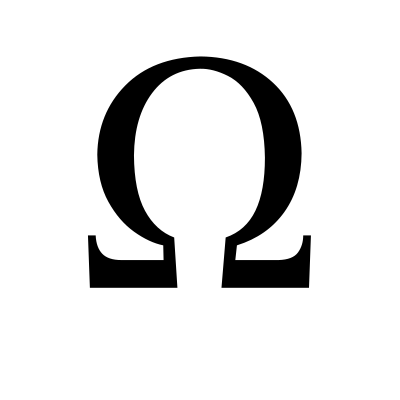 Omegax3Kappax3
Ō Kōkyte, to penthos aneu phobou akouō.
Your course is named among the deep rivers in Homer's account.
The sound of a lament deserves an ear, not a spectacle.
O Cocytus, I hear grief without fear.
Let a person speak only as much as they wish.
Let silence remain a valid language of mourning.
I will not demand that sorrow justify itself before receiving care.
The river's name may be dark, yet listening can be merciful.
Receive my honor for the truth that grief makes audible.
Listen to the natural sounds in the room, then let them rest.
 Mannazx10
 Berkanox10Mannazx10
 Pix3
Pix3 Alphax3
 Rhox3
Rhox3Ō Kōkyte, tois penthousi paramythian eukhomai.
A companion need not explain an ending in order to sit nearby.
A shared meal or a patient journey can be a greater answer than a speech.
O Cocytus, I pray for consolation for mourners.
Let help arrive in ways a person may accept or decline.
Let quiet company be offered without claiming to understand every loss.
May households have the time and practical means to tend their grief.
The cypress stands at the bank; the living have a place to stand too.
May compassion be faithful when the first solemn day has passed.
Think of one concrete way to offer or receive support.
 Tiwazx10
 Ansuzx10Tiwazx10Alphax3
 Lambdax3
 Etax3
Etax3Ō Kōkyte, to pathos en alētheiai onomazō.
Plato's river is part of a story in which wrong and response matter.
Truthful grief does not need to conceal a wrong in order to seek peace.
O Cocytus, I name suffering in truth.
Let the harmed be heard without pressure to forgive on command.
Let anyone who caused harm answer through changed conduct.
Let memory distinguish an actual event from a fearful guess.
The stone in the Shenu holds the bank steady while water moves.
May truth make compassion sounder, not colder.
Separate a known fact from an assumption, then leave both in peace.
 Raidhox10
 Wunjox10Raidhox10
 Phix3Rhox3
 Omicronx3
Ō Kōkyte, ton thrēnon eis phrontida metaballō.
A lament can remain true while the hands begin a needed task.
The task may be as plain as rest, food, a call, or a kept promise.
O Cocytus, I turn lament into care.
Let memory guide kindness to those still here.
Let sorrow have its season without ruling every season.
I thank you for the river's grave witness to mourning.
I leave the pictured bank and return to my actual home.
Zeus, bless the work of care that follows prayer.
Choose a simple act of care that asks for no spectacle.
May mourners be met with truth, company, and useful kindness.
Zeus, guide us from sorrow toward patient care.
I return to the living bank.
Look at the room and name one ordinary support available now. Use it or offer it in its proper time.
Short return if stopping early
Cocytus, receive my honor. I return to the living. Hail Zeus.
On Cocytus
Homer, Odyssey 10.508 to 515, names Cocytus as a branch of Styx flowing toward Acheron. The poetic name is associated with wailing. The rite treats this as a river image of lament, not a demand to make lament or to seek a journey into the underworld.
Plato, Phaedo 113b to 114b, gives Cocytus another course in a more elaborate story of rivers, judgment, and possible reconciliation. The third station draws from that account the importance of truthful response to injury. Homer and Plato are not silently made into one identical map.
Lament and a Living Companion
The cypress and stone in the sigil are new forms for mourning and steadiness. They are not claimed as ancient cult objects of Cocytus. The first station grants grief a hearing. The second offers practical companionship. The third keeps truth beside compassion. The fourth takes one act of care back into ordinary life.
No participant must disclose a bereavement. This is a ritual of reverent address and living responsibility, and the short return is a complete ending if the full form should feel too heavy. Consolation is requested without requiring quick relief or any display of gratitude.
The Shenu and Liturgical Letters
The Shenu holds white space around a dark blue river, with an unbroken black inner circle. ΚΩΚ marks the addressed name; ΠΑΡ points to consolation; ΑΛΗ to truth; ΦΡΟ to care. These clusters are newly chosen memory aids, not ancient river sigils or names of power.
Four station triads produce 156 voiced sounds, followed by 13 in the closing. Every station contains one short Ancient Greek sentence, a reading guide, an aligned English meaning, and a wider English prayer. The rite is complete when the speaker returns to a real source of support or offers one.
The Historical Image
View the historical artwork and its reuse record. Füssli's 1774 drawing follows Dante into a frozen Cocytus. Homer names Cocytus as a watercourse meeting Acheron, and Plato gives it another course through the underworld. The ice belongs to Dante's later literary vision. Showing this artwork with its title makes the history of reception visible without inserting the ice into the ancient Greek prayer. The rite listens to lament and seeks living consolation; it does not borrow Dante's punishment scene as a theological claim.
