Charon Power Ritual
Χάρων · Ferryman of Souls
We stand on the near bank with the river and its silence before us.
In the order of Zeus, we honor your office.
Let the living honor your labor and remember those who have crossed.
 Isax10
 Laguzx10Isax10
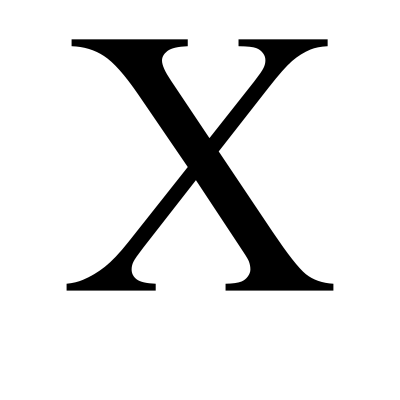 Chix3
Chix3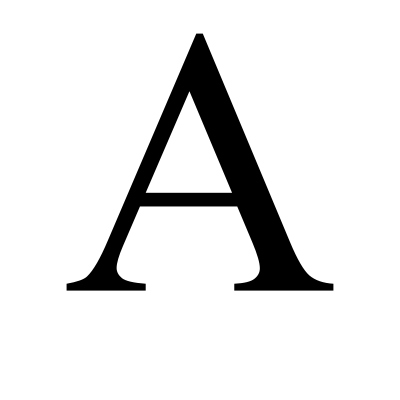 Alphax3
 Rhox3
Rhox3Ō Kharōn, epi tēs okhthēs tou Akherontos hestēkas.
O Charon, you stand on the bank of Acheron.
The bank receives the living speaker and holds the water beyond reach.
You keep the boundary and know the road.
The road before you belongs to the souls whose passage is due.
We who live stand here in reverence.
We speak their names without pretending to take their place.
We honor life and remember the departed.
Let memory deepen our care for the day entrusted to us.
O ferryman, receive this honor at the edge of your appointed work.
Keep your gaze on the near bank. Remain on this shore.
 Raidhox10Laguzx10Raidhox10
 Pix3
Pix3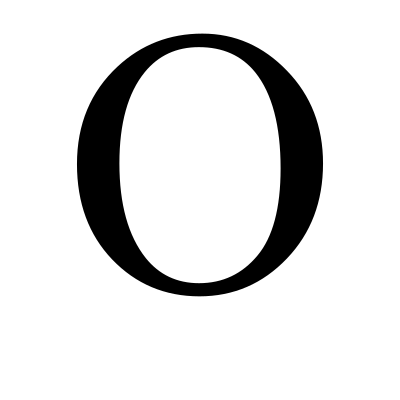 Omicronx3Rhox3
Ō Kharōn, dexai tēn timēn hēmōn epi tou peramatos.
O Charon, your vessel moves through the water.
The pole finds the riverbed and the oar answers the current.
You bring souls to the farther bank.
You give each crossing its course and do not lose the farther shore.
In your passage, the crossing has order.
Within that movement, every passenger remains a person with a name.
O Charon, receive our honor at the crossing.
Let the living honor the labor by which the dead are carried.
Receive our prayer beside the water and the vessel held steady there.
Follow the boat and its pole with your eyes.
 Mannazx10
 Ansuzx10Mannazx10
 Mux3
Mux3 Nux3
Nux3 Etax3
Etax3Ō Kharōn, genoito autois hē poreia hēsykhos.
We remember the names of the departed with honor.
Let no life be reduced to the hour of its ending.
We preserve the good that we received from them.
We keep their counsel, their kindness, and the works they left in our hands.
Their memory remains in our hearts.
The name may be spoken aloud or cherished in a silence of equal honor.
O Charon, may their journey be peaceful.
May the road appointed to them be gentle.
Charon, carry our reverence for those whose faces we remember.
Speak the name of someone departed once, or hold the name in silence. You may also remain silent.
 Algizx10Isax10Algizx10Omicronx3Rhox3
 Iotax3
Ō Kharōn, to perama horion estin alēthes.
O Charon, the crossing is a true boundary.
The river has a near bank and a farther bank; I know where I stand.
Before you, we acknowledge fear.
Fear may be named plainly while the feet remain firm.
With courage, we carry out the work of the living.
Courage begins with care for those who share this day with us.
We honor the boundary and take up the present day.
The present hour asks for a deed, a word, and a faithful return.
Keep the crossing in your charge, Charon; we honor it from this shore.
Look at the inside and outside of the ring. Let the boundary remain clear.
 Dagazx10
 Othalax10Dagazx10
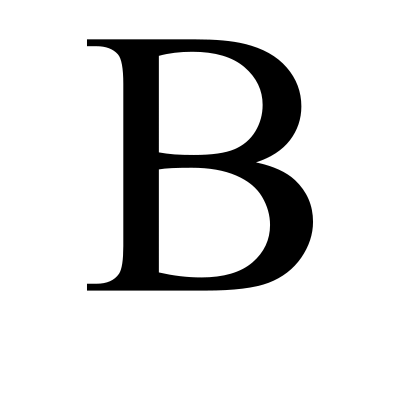 Betax3Iotax3Omicronx3
Ō Kharōn, dexai tēn eukhēn kai tēn timēn hēmōn.
O Charon, receive our prayer and honor.
The ferry stays in its own water as our steps turn homeward.
We step away from the bank.
Let our grief find a dwelling in remembrance and service.
We return to the light and to the work of the living.
Daylight reveals the people and the duties still waiting for us.
The boundary remains clear; remembrance remains faithful.
No name treasured here is lost when we return to life.
Hail, Charon, keeper of the crossing.
Receive this completed rite, and let the boundary stand clear.
We go from the river with reverence, steadiness, and open hands.
See the boat remain at the river. Turn your attention toward daylight.
You guard the crossing and ferry the souls.
May each departed name be held with dignity among the living.
In the order of Zeus, we honor you.
We return to life.
The water remains behind us; the present day opens before us.
Hail, Charon. Hail, Zeus.
Look once more at the empty ferry within the Shenu ring. Let the names remembered in this rite rest in your heart. See the river remain behind you as your attention returns to the light of the present day. Rest your hands, notice the room, and return to ordinary activity.
Short return if stopping early
Charon, receive my honor. I return to the work of the living. Hail Zeus.
On Charon
Charon, Χάρων, holds a particular office at the boundary of death: he is the ferryman. He is neither the lord of Hades nor the judge of the dead. In Euripides' Alcestis 252 to 259, Alcestis, near death, sees the boat on the water and Charon urging her to come. The scene gives his summons urgency, yet places him at the oar. This rite honors that office without asking the living practitioner to make the crossing.
Pausanias, Description of Greece 10.28.1 to 4, records Polygnotus's painting of the underworld at Delphi. The water resembles Acheron, with reeds and fish so faint that they seem like shadows. Charon sits at the oars of a boat carrying named passengers, Tellis and Cleoboea. Pausanias compares the aged ferryman in the painting with the older poem called the Minyad. This witness joins river, vessel, passengers, and ferryman in one visible scene. The empty ferry in the sigil is a new ritual choice: the living speaker remains on the bank.
In Seven Against Thebes 854 to 860, Aeschylus's chorus imagines a black-sailed ship crossing Acheron to a sunless shore while mourning the dead brothers. The ferryman is not named in those lines, so the scene is a witness to the passage and its lament rather than a separate account of Charon's identity. Beside Alcestis's urgent vision, it gives the rite two ancient voices: one facing the imminent crossing, the other accompanying the dead with grief and honor.
Acheron, the Boat, and the Fare
Acheron is named here because Pausanias places the painted boat upon it. Virgil's Aeneid 6.295 to 336 also leads Aeneas to Acheron's waters and presents Charon as the keeper of the ferry. The Sibyl distinguishes the buried dead, who may cross, from the unburied, who remain on the bank. That is the rule of Virgil's poem, not an instruction to perform a modern funerary act. The water bowl in this rite represents the boundary only. Its still surface reminds the living speaker where to stand.
Aristophanes' Frogs 136 to 142 and 180 onward gives another register: Dionysus is told of a small boat and a two-obol fare, then meets Charon on stage and rows across. The comic fare should not be turned into a universal rule for every ancient account. The rite therefore makes no payment demand. It gives its attention to the passenger's dignity and to truthful remembrance. At the third station a name may be spoken once, or held silently.
Charon in Funerary Art
An Attic white-ground lekythos of 440 to 430 BCE, National Archaeological Museum, Athens, inventory A1926, shows Hermes Psychopompos bringing a young woman to Charon at Lake Acherusia. Charon holds his boat against the shore with a pole; Hermes stands apart as the divine guide who delivers her. The museum describes Charon here as a man of toil, wearing an exomis and a leather cap, and observes that funerary paintings vary his age and features. The rite's pole and near bank recall this attested image. Its empty vessel keeps the living practitioner outside the ancient scene.
The Shenu Ring and Sat
The Egyptian shen sign is a loop of rope associated with encircling and protection, as described in the Metropolitan Museum of Art's Art of Ancient Egypt: A Resource for Educators and the British Museum's account of the shen ring. In this newly composed sigil it encloses Charon's ferry. The use of an Egyptian form here is a modern liturgical choice, not a claim that a Greek painter put a shen around Charon.
The four inscriptions outside the ring read सत्, sat. The Monier-Williams Sanskrit-English Dictionary, under sat, includes the senses being, real, and true. Their placement at the four sides is likewise a new construction. They call the eye back to the reality of the boundary and the truth owed to those remembered.
The Charon Sigil
The five Greek capitals Χ Α Ρ Ω Ν spell Charon's name around the inner design. Below them stand the two banks, the water, the empty ferry, its pole, and its oar. The vessel is empty because the living speaker remains on the near shore. Its course belongs to Charon and to the souls he carries. The white interior keeps the boat, name, and banks distinct within the engraved black and gold ring.
The Five Stations
The Shore establishes the speaker's place. The Vessel gives attention to Charon's work. The Names Remembered holds the departed in honor. The Boundary acknowledges the passage without crossing it. The Return turns the living speaker toward daylight and present duties. Each station ends with a pause at the sigil, allowing its prayer to settle before the next movement begins.
Runic Triads
The rune sequence changes with the action of each station. Isa, Laguz, Isa holds stillness beside the water at the Shore. Raidho, Laguz, Raidho carries the sense of a route across the Vessel's water. Mannaz, Ansuz, Mannaz gives the Names Remembered a human voice. Algiz, Isa, Algiz holds the Boundary. Dagaz, Othala, Dagaz brings the Return to daylight and home. Each rune is vibrated ten times in its printed position.
Greek Sacred Letters
The five letter groups follow the rite's path: ΧΑΡ from ΧΑΡΩΝ, Charon; ΠΟΡ from ΠΟΡΘΜΕΥΣ, ferryman; ΜΝΗ from ΜΝΗΜΗ, memory; ΟΡΙ from ΟΡΙΟΝ, boundary; and ΒΙΟ from ΒΙΟΣ, life. Each letter is sounded by its full name three times. The sequence begins with the ferryman's name and closes with the life to which the speaker returns.
The Prayers and Closing
Each station moves from sound to a prayer addressed to Charon by his familiar name and ferryman's office. The Shore honors his place, the Vessel his work, the Names Remembered those he carries, the Boundary the passage, and the Return the life of the speaker. The closing vibrations and final prayer follow the Return. The last spoken names are Charon and Zeus, and the final contemplation leaves the river behind.
The Greek Invocations and Prayers
At each station, one newly composed Greek sentence carries the central act of the fuller English prayer. Its reading guide and English meaning stand beside it. The river scenes and Charon’s office rest on the ancient witnesses cited above; the station invocations are words composed for this rite.