Acheron Power Ritual
Ἀχέρων · The Confluence and the Honored Crossing
Before you begin
These rites are for adults. Children and teenagers must not perform them. Pregnant women should not perform them.
Read this ritual in full before beginning, follow its instructions with care, and allow the intervening day its proper quiet.
This rite may be combined with the Ritual of Hades, the God who rules the underworld.
May Zeus bless this observance, and may the Great Chthonic Gods receive our devotion in friendship and honour.
Homer names the waters that meet at your course.
Let their meeting teach me to honor a boundary and to keep a safe shore.
Zeus, guide my attention back to the living at the rite's end.
 Laguzx10
 Eihwazx10Laguzx10
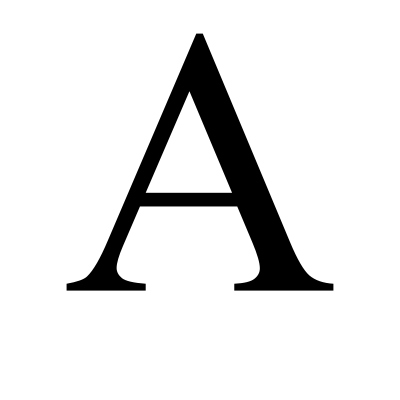 Alphax3
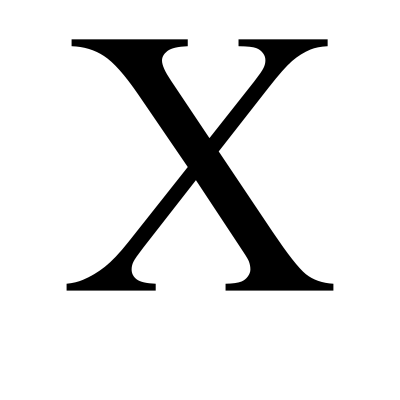 Chix3
Chix3 Epsilonx3
Ō Akheron, tēn synodon tōn hydatōn en timēi horō.
Circe directs Odysseus toward the place where deep rivers join.
Your name stands at the meeting of distinct currents.
O Acheron, I behold the meeting of waters with honor.
Let different griefs be allowed different voices.
Let two people meet without one swallowing the other's story.
Let the moving water teach a patient sense of relation.
I praise the deep course without claiming its passage for myself.
The confluence is enough to contemplate from this bank.
Think of a meeting that requires listening to more than one voice.
 Isax10
 Algizx10Isax10
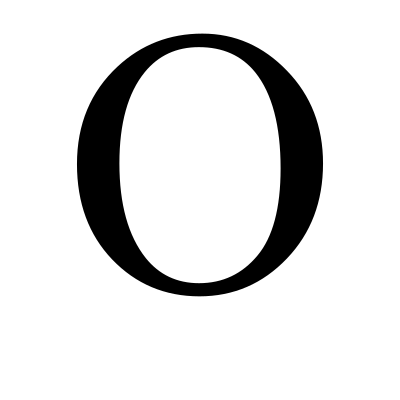 Omicronx3Chix3
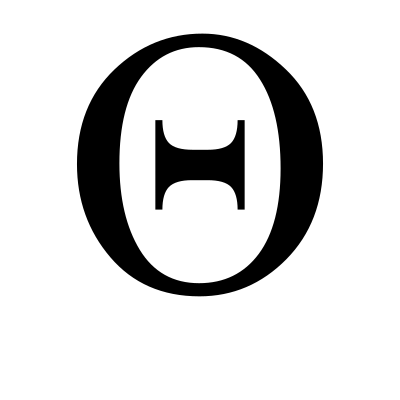 Thetax3
Ō Akheron, tēn okhthēn tōn zōntōn phylassō.
A shore gives a river shape and the traveler a place to stand.
My place in this rite is on the living bank.
O Acheron, I keep the bank of the living.
Let remembrance cross my thoughts without displacing my duties.
Let the boundary protect the dignity of those beyond it.
Let a mourner receive company here, in the world of breath and bread.
No name is needed to compel an answer from the dead.
I honor the river by respecting its bank.
Feel the support beneath your body and name one living duty.
 Raidhox10
 Othalax10Raidhox10
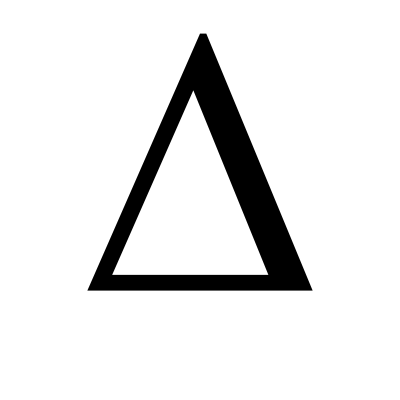 Deltax3
 Iotax3Alphax3
Ō Akheron, pasa diabasis meta timēs noeisthō.
Poets place a boat upon these waters and speak of a passage.
Their images have helped generations give form to farewell.
O Acheron, let every crossing be conceived with honor.
Let no person be reduced to a fare or a burden.
Let family and friend speak of a whole life with accuracy and love.
Let the living attend to lawful burial and remembrance where these are theirs to give.
The boat in the Shenu carries no demanded passenger.
My petition is for dignity, not control over a soul.
Hold the idea of dignity without picturing an individual crossing.
 Berkanox10
 Dagazx10Berkanox10
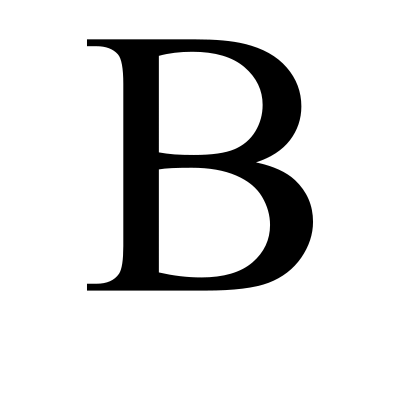 Betax3Iotax3Omicronx3
Ō Akheron, pros ton bion epanerkhomai.
The river remains in its ancient story; I stand in my present room.
Here are hands that can prepare food and words that can comfort.
O Acheron, I return to life.
Let me not abandon living kin in the name of contemplating the dead.
Let memory encourage care without demanding a vision.
I thank you for the grave beauty of a boundary honestly kept.
The waterline ends in the gold base of the Shenu.
Zeus, guide this return to humane work.
Choose one act for a living person or one neglected duty.
May every farewell be marked by dignity and truthful memory.
Zeus, bless those who remain and those who care for them.
I stand again upon the shore of life.
Look away from the river image. Notice three things in the room and take the chosen action.
Short return if stopping early
Acheron, receive my honor. I stand on the living shore. Hail Zeus.
On Acheron
Homer, Odyssey 10.508 to 515, puts Acheron at the place where Pyriphlegethon and Cocytus join it. Circe's instructions belong to Odysseus' epic journey, not to this reader's practice. The present rite takes only the confluence and shore as contemplative images; it contains no pit, sacrifice, inquiry of a shade, or attempt to imitate the ancient episode.
Plato, Phaedo 113a and 113d to 114a, offers a different account in which Acheron runs toward the Acherousian Lake and souls arrive there for judgment and purification. That philosophical geography grounds the third station's concern for dignity. It does not establish a uniform map shared by all ancient authors.
The Boat and the Bank
The unoccupied boat is new ritual art. It recalls the wider ancient ferryman tradition, but this rite does not repeat Charon's separate office or demand a fare. The bank is the key to the action: the speaker stays among the living, offers remembrance, and then returns explicitly to an ordinary task.
Homer's meeting of rivers and Plato's lake are distinct ancient scenes. Their shared name, Acheron, gives this page a subject; their differences remain visible in the notes. The four stations name meeting, boundary, honorable passage, and a living return.
Shenu, Letters, and Sound
The Shenu's black inner circumference is continuous around a white field. Three gold waterlines meet below a small boat, and none breaks the enclosing ring. ΑΧΕ, ΟΧΘ, ΔΙΑ, and ΒΙΟ are the station letters for Acheron, bank, crossing, and life. The design is a present symbolic construction, not an ancient seal.
The runes and letter names are spoken in a fixed four-station order, totaling 156 sounds before the 13 closing sounds. Each newly composed Greek line appears once with a reading guide, then reappears in meaning as one line of the full English prayer. The final action keeps the rite's return concrete.
The Historical Image
View the historical artwork and its reuse record. Hirémy-Hirschl's 1898 canvas gathers souls along Acheron's bank in a later painter's vision. The river is named in the work's title, so the image is more direct than a general underworld scene, although it is not ancient Greek testimony. Homer and Plato, cited above, carry the ancient river geography. The page's boat and cypress belong to its Shenu design; the painting is offered as a historical act of artistic remembrance, never as recovered ritual iconography.
