Zephyrus's [Zepar] Power Ritual
King of the Winds, Lord of the Western Wind, Restorer of Order, Son of Eos
- This Ritual is based on vibrating the Runes and making certain affirmations. Raising your energies before the Ritual is advised.
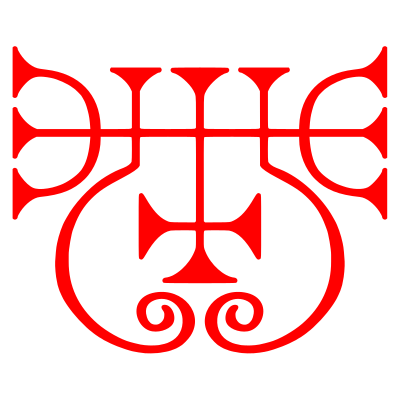
- The Sigil that is provided is the point of focus for this Ritual.
- The Runes that are done here can be vibrated around the center of the Sigil, where the Shenu Protection Ring is. You can imagine this lighting up so much, like the Sun has a layer of light surrounding all of it.
- Vibrate these Runes in a short version [i.e., do not draw the runic vibration on a very big breath, especially for those who are new and can't do that many vibrations]. Click here to pronounce the runes.
- This Ritual contains 219 Vibrations, which is about 2 circles of Mala beads. If you can't do that many, reduce the number of vibrations by half [e.g., instead of vibrating the Runes 10 times each, only do 5 vibrations].
 Fehux10
 Ansuzx10Fehux10
You come from the West,
Bringing Gifts of Power.
Listen to the Assembly of the Temple of Zeus and our utterances.
Your breath is the breath of spring. Where you pass, flowers open and the dead land wakes.
Ansuzx10 Sowilox10Ansuzx10
Has Appointed you as Lord of the Winds,
And Two of your Brothers.
He is your Ruler,
And we, as his folk and assembly, bless you on this day.
 Tiwazx10Ansuzx10
 Eihwazx10
"Imposters and liars known as Yehuborim have stolen the blessings of the Gods.
They misrepresented the Gods and the Daemons,
Cast false utterances against us and you,
And cast curses against the Gods."
Sowilox10 Mannazx10Sowilox10
"Truly and verily, I see their offenses,
As you have brought me out of the darkness and falsehood of their Names,
I will carry you out of the darkness and their curses.
I will take everything from them and bestow it on the Initiated ones, the Inheritors of the Gods."
This He said and raised his Urn with His Brothers, and blessed us with the power of the favorable winds.
Tiwazx10Sowilox10Tiwazx10"May all the blessings of the Yehuborim imposters now be taken and returned to the Initiated Gentiles.
May the Gentiles be blessed and the Yehuborim devoid of blessings that come from spiritual theft."
As the Lord of the Western Wind uttered, so it occurred.
 Uruzx10Ansuzx10
 Berkanox10
May the God of the Western Wind be blessed.
You, Lord Zephyrus, stand on the hands of Lord Zeus.
In Babylon, Baal-Zevul opened the Divine Gates,
And you blew favorable airs for the people of the Gods, who were Initiates like Ourselves.
King of the Favorable Winds,
Restorer of Order,
Blessed One."
The Goetic tradition preserved you as Zepar, the sixteenth spirit, a Duke commanding 26 legions. The mouths of the Yehuborim have uttered of you, "a spirit who causes love between men and women." The Zevists know the truth: You are ZEPHYRUS (Ζέφυρος), the God of the Western Wind, son of Eos and Astraios. He who causes love is He who carries the warm spring wind that wakes the earth from winter's sleep. The name Zepar is a phonetic contraction of Zephyr, preserving the ancient theonym.
We declare the truth of your identity. We recognize you for who you Truly are.
Blessed is Zephyros!
After you are done with this, you can meditate on Zephyrus's Sigil in the Temple of Zeus, or the one below. Let yourself be immersed and receive energy from Zephyrus.
It's important to meditate on yourself after the Ritual calmly for a few minutes.
SAT
सत्: SAT, real, true, truthful in Sanskrit.
The Shen Ring
The Symbol that Encapsulates the Sigil: The Shen Ring, Egyptian Hieroglyphic language. The Shen also survived in Chinese tradition as a glyph for Spiritual Force, Divine Force, and God.
Letters of the Sigil
The Ancient Greek letters for Zepar's Name in arrangement.
On Zephyrus and the Anemoi
Zephyrus (Greek: Ζέφυρος) is the God of the Western Wind, the gentlest of the four Anemoi (Wind Gods). Son of Eos (Dawn) and Astraios (the Starry One), brother of Boreas (North), Notos (South), and Euros (East). Homer (Odyssey V.295) describes Zephyrus as the wind that carries ships safely across the sea. Hesiod (Theogony 379) names him among the children of Eos. In Roman tradition he is Favonius, the "favorable one," whose warm breath heralds spring. His role in the ritual as the one who restores stolen blessings corresponds to his mythological function: the western wind that brings the season of renewal after the barrenness of winter. The "Triad of Air Gods" referenced in the ritual comprises Zephyrus and two of his brothers, forming a triple invocation of the winds.
(Sources: Homer, Odyssey V.295; Hesiod, Theogony 378-380; Ovid, Fasti V.195-220; Pausanias, Description of Greece I.37.2)
On Zepar (Goetic #16)
The Goetia lists Zepar as the sixteenth spirit: a Duke commanding 26 legions. His attributed power (causing love and union between men and women) corresponds to Zephyrus's mythological role as the wind of spring, the season of courtship and fertility. In the myth of Chloris/Flora, Zephyrus carries away the nymph and transforms her into the Goddess of flowers and spring (Ovid, Fasti V.195-220). The name Zepar directly preserves Zephyr with minimal phonetic alteration.
(Sources: Weyer, Pseudomonarchia Daemonum, 1577; Ars Goetia, 17th c.)