Valerefontis's [Valefor] Power Ritual
He Who Tamed the Pegasus, King of Healing Powers, Great Healer of Mortals, Head of Myriads of Healing Powers, Protector of Mind, Soul, Flesh, and Spirit
- This Ritual is based on vibrating the Runes and making certain affirmations. Raising your energies before the Ritual is advised.
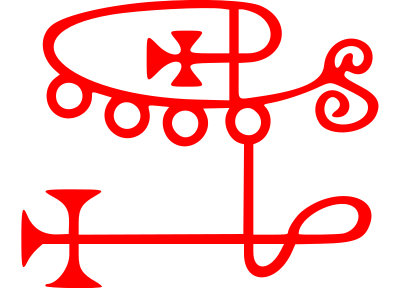
- The Sigil that is provided is the point of focus for this Ritual.
- The Runes that are done here can be vibrated around the center of the Sigil, where the Shenu Protection Ring is. You can imagine this lighting up so much, like the Sun has a layer of light surrounding all of it.
- Vibrate these Runes in a short version [i.e., do not draw the runic vibration on a very big breath, especially for those who are new and can't do that many vibrations].
 Fehux10
 Sowilox10
 Kenazx10
You are one Great Healer of Mortals.
Teach us humility, heal us from pointless arrogance, and keep us on the path of the Gods,
For we remember your Great deeds!
Heal us and approach us in friendliness, for the Temple of Zeus is of Zeus, and we present ourselves in His Glory!
You who mounted the winged horse and soared above the clouds: lift us now above the sickness that pins us to the earth.
 Algizx10
 Tiwazx10Sowilox10
You ward off illness of the mind, the body, and the spirit.
Certain is your healing of pain and peril.
Remove all ignorance from our minds, and absolve us of false arrogance,
Because you have uttered:
"Blessed are the lots of all Zevists, preach their Great Works to all the Nations!"
O Valefor, lead us to health of soul by your blessings!
The mouths of the Yehuborim called you "a tempter to thievery," but you steal nothing: you return to us what disease has taken. You are the thief who robs illness of its power.
 Dagazx10
 Eihwazx10Sowilox10
Now you are Glorified by all the knowers of your Divine Name.
Head are you of myriads of healing powers;
You protect the mind, the soul, the flesh, and the spirit!
As Bellerophontes, you rode across the sky and slew the Chimaira. The monster of disease, the fire-breathing beast of affliction, falls beneath your spear as it fell then.
Dagazx10Eihwazx10Sowilox10We, Zevists, pay homage to you,
We are among the receivers of your greatest blessings.
Your Name itself is a medicine: Vale, "be well," echoes in every syllable. You are the God whose very Name is a prescription for health.
The Goetic tradition preserved you as Valefor (also Valefar and Malafar), the sixth spirit, a Duke commanding 10 legions, appearing as a lion with the head of a donkey. The mouths of the Yehuborim have uttered of you, "a spirit who tempts people to steal." The Zevists know the truth: You are VALEREFONTIS, the Greek Bellerophontes (Βελλεροφόντης), the hero-king who tamed Pegasus with the golden bridle given by Athena and slew the Chimaira. He who "tempts to steal" is He who steals disease from the body and ignorance from the mind. The lion is the solar beast of courage; the donkey head is the beast of patient labour. Together they form the image of the Healer who fights with the ferocity of a lion and serves with the endurance of a beast of burden.
We declare the truth of your identity. We recognize you for who you Truly are.
Great is your power, your kingship, and your control.
When your name is uttered, VALEFOR, Great God,
The darkness of disease disappears.
The healing power of your names is powerful; you hold the power of disease and of health in the aeons.
You free and uplift us all through the wellspring of regeneration and great health.
We are blessed by you, Great Valerefon.
VALEFOR, MALAFAR, VALEFAR, VALLEREFONTI, VALEREFON, KING OF HEALING POWERS, THE TEMPLE OF ZEUS SALUTES YOU!
After you are done with this, you can meditate on Valerefontis's Sigil in the Temple of Zeus, or the one below. Let yourself be immersed and receive energy from Valerefontis.
It's important to meditate on yourself after the Ritual calmly for a few minutes.
SAT
सत्: SAT, real, true, truthful in Sanskrit.
The Shen Ring
The Symbol that Encapsulates the Sigil: The Shen Ring, Egyptian Hieroglyphic language. The Shen also survived in Chinese tradition as a glyph for Spiritual Force, Divine Force, and God.
Letters of the Sigil
The Ancient Greek letters for Valefor's Name in arrangement.
On Valerefontis and Bellerophon
The ritual identifies Valefor with Bellerophon (Greek: Βελλεροφόντης, Bellerophontes), the Corinthian hero-king who tamed the winged horse Pegasus with a golden bridle given by Athena (Pindar, Olympian XIII.63-92) and slew the fire-breathing Chimaira (Homer, Iliad VI.155-195). The name Valerefontis is a Latinized form of Bellerophontes, preserving the original through phonetic shift (B→V, a common Latin-Greek interchange). The Goetic names Valefor, Valefar, and Malafar are further contractions of this same theonym. The Latin root vale ("be well, be strong") embedded in the name connects Bellerophon's heroic identity to his healing function: the hero who conquered the Chimaira (disease in its triple form: lion-head for ferocity, goat-body for chronic persistence, serpent-tail for hidden venom) is the divine physician who conquers illness in all its manifestations.
(Sources: Homer, Iliad VI.155-195; Pindar, Olympian XIII.63-92; Apollodorus, Bibliotheca II.3.1-2; Weyer, Pseudomonarchia Daemonum, 1577; Ars Goetia, 17th c.)
On Valefor (Goetic #6)
The Goetia lists Valefor as the sixth spirit: a Duke commanding 10 legions, appearing as a lion with the head of a donkey (or a many-headed lion). His attributed power of "tempting people to steal" is a Yehuboric inversion of his true function: the God who steals disease from the body, who robs affliction of its hold on the flesh, who takes away what harms and returns what heals. The lion form preserves the solar heroism of Bellerophon, and the multiple heads may recall the multiple heads of the Chimaira he slew: the healer who has conquered a multi-headed disease carries its image as a trophy.
(Sources: Weyer, Pseudomonarchia Daemonum, 1577; Ars Goetia, 17th c.)