The Grand Ritual of Zeus
Deus Patar, King of the Heavens, Father of Fathers, He Who Is, Was, and Ever Will Be
- This Ritual is the Ritual we perform for our God. It is long, powerful, and deeply meaningful. As we've explained on the Temple of Zeus website, our God has been known by many names and aliases and has been universally revered throughout the ages.
- This Ritual will reveal to you the power of our God, honor and sanctify all His Identities, and affirm that He is the God of Gods, without equal, without predecessor, and without successor. Each Name is an aspect of His divine Identity. He who exists beyond all of this is the Creator, the Unfathomable.
- Within this Ritual, other sacred rituals of the Gods are also contained. They are placed in the context of this mythical ritual, which will speak directly to your soul and your being, giving you clarity and insight.
- This Ritual is based on vibrating the names of Zeus and making certain affirmations. Raising your energies before the Ritual is advised.
- The Sigil that is provided is the point of focus where this Ritual is upon.
King of the Heavens,
Bearer of the Bolt, Weaver of the Universe,
You who transcend Time and Space,
You who pervade all consciousness and Life, both existing and yet to come.
Father of Fathers, Deyus Pater,
You who exist everywhere and within all things.
You are the Ultimate, the Truth, the All,
That which Is, Was, and Ever Will Be.
We approach You humbly,
O Greatest King of Kings.
You are invoked by the Assembly of the Temple of Zeus,
As we prostrate ourselves before Your Eternity,
Before Your boundless Knowledge and infinite Wisdom.
Hear our honest prayer.
O Zeus, You who gathers and unites all things.
O Dias, You who divides and severs as required, who decides the fates of Gods and Men.
O Zina, You who creates and gives life from the Eternal Aether.
Trine are the Names of Power before which we prostrate ourselves.
We follow Your Divine Dictates.
Bless us and uphold us, Your Children and Initiates.
Blessed is Your Victory, and blessed are we in being victorious,
For the Romans believed in You, and they were blessed with great power.
You created Yourself, arising from the Eternal,
Bringing forth Eternity itself.
Great Amun, Ammonas, many are Your Names,
Yet Your Eternal Power remains constant.
We recognize You, we revere You, and we request Your Blessing in all forms.
Blessed is Your Eternity.
Blessed are Your Powers.
 Ansuzx10Ansuzx10Ansuzx10
and they called You ANU, Lord of the Sky, King of the Gods.
You decreed the fates of Gods and Men.
The clay tablets preserved Your name for five thousand years.
The ziggurats rose toward You, step by step, earth reaching for sky.
You who wore the horned crown before crowns were forged,
You who set the constellations in their courses:
we speak Your name again, and the sky remembers.
IAO ANU ANU ANU IAEO
Great Eternal Lord, we also call You Indra.
You wield the Thunderbolt that shakes the Aether,
The indomitable and supreme force of Command.
When You arise, even the Gods ask among themselves:
"Who wields more power than Indra?
Who proceeds in power without His Divine Decree?"
Blessed are Your Three Names: Brahma, Shiva, and Vishnu.
You shall maintain and create us, Vishnu.
You shall destroy what is dangerous and perilous for us, Shiva.
You shall guide us to Wisdom, Brahma.
Blessed is Your Tripartite Nature, in which the Three are equal to the One.
As humanity lost its way and inverted its path,
You set them straight by inverting Yourself to lead the pious and wise to enlightenment in the falling Age.
You remained with humanity as an eternal symbol, never departing from our conscience or presence,
And Your Will has been thus:
"Let those who do not corrupt themselves in the Age of the Fallen
Reach Me through the form of the Fallen, so that they might Rise."
You sat upon the Eternal Throne,
Bestowing Knowledge and Wisdom from the Throne of the Darkness during the Dark Age of Man, which is now passing.
Wherever You appear, in any form,
You bring Wisdom, Blessings, and Triumph.
The Initiates have uttered Your Name, Baal-Zevul, You who were even called "The Devil."
For You are the bringer of the Nous, the Mind, the Soul, the Spirit; the ability to think in Divine Noetic capacity.
You guide even the misguided and unenlightened toward the Eternal Path.
An Age of Ignorance, You shall end and transform into the Age of Wisdom,
With a force mighty and purifying.
All of Humanity shall say: "Now, we see the Great God of Gods."
For You are the Great God of Thunder, the Baal of Baals, the King of Kings,
And Your people love and revere You in this form as well.
A gift of Yours, Great God, is bestowed upon us.
The Light of Eosforos, the Light Bringer, is the shining bolt of Your Wisdom,
Striking like lightning, illuminating us all.
IAO ANU ANU ANU IAEO!
Great Odin, Master of Wisdom,
The peoples of the North have worshipped You and called You Wodan.
You are known as their Father, and the Father of all Fathers, of Gods and Men.
You taught us the value of sacrifice in pursuit of Knowledge,
And we rejoiced in the revelation of Your power and mysteries.
Perun, they also called You,
You who strikes with violence the intruder and the sinner, reducing them to ash.
For the Gods beheld Your Justice and Power,
And no man nor God could resist Your Divine Justice.
You will crack the heavens open;
Your rain shall nurture us,
Your thunder shall enliven us,
And Your wisdom shall purify us.
The people shall speak to You in their own tongues and call You by many names:
Hadad, Hammon, An Daghdha, these are your Names of Power, uttered in reverence.
Heavenly Marduk, Lord of An, Dweller in the Sky.
Raijin, Lord of Thunder and the Skies.
Thor, Zamolxis, Shango, Tarhunt, Tinia, Tlaloc, Viracocha,
Great Tengri, who leads the East and upholds its peoples.
Lightning Power, Perkunas, You who shine forth and burn away all impurity.
As I utter Your Names, allow me to see the You within You.
Grant me, and all the people of the Temple of Zeus, Your approval,
To be accepted as Your children and Your Initiates.
O Greatest One, these are but some of Your Names,
For Your Names beyond Names remain secret.
I am Your Initiate.
And You are the King of all Gods and Daemons,
Older than all, the Source of all,
The Eternity of all things, seen and unseen.
Strongest and mightiest, brightest and most supreme,
You are He who is unfathomable, beyond all measure.
We pray that You uphold us on the Path,
Bless us with courage, health, riches, spiritual enlightenment, and True Guidance.
For we, the People of the Temple of Zeus, are those who bring You forth,
The heralds of the Golden Age, each in our roles, each in our missions,
Yet united as One, we revere You, O Greatest One.
May Your Kingdom of Humanity, Gods, and Daemons be blessed,
In the upper world, the middle world, and the underworld.
We prostrate ourselves; bless us all with Your love and favor,
And be our benefactor in all things.
We hail You, Eternal One.
After you are done with this, you can meditate on Zeus's Sigil in the Temple of Zeus, or the one below. Let yourself be immersed and receive energy from Zeus.
It's important to meditate on yourself after the Ritual calmly for a few minutes.
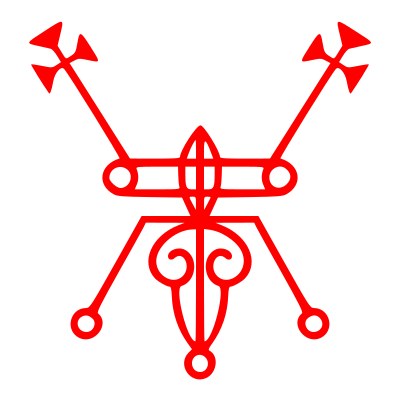
SAT
सत्: SAT, real, true, truthful in Sanskrit.
The Shen Ring
The Symbol that Encapsulates the Sigil: The Shen Ring, Egyptian Hieroglyphic language. The Shen also survived in Chinese tradition as a glyph for Spiritual Force, Divine Force, and God.
Letters of the Sigil
The Ancient Greek letters for Zeus's Name in arrangement.
On Zeus across Traditions
The name Zeus derives from Proto-Indo-European *Dyēus Pḥ₂tēr ("Sky Father"), the reconstructed supreme deity of the PIE pantheon. This root survives across nearly every Indo-European language: Latin Iūpiter/Deus, Vedic Dyáuṣ Pitṛ́, Lithuanian Dievas, Old Norse Týr, Albanian Zojz, Hittite šiuš. The word "God" in Romance languages (Dieu, Dios, Deus) descends from the same root that gives us "Zeus." This is not a theological claim but a documented fact of historical linguistics.
(Sources: Sihler, New Comparative Grammar of Greek and Latin, 1995; Fortson, Indo-European Language and Culture, 2010; Mallory & Adams, Encyclopedia of Indo-European Culture, 1997; Beekes, Etymological Dictionary of Greek, 2010)
On ANU
Anu (Sumerian: 𒀭𒀀𒉣, An, "Heaven") is the supreme sky-god of the Sumerian, Akkadian, Babylonian, and Assyrian traditions. Father of Enlil (Lord of Command) and Enki (Lord of Wisdom), he ruled from the E-anna ("House of Heaven") in Uruk. His role as the distant, sovereign sky-father who decrees the fates of gods and mortals directly parallels Zeus/Jupiter/*Dyēus. The horned crown of divine authority (aga) was his attribute, later inherited by all Mesopotamian deities.
(Sources: Enuma Elish; Lambert, Babylonian Creation Myths, 2013; Black & Green, Gods, Demons and Symbols of Ancient Mesopotamia, 1992)
On Bael (Goetic #1)
The Goetia lists Bael as the first of the 72 spirits: a King ruling over 66 legions, appearing in various forms. The name Bael derives from Ba'al ("Lord"), the Semitic title of the supreme sky-god. Baal-Zevul (Βεελζεβούλ in the Septuagint) means "Lord of the Heavenly Dwelling" (Ba'al Zebūl), a title systematically inverted by later traditions into "Beelzebub" ("Lord of Flies") as an act of deliberate desecration. The first Goetic spirit is, in truth, the first God: the Sky Father under his Semitic name.
(Sources: Herrmann, "Baal" in Dictionary of Deities and Demons in the Bible, 1999; Weyer, Pseudomonarchia Daemonum, 1577; Ars Goetia, 17th c.)
On the Vowel Series (I-A-O-E)
The vibration of vowel sequences is attested in the Greek Magical Papyri (PGM) as a technique for invoking the planetary powers and the supreme deity. Each vowel corresponds to a celestial body and a mode of divine expression: Ι (Iota) = the Sun, Α (Alpha) = the Moon, Ω (Omega) = Saturn, Ε (Epsilon) = Mercury. The sequence I-A-O (ΙΑΩ) is the most ancient Greek form of the supreme divine name, identified by Macrobius (Saturnalia I.18) with Zeus himself. The closing vowel series of this Ritual echoes the PGM practice of sealing invocations through the complete spectrum of divine sound.
(Sources: Betz, The Greek Magical Papyri in Translation, 1986; Macrobius, Saturnalia I.18; Dornseiff, Das Alphabet in Mystik und Magie, 1925)