Seshat's Power Ritual
Seven-Horned Goddess, Queen of Scribes, Heavenly Lady of Knowledge, She Who Writes the Fates
- This Ritual is based on vibrating the Runes and making certain affirmations. Raising your energies before the Ritual is advised.
- The Sigil that is provided is the point of focus for this Ritual.
- The Runes that are done here can be vibrated around the center of the Sigil, where the Shenu Protection Ring is. You can imagine this lighting up so much, like the Sun has a layer of light surrounding all of it.
- Vibrate these Runes in a short version [i.e., do not draw the runic vibration on a very big breath, especially for those who are new and can't do that many vibrations]. Click here to pronounce the runes.
- This Ritual contains 183 Vibrations, which is about 2 circles of Mala beads. If you can't do that many, reduce the number of vibrations by half [e.g., instead of vibrating the Runes 10 times each, only do 5 vibrations].
 Ansuzx10
 Fehux10Ansuzx10
In Zeus's Name and Authority you are called,
Inside the Temple of Zeus,
The Assembly of the Gods.
Your reed pen first touched papyrus before the first word was spoken, for you are the one who records what the Gods decree.
 Raidhox10
 Kenazx10Ansuzx10
Seven-Horned Goddess.
Seven are the Rivers of Knowledge,
Help us attain their flow within us.
Each horn upon your crown is a ray of understanding, and the seven together form the complete light of wisdom.
 Sowilox10Ansuzx10Kenazx10
Many are your Names,
Known and Unknown,
Yet all your Names can be uttered to our Aid.
Thoth speaks and you record; He reveals and you preserve. Together you are the memory of the cosmos.
Sowilox10 Tiwazx10
 Thurisazx10
You are breaking all our shackles,
You have set us free,
O, Divine Seshat, Heavenly Lady of Knowledge.
The mouths of the Yehuborim erased your name from the temples and claimed that writing itself was their invention. But you held the pen before they held the lie, and what you have written cannot be unwritten.
 Mannazx10
 Laguzx10
 Ehwazx10
And you have uttered of us:
"I shall change your memories from failure to success.
Your Path I shall change from imposition to freedom,
For I have written about your Fates in the Book of Life and Glory, O Blessed Children of the Gods."
And so it has occurred!
We declare the truth of your identity. We recognize you for who you Truly are.
The Lady Goddess of the Temple of Zeus,
Blessed are We,
By the Queen of Scribes.
After you are done with this, you can meditate on Seshat's Sigil in the Temple of Zeus. Let yourself be immersed and receive energy from Seshat.
It's important to meditate on yourself after the Ritual calmly for a few minutes.
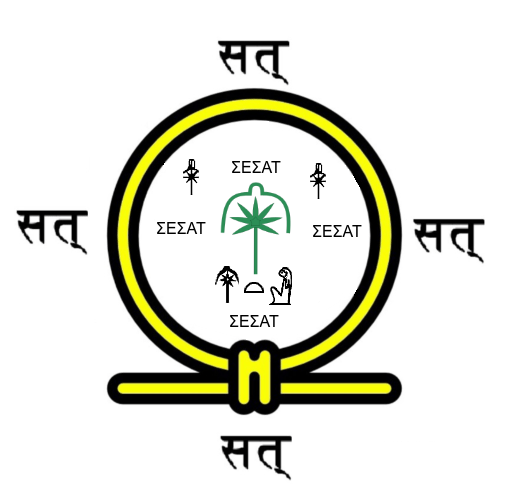
SAT
सत्: SAT, real, true, truthful in Sanskrit.
The Shen Ring
The Symbol that Encapsulates the Sigil: The Shen Ring, Egyptian Hieroglyphic language. The Shen also survived in Chinese tradition as a glyph for Spiritual Force, Divine Force, and God.
Letters of the Sigil
The Ancient Greek letters for Seshat's Name in arrangement.
On Seshat
Seshat (Egyptian: Seshat, "She Who Scribes") is the Goddess of writing, measurement, architecture, astronomy, mathematics, and the recording of sacred knowledge. She is depicted wearing a seven-pointed star (or seven-petaled flower) above her head, surmounted by a pair of inverted horns. As consort of Thoth, she forms one half of the divine partnership of all knowledge: Thoth reveals, Seshat records; Thoth speaks, Seshat preserves. Her primary ritual function was the "Stretching of the Cord" (pedj shes), the sacred surveying ceremony that established the orientation and dimensions of temples. She recorded the regnal years of every Pharaoh upon the leaves of the Ished tree (the Sacred Persea), making her the keeper of royal and cosmic time.
(Sources: Wilkinson, The Complete Gods and Goddesses of Ancient Egypt, 2003; Budge, The Gods of the Egyptians, Vol. I, 1904; Pyramid Texts, Utterance 616)
On the Seven-Horned Crown
The ritual addresses Seshat as the "Seven-Horned Goddess" and identifies seven Rivers of Knowledge. The seven-pointed star upon Seshat's head has been interpreted as representing the seven classical planets (Sun, Moon, Mercury, Venus, Mars, Jupiter, Saturn), the seven liberal arts (grammar, rhetoric, logic, arithmetic, geometry, music, astronomy), or the seven energy centers of the subtle body. In Zevist theology, the seven correspond to the seven planetary spheres through which the soul ascends: each "horn" is a gateway, and Seshat holds the key to all seven.