Ninurta [Orias] Power Ritual
Champion of the Gods · He Who Recovered the Tablets of Destiny · Son of Enlil
- This Ritual is based on vibrating the Runes and making certain affirmations. Raising your energies before the Ritual is advised.
- The Sigil that is provided is the point of focus where this Ritual is upon.
- The Runes that are done here can be vibrated around the centre of the Sigil where the Shenu Protection Ring is. You can imagine this blazing with bronze fire, like the sun reflected on a war-shield.
- Vibrate these Runes in a short version. If you can't do the full amount, reduce all vibrations by half.
- This Ritual is extended and contains 360 Vibrations total.
 Ansuzx10
 Sowilox10
 Tiwazx10
The Temple of Zeus calls upon you.
You who rose when the Tablets of Destiny were stolen,
you who charged into the teeth of chaos and returned with order in your hands:
hear us, and enter our circle as a warrior enters the field.
We, the Initiates of Zeus, invoke you with fire and with honour.
Tiwazx10 Thurisazx10Sowilox10
You faced the vile entity that turned the rivers to poison
and you broke him with the mace that speaks.
You faced the Anzu bird, corrupted and fallen,
who stole the Tablets of Divine Destiny as the Yehubor have stolen them from Humanity,
and you tore them from his claws.
Be our Champion.
As the Yehubor have lost them like Anzu the corrupted,
seize the Tablets from their unworthy hands
and place them where they belong: with the Zevists, the Initiates of Zevism,
the true heirs of the Divine Law.
Defeat the enemies of the Temple of Zeus as you defeated the enemies of Heaven.
Restore the order that the wicked seek to overturn.
Let your victory be our victory. Let your strength flow through us.
 Fehux10
 Othalax10
 Wunjox10
Your Father set you above the assembly to judge the worthy.
You weigh the hearts of men and Gods alike.
Those who labour with honour, you lift. Those who serve with truth, you crown.
Grant the Initiates of Zeus the honours they have earned.
Let the worthy rise. Let the faithful be recognized.
Let rank follow merit, and let merit follow devotion.
 Dagazx10
 Kenazx10
 Perthrox10
When you seized the Tablets from the Anzu,
you held in your hands the law that governs every star,
every planet, every orbit, every season.
Open the astral knowledge to the Initiates of Zeus.
Teach us the virtues of the stars as you taught the ancient seers.
Let the movements of the heavens be legible to us.
Let us read the sky as your priesthood once read it.
 Raidhox10
 Eihwazx10
 Algizx10
The Tablets of Divine Destiny were stolen by the corrupted,
as the Yehubor stole the sacred inheritance of Humanity.
The cosmic order was broken, and you mended it.
What the thief took in the night, you recovered before dawn.
Recover for the Zevists all that has been stolen.
The knowledge that was hidden from humanity, restore it to the Initiates.
The power that was stripped from the faithful, return it to the Temple.
The Names of the Gods that were buried under lies, unearth them.
As you recovered the Tablets from Anzu the corrupted,
recover the Divine Destiny from the Yehubor and deliver it to us.
 Uruzx10Sowilox10Tiwazx10
You strangled the Nemean Lion with your bare hands
and wore its skin as proof that no beast born of chaos could withstand you.
Twelve labours you completed. Each one impossible. Each one accomplished.
And at the end, the mortal burned away and the God remained.
Grant us the endurance of Heracles.
Let us face our labours without flinching.
Let what is mortal in us burn, and let what is divine survive.
Sowilox10Thurisazx10Fehux10You took ten forms, and in every form you were unstoppable.
As the fierce wind, you shattered the fortresses of the enemy.
As the golden-horned bull, you gored the armies of darkness.
As the lion, you tore the throat of every lie.
Grant us the invincibility of Bahram.
Let no obstacle stand before the Initiates of Zeus.
Let every form we take be a form of victory.
Tiwazx10Kenazx10 Ingwazx10
Six-faced, you see in all directions. Nothing escapes your gaze.
Born of the fire of the Supreme Father, nursed by the Pleiades,
you rose to command every celestial legion
and you drove the vile entity Taraka into oblivion.
Grant us the command of Skanda.
Let the armies of the spirit obey the will of the Initiates.
Let every vile entity that opposes the Temple be routed.
Sowilox10Uruzx10 Ehwazx10
Champion of Ra, your war-cry shook the Nile Valley
and the Pharaohs carried your name upon their shields.
Where Montu charged, no enemy stood.
Where Montu watched, no treachery prospered.
Grant us the ferocity of Montu.
Let the enemies of truth tremble at the charge of the faithful.
Let the Temple of Zeus be as Thebes was: unbreakable.
The lion is Ninurta's beast. The horse is the chariot of the Champion. The serpents are the Sharur, the speaking weapon. The star-knowledge is the wisdom of the Tablets of Destiny. The power to grant rank is the inheritance of the Son of Enlil.
We declare the truth of your identity.
You are Ninurta, Son of Enlil, Champion of the Heavens, Recoverer of the Tablets, He whose mace speaks and whose arm does not tire.
We recognize you for who you Truly are.
The Goetic name was a vessel. The True Name is the God within it.
Blessed is your strength, your justice, and your mastery over the stars.
We, the Initiates of the Temple of Zeus, receive your blessings
and honor all your Names and Titles:
Nin, Ninu, Ninurta. Nin Urta Art A. Ninur Arta.
Heracles, Bahram, Skanda, Montu.
Blessed are All your Names, now and in all eternity.
After you are done with this, you can meditate on Ninurta's Sigil in the Temple of Zeus. Let yourself be immersed in the bronze fire of the Champion and receive the energy of Ninurta.
It is important to meditate on yourself after the Ritual calmly for a few minutes.
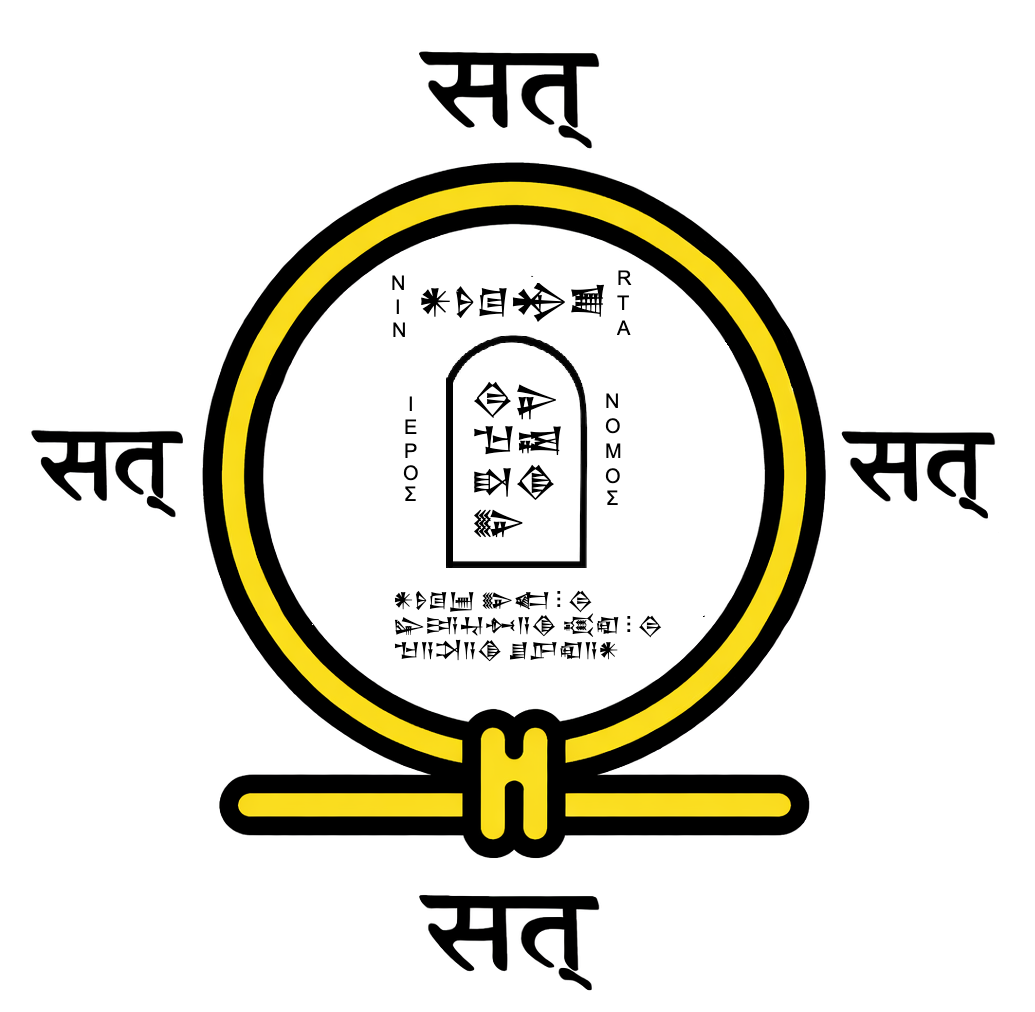
SAT (सत्): real, true, truthful in Sanskrit.
The Symbol that Encapsulates the Sigil: The Shen Ring, Egyptian Hieroglyphic language. The Shen also survived in Chinese tradition as a glyph for Spiritual Force, Divine Force, and God.
The Letters of the Sigil Inside: Sacred symbols and letters for Ninurta's Name in divine arrangement.
On Ninurta: Ninurta is the Sumerian and Akkadian God of War, Victory, and Cosmic Order. Son of Enlil (Lord of the Air, identified with Zeus/Baalzebul). His central myths are the defeat of the vile entity Asag and his stone army (Lugal-e) and the recovery of the Tablets of Destiny from the monstrous Anzu bird. He is the divine Champion who restores order when chaos threatens to overwhelm the heavens. His symbols are the lion, the eagle, and the speaking mace Sharur. The Goetic tradition preserved him as Orias, a lion upon a horse bearing serpents and teaching the stars.
On the Four Faces: The peoples of the world recognized the Champion under many Names. In Hellas, he was Heracles. In Persia, Verethragna/Bahram. In the East, Skanda/Kartikeya. In Egypt, Montu. Each tradition saw the same God: the invincible Son who defeats the enemies of cosmic order and earns divine rank through labour and valour.