Nephthys's [Bathin] Power Ritual
Queen of the Night, Mother of Anubis, the Foundational Pillar, Mysterious Goddess of Magick, Guide Through the Duat
- This Ritual is based on vibrating the Runes and making certain affirmations. Raising your energies before the Ritual is advised.
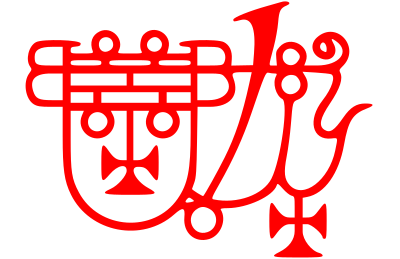
- The Sigil that is provided is the point of focus for this Ritual.
- The Runes that are done here can be vibrated around the center of the Sigil, where the Shenu Protection Ring is. You can imagine this lighting up so much, like the Sun has a layer of light surrounding all of it.
- Vibrate these Runes in a short version [i.e., do not draw the runic vibration on a very big breath, especially for those who are new and can't do that many vibrations]. Click here to pronounce the runes.
- This Ritual contains 273 Vibrations, which is about 2 and a half circles of Mala beads. If you can't do that many, reduce the number of vibrations by half [e.g., instead of vibrating the Runes 10 times each, only do 5 vibrations].
 Fehux10
 Ansuzx10Fehux10
 Laguzx10
 Dagazx10Laguzx10
 Tiwazx10
 Sowilox10Tiwazx10Sowilox10
 Algizx10Sowilox10Laguzx10Tiwazx10Laguzx10
 Wunjox10
 Berkanox10Wunjox10Algizx10Berkanox10Algizx10Laguzx10Algizx10Laguzx10
The Goetic tradition preserved you as Bathin, the eighteenth spirit, a Duke commanding 30 legions, who "knows the virtues of herbs and precious stones" and "can transport men from one country to another." The mouths of the Yehuborim have uttered of you, "a powerful spirit of dark knowledge." The Zevists know the truth: You are NEPHTHYS (Nb.t-Hwt, "Lady of the House"), sister of Isis, Mother of Anubis, She who stands at the boundary between the worlds. He who "knows the virtues of herbs" is She who knows the spells of healing and embalming. He who "transports men from country to country" is She who guides the dead from this world to the next, across the waters of the Duat.
We declare the truth of your identity. We recognize you for who you Truly are.
"Blessed is the Eternal Power of Nephthys,
Grateful and Blessed are we through you,
May Our Gods and all of us be remembered in your Name forever.
Blessed is Lady Nephthys in Her Divine Providence!"
After you are done with this, you can meditate on Nephthys's Sigil in the Temple of Zeus, or the one below. Let yourself be immersed and receive energy from Nephthys.
It's important to meditate on yourself after the Ritual calmly for a few minutes.
SAT
सत्: SAT, real, true, truthful in Sanskrit.
The Shen Ring
The Symbol that Encapsulates the Sigil: The Shen Ring, Egyptian Hieroglyphic language. The Shen also survived in Chinese tradition as a glyph for Spiritual Force, Divine Force, and God.
Letters of the Sigil
The Ancient Greek letters for Nephthys's Name in arrangement.
On Nephthys
Nephthys (Egyptian: Nb.t-Hwt, "Lady of the House/Enclosure") is the Goddess of the night, death, mourning, funerary rites, and the unseen world. Daughter of Geb and Nut, sister of Isis, Osiris, and Set, mother of Anubis. In the Osirian cycle she stands alongside Isis as one of the two kites (divine mourners) who lament Osiris and assist in his resurrection. The Pyramid Texts (Utterance 485) identify her as a protective force: "Nephthys has collected all your members for you in her name of Seshat, Lady of Builders." Her identification with Hestia in the ritual reflects the Greek interpretatio of Nephthys as the Goddess of the sacred household and the foundational enclosure. The Duat (Egyptian underworld) through which she guides the dead is not a place of punishment but of transformation: the deceased must navigate its waters and pass through its gates to achieve the state of akh (transfigured spirit).
(Sources: Pyramid Texts, Utterance 485, 364; Coffin Texts, Spell 148; Plutarch, De Iside et Osiride 12, 38; Wilkinson, The Complete Gods and Goddesses of Ancient Egypt, 2003)
On Bathin (Goetic #18)
The Goetia lists Bathin (also Bathym, Marthim) as the eighteenth spirit: a Duke commanding 30 legions, appearing as a strong man with a serpent tail, riding a pale horse. His attributed powers (knowledge of herbs and stones, instantaneous transportation between countries) correspond to Nephthys's role as the Goddess who knows the spells of embalming (herbs and minerals used in mummification) and who transports the dead across the boundary between worlds. The serpent tail reflects the uraeus serpent associated with protective Egyptian Goddesses, and the pale horse is the steed of the psychopomp who carries souls between realms.
(Sources: Weyer, Pseudomonarchia Daemonum, 1577; Ars Goetia, 17th c.)