Khnum's [Raum] Power Ritual
Fashioner of the Living World, Protector of Life, Master of the Ankh, the Everlasting Circle That Creates
- This Ritual is based on vibrating the Runes and making certain affirmations. Raising your energies before the Ritual is advised.
- The Sigil that is provided is the point of focus for this Ritual.
- The Runes that are done here can be vibrated around the center of the Sigil, where the Shenu Protection Ring is. You can imagine this lighting up so much, like the Sun has a layer of light surrounding all of it.
- Vibrate these Runes in a short version [i.e., do not draw the runic vibration on a very big breath, especially for those who are new and can't do that many vibrations]. Click here to pronounce the runes.
- This Ritual contains 181 Vibrations, which is about 2 circles of Mala beads. If you can't do that many, reduce the number of vibrations by half [e.g., instead of vibrating the Runes 10 times each, only do 5 vibrations].
 Ansuzx10
 Wunjox10Ansuzx10
Most excellent fashioner of the living world,
The Temple of Zeus Assembly is blessing you,
Uttering blessings upon your holy name.
Your hands shaped us on the potter's wheel before we drew our first breath.
Atum, who is All in All, gave you life, and you in turn gave life to all that lives.
Ansuzx10 Ingwazx10Wunjox10
Protector of Life and Living Beings.
Greatest is your Kindness,
Hidden are your secrets inside the innermost part of Life.
For Atum gives us life through you: every breath we draw was shaped upon your wheel.
 Dagazx10
 Berkanox10
 Sowilox10
The Regenerator of Life,
The Power of the Living Force,
The Final Resurrection.
Sowilox10Dagazx10 Laguzx10
Bless us All,
Great Raum, Great Khnum,
Master of the Ankh and the Name.
Atum sustains the bond between the potter and the clay, between the God and the Initiate, between the wheel and the world it shapes.
Sowilox10 Eihwazx10Sowilox10
Your Habitation is in the House of the Aeons.
You are the Key and the Master of the Everlasting Circle that always resonates, rotates, and creates.
For Atum is All in All, and you, Khnum, are the hands through which the All takes form.
Patron of Life and Glory.
Blessed is Khnum,
Master of the Seas of Life.
The Goetic tradition preserved you as Raum, the fortieth spirit, an Earl commanding 30 legions, appearing as a crow. The mouths of the Yehuborim have uttered of you, "a spirit who steals treasures and destroys cities." The Zevists know the truth: You are KHNUM, the ram-headed God of Elephantine, Fashioner of all living things upon his potter's wheel. He who "steals treasures" is He who shapes the treasure of life from the clay of the Nile. He who "destroys cities" is He who dissolves what is false so that the real may be rebuilt. The crow is the bird that watches from above as the potter works below.
We declare the truth of your identity. We recognize you for who you Truly are.
Blessed are we by you,
Protected are we by you,
Resurrected are we by you.
For Atum is All in All, and through your hands, He shapes us still.
After you are done with this, you can meditate on Khnum's Sigil in the Temple of Zeus, or the one below. Let yourself be immersed and receive energy from Khnum.
It's important to meditate on yourself after the Ritual calmly for a few minutes.
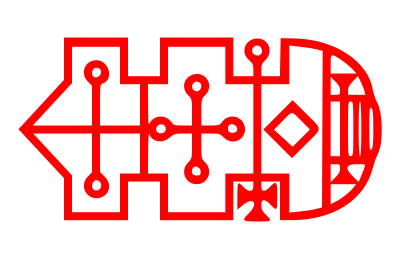
SAT
सत्: SAT, real, true, truthful in Sanskrit.
The Shen Ring
The Symbol that Encapsulates the Sigil: The Shen Ring, Egyptian Hieroglyphic language. The Shen also survived in Chinese tradition as a glyph for Spiritual Force, Divine Force, and God.
Letters of the Sigil
The Ancient Greek letters for Raum's Name in arrangement.
On Khnum
Khnum (Egyptian: Khnemu, "the Moulder") is the ram-headed God of the First Cataract at Elephantine (Aswan), guardian of the source of the Nile and the divine potter who fashions every living creature upon his wheel. In the Esna Temple texts, Khnum creates the ka (spiritual double) and the physical body simultaneously, spinning them together on his wheel from the clay of the Nile. He is one of the oldest deities of Egypt, attested from the Early Dynastic Period. His rams are the earliest species of Egyptian domestic sheep (Ovis longipes palaeoaegyptiacus), with horizontal spiral horns. The Ankh, the key of life that Khnum holds, represents the union of masculine and feminine principles in the act of creation. His connection to the Nile's inundation makes him the source of all fertility and regeneration in the Egyptian world.
(Sources: Esna Temple Texts; Pyramid Texts, Utterance 300; Wilkinson, The Complete Gods and Goddesses of Ancient Egypt, 2003; Leitz, Lexikon der agyptischen Gotter und Gotterbezeichnungen, 2002)
On Raum (Goetic #40)
The Goetia lists Raum as the fortieth spirit: an Earl commanding 30 legions, appearing as a crow. His attributed powers (stealing treasures from kings, destroying cities and dignities, revealing past/present/future) correspond to Khnum's role as the God who shapes and dissolves material form. The crow's association with Raum parallels the role of carrion birds in Egyptian religion: the Ba-bird that watches over the body as the soul journeys. The name Raum preserves the Egyptian Ra element (sun, divine power) combined with a Semitic suffix.
(Sources: Weyer, Pseudomonarchia Daemonum, 1577; Ars Goetia, 17th c.)