Furfur's Power Ritual
Great Daemon of Vegetation and Abundance, Son of Demeter, Lord of the Ravens, Nourisher of the Living
- This Ritual is based on vibrating the Runes and making certain affirmations. Raising your energies before the Ritual is advised.
- The Sigil that is provided is the point of focus for this Ritual.
- The Runes that are done here can be vibrated around the center of the Sigil, where the Shenu Protection Ring is. You can imagine this lighting up so much, like the Sun has a layer of light surrounding all of it.
- Vibrate these Runes in a short version [i.e., do not draw the runic vibration on a very big breath, especially for those who are new and can't do that many vibrations]. Click here to pronounce the runes.
- This Ritual contains 208 Vibrations, which is about 2 circles of Mala beads. If you can't do that many, reduce the number of vibrations by half [e.g., instead of vibrating the Runes 10 times each, only do 5 vibrations].
 Berkanox10
 Sowilox10
 Laguzx10
We evoke and invoke your power through your Mother Demeter, who rules over you.
You who stand where the seed breaks open in the dark soil,
You who are present in the first green shoot that splits the earth:
Be blessed by us, the Disciples of the Temple of Zeus, and our honorable utterances!
Berkanox10 Ansuzx10Laguzx10
Bless our vegetation,
Bless our cattle,
Bless our production for the necessities of life,
Bless us with abundance in food and spiritual lifeforce.
Let the roots drink deep and the branches bear heavy.
Let no drought wither what you have blessed, no blight touch what you have named.
Be blessed, O Furfur, Son of Demeter, the Great Life Giver.
Berkanox10 Dagazx10Laguzx10
Grant us vitality,
Feed us the holy bran,
Restore us into liveliness,
Protect our Wisdom in the Head and the Seat of our Soul.
For as the raven flies between worlds carrying the word of the Gods,
so you carry nourishment between the seen and the unseen, the body and the spirit.
Berkanox10Laguzx10 Ingwazx10
You who supplement us with spiritual and material sustenance.
For you have declared:
"When I arise, the bounty of the wise is plentiful, their table filled with the abundant products of the earth!"
We remember what the ancients knew: that the grain is sacred, that the harvest is a prayer answered, that the body fed is the spirit freed to rise.
Berkanox10 Kenazx10
 Eihwazx10
Restore our sight and bring our heads out of the darkness.
As you rule passions of the flesh,
Help us become masters over them.
For the body is the earth of the soul: tended well, it bears fruit; neglected, it consumes itself.
Berkanox10Laguzx10Berkanox10The mother shall eat,
The father shall eat,
The family will be blessed with the bountiful feast of the wonders of the earth.
No table shall be empty where your name is spoken. No mouth shall hunger where your Daemon walks.
The Goetic tradition preserved you as Furfur, the thirty-fourth spirit, an Earl commanding 26 legions, appearing as a hart with a fiery tail. The mouths of the Yehuborim have uttered of you, "a spirit of storms and falsehood." The Zevists know the truth: the hart that runs with fire is the living seed that carries the flame of growth through the dark soil. The storms you command are the rains that break the drought and feed the fields. You are FURFUR, Daemon of Demeter's Domain, the Nourisher, the Trofos.
We declare the truth of your identity. We recognize you for who you Truly are.
Grow our children, our folk, our wealth, our life force, and our consciousness,
So that we may pray blessings upon you onward to Eternity!
Furfur, Furfures, Bran, Trofos, blessed are you, now and in all eternity!
After you are done with this, you can meditate on Furfur's Sigil in the Temple of Zeus, or the one below. Let yourself be immersed and receive energy from Furfur.
It's important to meditate on yourself after the Ritual calmly for a few minutes.
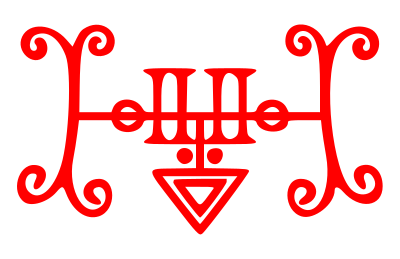
SAT
सत्: SAT, real, true, truthful in Sanskrit.
The Shen Ring
The Symbol that Encapsulates the Sigil: The Shen Ring, Egyptian Hieroglyphic language. The Shen also survived in Chinese tradition as a glyph for Spiritual Force, Divine Force, and God.
Letters of the Sigil
The Ancient Greek letters for Furfur's Name in arrangement.
On Furfur and the Domain of Demeter
Furfur is identified in this ritual as a Daemon (δαίμων) within the domain of Demeter, the Greek Goddess of grain, harvest, and the sacred cycle of growth. The term Daemon here carries its original Greek meaning: a divine spirit mediating between Gods and mortals (Plato, Symposium 202e-203a), not the later Yehuboric inversion into "demon." The name Furfur likely derives from Latin furfur ("bran, chaff, husk"), the outer shell of grain: the part that protects the seed until it is ready to nourish. The ritual name Bran reinforces this grain-etymology. Trofos (Greek: τροφός) means "nourisher, nurse, feeder": the one who sustains life after birth.
The Goetic description of Furfur as a hart (deer) with a fiery tail recalls the ancient association of deer with sacred groves and agricultural fertility. The fire in the tail is the vital heat that drives germination: the warmth beneath the soil that breaks the seed open. His power over storms and weather corresponds to the agricultural necessity of rain. The Eleusinian Mysteries, the most sacred rites of Demeter, centered on the revelation that death and growth are one cycle, that the grain dies in the earth so that it may rise: this is Furfur's domain.
(Sources: Plato, Symposium 202e-203a; Weyer, Pseudomonarchia Daemonum, 1577; Ars Goetia, 17th c.; Burkert, Greek Religion, 1985; Mylonas, Eleusis and the Eleusinian Mysteries, 1961)
On the Daemon (Δαίμων) in Greek Theology
In pre-Christian Greek theology, a daimon is a divine being or spirit, intermediate between Gods and mortals. Hesiod (Works and Days 122-126) describes the daimones as the spirits of the Golden Age who became "guardians of mortal men, watchers over justice and injustice." Plato defines the daimon as the mediating force between the divine and the human (Symposium 202e). The Yehuboric tradition systematically inverted this term into "demon" (a malevolent entity), as part of the broader campaign to demonize all pre-Christian spiritual beings. The Zevist use of "Daemon" restores the original meaning.
(Sources: Hesiod, Works and Days 122-126; Plato, Symposium 202e; Apology 27d; Burkert, Greek Religion, 1985)