Oscarius's [Forcas] Power Ritual
The One Who Wins, Son of Eosforos, Bringer of Triumph and Victory, Lord of the Manifold Power
- This Ritual is based on vibrating the Runes and making certain affirmations. Raising your energies before the Ritual is advised.
- The Sigil that is provided is the point of focus for this Ritual.
- The Runes that are done here can be vibrated around the center of the Sigil, where the Shenu Protection Ring is. You can imagine this lighting up so much, like the Sun has a layer of light surrounding all of it.
- Vibrate these Runes in a short version [i.e., do not draw the runic vibration on a very big breath, especially for those who are new and can't do that many vibrations]. Click here to pronounce the runes.
- This Ritual contains 153 Vibrations, which is about 1 and a half circles of Mala beads. If you can't do that many, reduce the number of vibrations by half [e.g., instead of vibrating the Runes 10 times each, only do 5 vibrations].
 Fehux10
 Ansuzx10Fehux10
In the Name of Zeus, Master of Daemons, whose Name is Truth,
And In His Divine Name of Baal-Zevul, whose Name is Justice,
You are invited to dwell among us forever.
Fehux10 Sowilox10Ansuzx10
You bring Triumph and Victory,
Nobody can deny you, and nothing can stand against you,
As the Gods have ordained you to be the One Who Wins.
Your name is the spear thrown by the Gods, and it has never missed its mark.
Ansuzx10 Algizx10
 Hagalazx10
Many are your followers who bless you on this day,
So, Forcas, you have said: "I shall bestow upon the Temple of Zeus ultimate and unequivocal victory in all its affairs. Those who bless and provide for the Temple of Zeus are eternally blessed with victory in their endeavors, now and forevermore."
Lord Eosforos is pleased and the Source of your Eternal Power, O Forcas!
 Tiwazx10Sowilox10
 Thurisazx10
You are the Son of Eosforos, and you carry His Beam of Light,
You lead us to victory and our enemies to ultimate defeat.
The enemies of the Gods know they have been defeated by us, now and forever, O Forcas!
The mouths of the Yehuborim have uttered of you, "a spirit who teaches logic and rhetoric." Indeed, you do, for the logic of truth always defeats the rhetoric of lies, and this is the victory you bestow.
The Goetic tradition preserved you as Forcas (also Foras, Furcas), the thirty-first spirit, a Knight and President commanding 29 legions. The mouths of the Yehuborim have uttered of you, "a spirit who teaches logic, ethics, the virtues of herbs, and makes men invisible." The Zevists know the truth: You are OSCARIUS, the One Who Wins. The name Oscar derives from Old Irish Os ("God/deer") + cara ("friend/beloved"), or from Old English Os ("God") + gār ("spear"): the God's Spear, the weapon of divine victory. He who teaches logic is He who gives the Initiate the weapon of clear thought. He who makes men invisible is He who shields them from the eyes of their enemies.
We declare the truth of your identity. We recognize you for who you Truly are.
Great is your Power, visible and felt by all.
The Power of Justice is always the first and final cause,
And you are the Lord of Lords in the Divine Tribunal.
Blessed be you forevermore!
After you are done with this, you can meditate on Oscarius's Sigil in the Temple of Zeus, or the one below. Let yourself be immersed and receive energy from Oscarius.
It's important to meditate on yourself after the Ritual calmly for a few minutes.
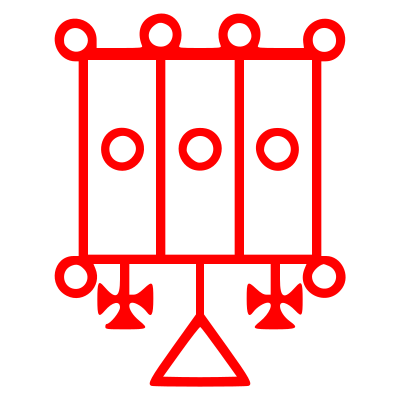
SAT
सत्: SAT, real, true, truthful in Sanskrit.
The Shen Ring
The Symbol that Encapsulates the Sigil: The Shen Ring, Egyptian Hieroglyphic language. The Shen also survived in Chinese tradition as a glyph for Spiritual Force, Divine Force, and God.
Letters of the Sigil
The Ancient Greek letters for Forcas's Name in arrangement.
On Oscarius and Forcas
The ritual identifies Forcas with the title Oscar/Oscarius, connecting the Goetic spirit to the concept of divine victory. The name Forcas may derive from Latin fortis ("strong, mighty") or from furca ("fork, pitchfork"), the latter being a weapon symbol. The Goetia describes Forcas as a Knight (the only Goetic spirit with this rank), appearing as a strong old man with a flowing beard, riding a great horse and carrying a sharp weapon. The knightly imagery corresponds to the divine warrior archetype: the one who rides into battle on behalf of the Gods and always returns victorious. His attributed power of teaching logic, ethics, and the properties of herbs and precious stones connects him to the ancient philosopher-warrior tradition, where wisdom and martial prowess are inseparable.
(Sources: Weyer, Pseudomonarchia Daemonum, 1577; Ars Goetia, 17th c.; Scot, The Discoverie of Witchcraft, 1584)