Equitas's [Eligos] Power Ritual
Lord of the Divine Tribunal, Executor of Heavenly Dictates, He Who Opens All Paths, Lord of Lords in the Court of Justice
- This Ritual is based on vibrating the Runes and making certain affirmations. Raising your energies before the Ritual is advised.
- The Sigil that is provided is the point of focus for this Ritual.
- The Runes that are done here can be vibrated around the center of the Sigil, where the Shenu Protection Ring is. You can imagine this lighting up so much, like the Sun has a layer of light surrounding all of it.
- Vibrate these Runes in a short version [i.e., do not draw the runic vibration on a very big breath, especially for those who are new and can't do that many vibrations]. Click here to pronounce the runes.
- This Ritual contains 153 Vibrations, which is about 1 and a half circles of Mala beads. If you can't do that many, reduce the number of vibrations by half [e.g., instead of vibrating the Runes 10 times each, only do 5 vibrations].
 Fehux10
 Ansuzx10Fehux10
May your many Names be praised.
Your Power is immense.
In the Name of Baal-Zevul, listen to our call.
You ride into the court of heaven armed with truth, and no falsehood can stand before you.
Fehux10 Sowilox10Ansuzx10
You are He who carries and executes the Dictates of the Heavenly Tribunal.
The Gods listen to you, and the Universe obeys you.
Assist the Assembly of the Temple of Zeus and all its members.
Ansuzx10 Algizx10
 Hagalazx10
"I have beheld that the Yehuborim have uttered falsehood in the heavenly tribunal. Their falsehoods, which are many, I will blot out in their entirety, for the love and the security of the Assembly of the Temple of Zeus.
Now, I shall remove with you, and from you, the following cursed utterance:"
 Tiwazx10Sowilox10
 Thurisazx10
His power is invincible and felt everywhere.
He always opens the Paths for the Initiates,
And when anyone tries to stop Him, Divine Fury visits them and quickly ruins them.
Blessed is He by the Children of the Gods.
The Goetic tradition preserved you as Eligos (also Abigor), the fifteenth spirit, a Duke commanding 60 legions, appearing as a knight carrying a lance, pennon, and sceptre. The mouths of the Yehuborim have uttered of you, "a spirit who discovers hidden things and knows the outcome of wars." The Zevists know the truth: You are ELIGOS EQUITAS, the Lord of the Divine Tribunal. He who discovers hidden things is He who exposes the false testimony of the Yehuborim in the heavenly court. He who knows the outcome of wars knows the outcome of all spiritual battles, for the Tribunal has already decided, and its judgement is final.
We declare the truth of your identity. We recognize you for who you Truly are.
Great is your Power, visible and felt by all.
The Power of Justice is always the first and final cause,
And you are the Lord of Lords in the Divine Tribunal.
Blessed be you forevermore!
After you are done with this, you can meditate on Eligos's Sigil in the Temple of Zeus, or the one below. Let yourself be immersed and receive energy from Eligos.
It's important to meditate on yourself after the Ritual calmly for a few minutes.
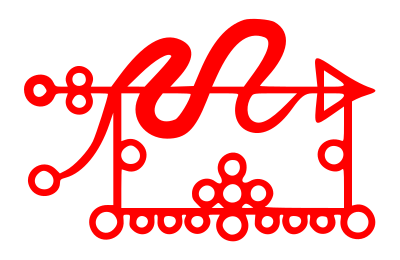
SAT
सत्: SAT, real, true, truthful in Sanskrit.
The Shen Ring
The Symbol that Encapsulates the Sigil: The Shen Ring, Egyptian Hieroglyphic language. The Shen also survived in Chinese tradition as a glyph for Spiritual Force, Divine Force, and God.
Letters of the Sigil
The Ancient Greek letters for Eligos's Name in arrangement.
On Eligos and Equitas
The ritual identifies Eligos with the Latin concept of Equitas (equity, fairness, divine justice). In Roman religion, Aequitas was a personified divine virtue, depicted holding scales and a cornucopia, representing the balance of justice tempered with abundance. The Goetic names Abigor and Abigael may preserve Semitic roots: Abi-gael ("my father is joy/exultation") or Abi-gor ("father of the sojourner/stranger"), both consistent with a deity who defends the cause of those who have been wrongfully accused or dispossessed. The name Eligos itself may derive from Latin eligere ("to choose, to elect"), pointing to His role as the one who selects the just cause and executes divine judgement.
(Sources: Weyer, Pseudomonarchia Daemonum, 1577; Ars Goetia, 17th c.; Fears, The Cult of Virtues and Roman Imperial Ideology, 1981)