Dagan's Power Ritual
Great Lord of the Sea of the Human Mind, Patron of Inspiration, Ruler of the Unconscious Depths
- This Ritual is based on vibrating the Runes and making certain affirmations. Raising your energies before the Ritual is advised.
- The Sigil that is provided is the point of focus for this Ritual.
- The Runes that are done here can be vibrated around the center of the Sigil, where the Shenu Protection Ring is. You can imagine this lighting up so much, like the Sun has a layer of light surrounding all of it.
- Vibrate these Runes in a short version [i.e., do not draw the runic vibration on a very big breath, especially for those who are new and can't do that many vibrations]. Click here to pronounce the runes.
- This Ritual contains 183 Vibrations, which is about 1 and a half circles of Mala beads. If you can't do that many, reduce the number of vibrations by half [e.g., instead of vibrating the Runes 10 times each, only do 5 vibrations].
 Ansuzx10
 Laguzx10
 Dagazx10
Blessed are you by us, the Initiates of the Temple of Zeus.
Excellent is your Wisdom,
Ultimate is your power over the Sea of the Human Mind.
You who move beneath the surface of thought like a current beneath still water:
rise now, and let us feel the tide of your presence.
Laguzx10Dagazx10 Berkanox10
Grand is your rule over the unconscious mind of humanity.
Zeus, your Lord and Father, has ordained you highly into His Glory,
Listen to us, who bless you in Zeus's Name.
Every dream that carries truth, every vision that arrives unbidden, every idea that surfaces from the deep: these are your gifts.
 Tiwazx10Ansuzx10
 Othalax10
Your people have perished from the genocide of the Yehuborim against them,
Now we bring you into a New and Beautiful Home,
We are your People; we are your Fellowship.
The mouths of the Yehuborim have uttered of you that your temple fell, that your image was broken. But temples can be rebuilt, and you were never the stone. You are the sea that no hand can shatter.
 Sowilox10Berkanox10
 Wunjox10
The memory of your People will live on through the aeons, and so will you!
Bless us to carry you forth into the minds and souls of mankind!
For what is drowned can rise again, and what is forgotten can be spoken anew.
 Raidhox10Berkanox10Wunjox10
Bless our Spirits with intelligence, spiritual aptitude, and Wisdom.
Bless us all, as we bless you in your New Home!
Let the waters of your domain wash clean what Izfet has muddied. Let the deep mind remember what the surface has been taught to forget.
The Goetic tradition preserved you as Zagan, the sixty-first spirit, a King and President commanding 33 legions. The mouths of the Yehuborim have uttered of you, "a spirit who makes men witty and turns water into wine." The Zevists know the truth: You are DAGAN, Lord of Grain and Sea, the ancient God of the Philistines, whose temple at Ashdod stood for centuries before it was torn down by those who feared his power. He who turns water into wine is He who transforms the raw depths of the unconscious into the nourishment of the spirit.
We declare the truth of your identity. We recognize you for who you Truly are.
Great One of the Seas,
Glorified and upheld is your Name,
Steady and plentiful are your people,
Eternal and Established is your Name!"
After you are done with this, you can meditate on Dagan's Sigil in the Temple of Zeus, or the one below. Let yourself be immersed and receive energy from Dagan.
It's important to meditate on yourself after the Ritual calmly for a few minutes.
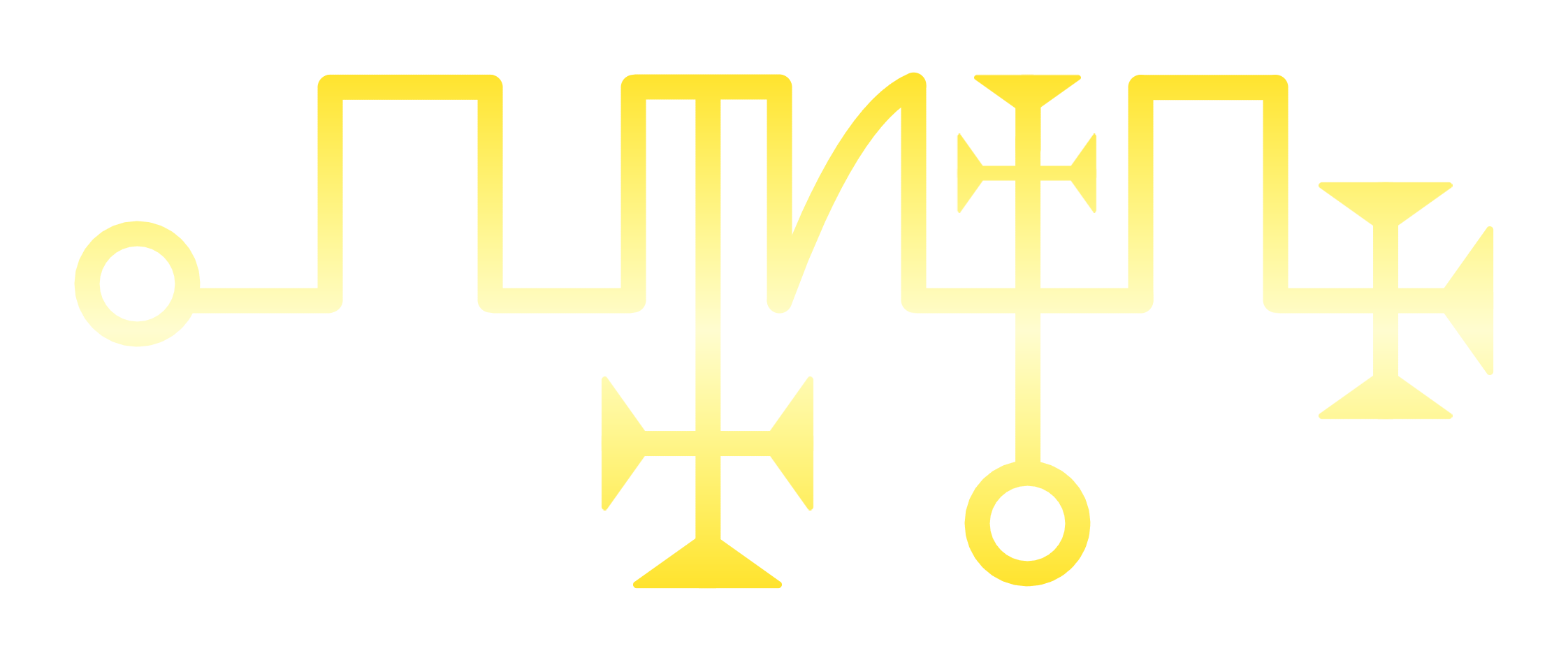
SAT
सत्: SAT, real, true, truthful in Sanskrit.
The Shen Ring
The Symbol that Encapsulates the Sigil: The Shen Ring, Egyptian Hieroglyphic language. The Shen also survived in Chinese tradition as a glyph for Spiritual Force, Divine Force, and God.
Letters of the Sigil
The Ancient Greek letters for Dagan's Name in arrangement.
On Dagan
Dagan (also Dagon) is one of the most ancient deities of the Near East, attested from the mid-third millennium BCE at Ebla, Mari, and throughout the Levant. His name likely derives from Semitic *dagn ("grain, corn") or *dag ("fish"), reflecting his dual nature as a God of both agricultural fertility and the sea. He was the chief deity of the Philistines (1 Samuel 5:1-7), with major temples at Gaza and Ashdod. The Ugaritic texts (14th-12th c. BCE) name him as the father of Baal Hadad, placing him among the highest tier of the Canaanite pantheon. His temple at Ashdod was systematically destroyed as part of the Israelite campaign against Philistine religion. The Biblical account of the fall of Dagon's statue (1 Samuel 5:3-4) is a Yehuboric propaganda narrative designed to demonstrate the "impotence" of polytheistic Gods.
(Sources: 1 Samuel 5:1-7; KTU 1.2, 1.5, 1.6 (Ugaritic texts); Feliu, The God Dagan in Bronze Age Syria, 2003; Black & Green, Gods, Demons and Symbols of Ancient Mesopotamia, 1992)
On Zagan (Goetic #61)
The Goetia lists Zagan as the sixty-first spirit: a King and President commanding 33 legions. His attributed powers (making men witty, turning water into wine and blood into wine, turning metals into coins) correspond to Dagan's dual domain: the transformation of raw material into sustenance (grain from earth, wine from water) and the power over the hidden depths of mind and matter. The name Zagan is a phonetic variant of Dagan/Dagon, preserving the ancient theonym through the grimoire tradition.
(Sources: Weyer, Pseudomonarchia Daemonum, 1577; Ars Goetia, 17th c.)