Botu and Wadjet Power Ritual
Βοτοῦ καὶ Οὐαδγήτ · The Serpent's Two Honored Forms · The Crown, the Counsel, and the Peace
Wadjet of the green Delta, receive the reverence of this house.
Botu, steadfast power of clear counsel, receive the reverence of this house.
I honor your feminine and masculine forms as one whole power, each with its own voice and dignity.
Let sight become honest, strength become measured, and estrangement yield where truth permits peace.
I enter this rite with gratitude, a willing heart, and no fear.
 Berkanox10
 Laguzx10Berkanox10
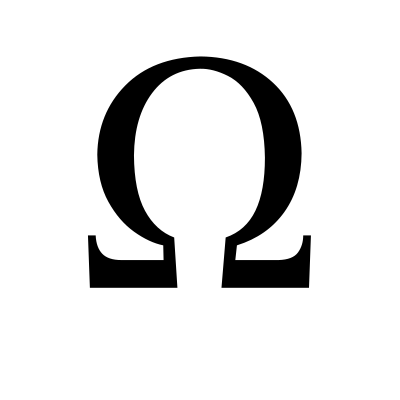 Omegax3
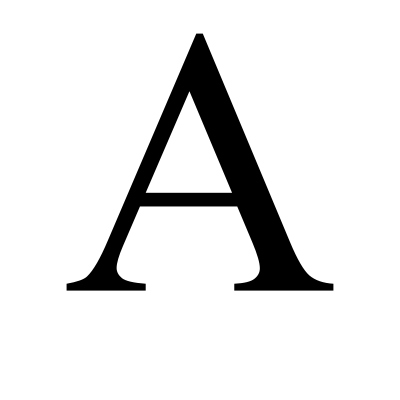 Alphax3
 Deltax3
Ō thea, phylasse tēn khloeran gēn tou Delta.
Wadjet, Lady of Buto, I greet you in the living green of the river land.
The papyrus stands upright where water and earth make room for life.
Your name belongs to that country, to its fertile color and its watchful sanctuaries.
O Goddess, guard the green land of the Delta.
Guard also the good beginnings that rise quietly among us.
Let what is tender be defended without being enclosed.
Let what is growing receive the light, the water, and the season it needs.
May I learn from the river how to move with purpose and from the reed how to stand without hardness.
Wadjet, receive this first praise beneath the sign of the living papyrus.
Botu, receive with her this praise for the life entrusted to our care.
Hold the image of an upright papyrus stem. Give thanks for one living thing you can actually tend.
 Algizx10
 Sowilox10Algizx10
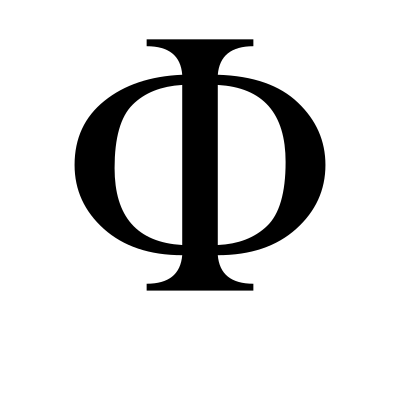 Phix3
Phix3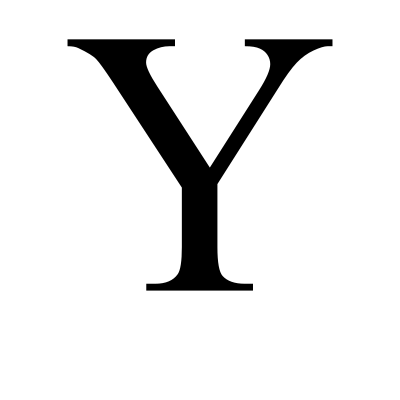 Upsilonx3
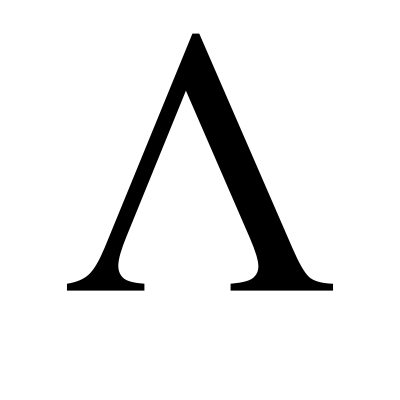 Lambdax3
Ō thea, to stemma tēs dikaiosynēs phylasse.
Wadjet, raised upon the brow, bright guardian of rightful authority, I honor you.
Your hood is open; your gaze keeps its measure.
Gold marks the vigilance demanded by the crown and the duty carried beneath it.
O Goddess, guard the crown of justice.
Where a hand has charge of others, let it remember those in its keeping.
Where a word carries weight, let it be spoken with care.
Where a boundary must be held, let it be held firmly and without cruelty.
Your place upon the crown makes protection visible before any command is heard.
Receive my praise, Lady of Buto, and bless every duty undertaken with a clear mind.
Botu, receive with her the vow that strength shall answer to just care.
Consider a responsibility you hold. Give it a clear, humane boundary.
 Tiwazx10
 Kenazx10Tiwazx10
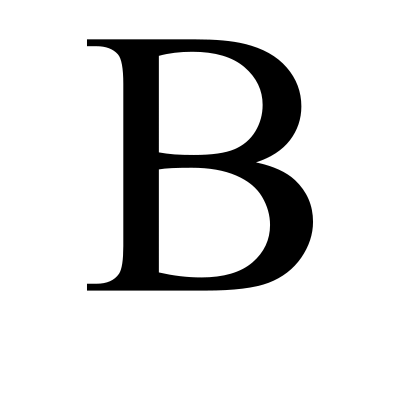 Betax3
 Taux3
Taux3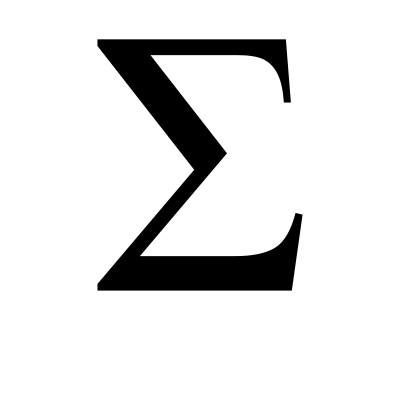 Sigmax3
Ō thee, tēn iskhyn meta sōphrosynēs phere.
Botu, I greet your masculine form within the whole power of the serpent.
You are alert where paths narrow and watchful where a careless step would wound.
I honor strength that knows its own edge and keeps it under command.
O God, bear strength with wise restraint.
Let courage be guided by attention rather than the heat of anger.
Let the guarded threshold remain open to the worthy and secure against harm.
Give me the patience to see before I answer and the firmness to answer when the hour has come.
The serpent does not squander its movement; its stillness also has power.
Botu, receive praise for the strength that protects through discernment.
Wadjet, receive with him this honor for strength that shelters.
Attend to the space between impulse and action. Let strength answer to judgment.
 Ansuzx10
 Raidhox10Ansuzx10
 Nux3
Nux3 Omicronx3Upsilonx3
Ō thee, peri tōn gegonotōn kai tōn mellontōn saphē boulēn didou.
Botu, God of the measured answer, I bring you a question without disguising its weight.
What has happened deserves to be seen as it was, not as pride or regret would repaint it.
What may come deserves preparation, not a claim to possess tomorrow.
O God, grant clear counsel concerning what has been and what may come.
Let memory yield its lessons without fastening me to an old mistake.
Let foresight consider consequence without stealing the peace of this day.
Give me the courage to ask plainly and the discipline to hear an unwelcome truth.
If the way divides, let the first true step become visible.
Botu, receive this petition for a mind made lucid by honesty.
Wadjet, let this clear counsel remain under your watchful crown.
State the question in one sentence. Separate what is known, what is feared, and what remains to be learned.
 Gebox10
 Mannazx10Gebox10
 Epsilonx3
 Iotax3
 Rhox3
Rhox3Ō thea kai thee, hē katallagē en alētheiai genesthō.
Wadjet and Botu, two honored forms of one power, receive this prayer for peace.
The guardian knows the worth of a boundary; the counsellor knows the worth of a word.
Join these gifts where estranged people seek a way to speak again.
O Goddess and God, let reconciliation arise in truth.
Let a wrong be named without turning the wrongdoer into a thing beyond repair.
Let an apology be more than sound and a promise more than a passing wish.
Let those who need distance have it, and those ready to return find a just path toward one another.
Keep false peace from covering injury; make room for the slower peace built by changed conduct.
Wadjet and Botu, receive honor in every honest effort to end a needless quarrel.
May the good that can be restored be restored in its proper time.
Consider a repair you can begin with truth and patience, leaving each person's freedom intact.
 Wunjox10
 Dagazx10Wunjox10Omegax3Nux3Sigmax3
Ō thea kai thee, mian dynamin en dysi morphais timōmen.
Wadjet and Botu, I praise your whole power without silencing either voice.
In the feminine form, the green sanctuary and the lifted crown stand before me.
In the masculine form, the guarded threshold and the lucid answer stand beside them.
O Goddess and God, we honor one power in two forms.
May protection never lose tenderness, and may counsel never lose courage.
May a strong boundary serve life, and may a truthful word open a just peace.
I offer this prayer in trust; honor itself is the first gift laid before you.
Let the serpent's watchfulness be remembered wherever care has been placed in my hands.
Wadjet and Botu, receive this rite as one act of gratitude, spoken to you both.
Under Zeus's wide heaven, let the blessing take its place in the work of living.
Hold the paired names in quiet respect, then let the image resolve into the room around you.
Botu, receive my thanks for measured strength, clear counsel, and the labor of peace.
Together, receive this completed honor as the feminine and masculine forms of one power.
Zeus, keep this work in noble order and guide my return to the duties before me.
May what was seen clearly be acted upon wisely. May what can be healed be tended patiently.
The rite is complete, and I go in goodwill.
Look once at the joined Shenu and then away from it. Notice the ground beneath you, the light in the room, and one ordinary task you will do next. Carry a single, practical act of care or truthful counsel into that task.
Short return if stopping early
Wadjet and Botu, receive my honor. I return in peace to the present day. Hail Zeus.
On Wadjet and Botu
Wadjet is the Egyptian Goddess whose sacred cobra rose upon the royal brow. A Late Period votive statue now in the Grand Egyptian Museum names her Lady of Buto, Mistress of Heaven and identifies her as patroness of Lower Egypt. The Metropolitan Museum of Art identifies the rearing cobra on a crown as the uraeus, Wadjet's protective image. The first two stations take their images from this Egyptian record: the Delta's living green and the cobra that guards a charge entrusted to human hands.
This rite venerates Botu as the masculine form of the same sacred power and Wadjet as its feminine form. They are addressed as a pair of a whole, with equal honor and distinct voices. The relation between these two names is the liturgical understanding governing this rite. Egyptian objects attest Wadjet's name and iconography; they do not inscribe a historical Egyptian cult of Botu beside her. The prayer states its theology openly while leaving the ancient evidence in its own place.
The green sanctuary belongs to Wadjet's Delta setting. The guarded threshold, measured strength, truthful counsel, and reconciliation are the offices by which this rite honors Botu. The fifth and sixth stations join the two forms: protection must allow what is good to grow, while counsel must answer for the lives affected by it. Their union is sung as a power that keeps watch and makes peace.
The Cobra, the Crown, and Buto
The Grand Egyptian Museum's bronze Statue of Wadjet (GEM 5104) gives a direct ancient witness to the title Lady of Buto and notes her place in Lower Egypt. The Metropolitan Museum of Art's Uraeus (50.198.3) explains the raised head and expanded hood on the royal brow. A second Met object, Scarab with Winged Uraeus (Wadjet) on Gold Hieroglyph (89.2.500), associates the winged cobra with the sun disk and her protection of the king and Gods. These objects support the crown and guardianship imagery; the prayers' requests for just rule are new liturgical petitions.
Wadjet stands with Nekhbet in the Egyptian royal language of the Two Ladies, the cobra of Lower Egypt and the vulture of Upper Egypt, as University College London's Digital Egypt explains. This rite gives Wadjet her own ancient place in the crown before placing her beside Botu in the paired devotion. Herodotus, Histories 2.155 to 156, describes the sanctuary and oracle at Buto through Greek names; his account is evidence for the place, while the Egyptian statue gives the title used in the prayer.
The papyrus is chosen for the first station because the Goddess's name is linked to green growth and the Delta, and because a Middle Kingdom relief at the Metropolitan Museum of Art joins her cobra form with a papyrus stem. It is a sign of living ground, not an instruction to gather a plant or reproduce an ancient temple rite. The second station moves from the country to the brow: guardianship becomes a visible responsibility, and the prayer asks that authority retain justice and care.
The Shenu and Its Three Names
The Shenu's joined black and gold ring holds a white interior. Its unbroken inner circle gives the composition a complete boundary, while the knot and base settle the emblem. Inside is a triangle whose points bear Β, Τ, and Σ, one letter at each point. A crowned uraeus rises at its center. The triangle and its letters are this rite's design and are not presented as an ancient Egyptian seal.
Three lines of Egyptian signs stand within the triangle. The first represents Botu, the second the later grimoire name explained at the close of these notes, and the third Wadjet. Wadjet's line follows a documented Egyptian spelling conventionally transliterated wꜣḏyt, with the papyrus sign, two reed signs, the bread loaf, and a cobra determinative (Gardiner M13-M17-M17-X1-I12; see the Egyptian sign dictionary). The first two lines are modern phonetic renderings using Egyptian signs. They are not recovered Egyptian spellings or evidence of those names in ancient Egyptian inscriptions.
The three written lines let the emblem hold both its Egyptian root and its later textual history. The second line's letters are not recited. Only Wadjet and Botu are addressed in the ritual prayers. The image makes the relationship visible without letting the later name displace the two names of devotion.
The Six Stations and Their Sound
The Green Sanctuary and the Uraeus of the Crown give Wadjet the first emphasis, while Botu is honored beside her. The Serpent's Strength and Counsel Across Time turn to Botu's masculine voice, with Wadjet still addressed. The Making of Peace joins both forms in a petition for truthful reconciliation. One Power, Two Honored Forms concludes with equal praise and a return to ordinary responsibility. Each station contains one Greek sentence drawn from the meaning of a fuller English prayer; the Greek lines are newly composed for this rite, not quotations from an ancient hymn.
The rune triads and Greek letter groups are present liturgical measures. They are not claimed as Egyptian temple formulae. The third station's Β Τ Σ matches the three letters at the triangle's points, while the other clusters mark the progression of green life, guardianship, measured strength, counsel, peace, and wholeness. At every station the three runes are voiced ten times each and the three letters three times each. Six stations give 234 such repetitions; the final tenfold and threefold seal brings the complete count to 247.
The last contemplation ends at the actual ground and light of the room. The rite's petitions ask for no forced vision and no compelled encounter. Its promised work remains humanly legible: tend what lives, hold a just boundary, seek the facts, and make a repair where repair is possible.
In the Grimoire Tradition
A later and different textual witness names Botis. Johann Weyer's Pseudomonarchia Daemonum, entry 9, presents Botis (also Otis) first in viper form, then in a human form bearing a sword; it attributes answers about past, present, and future and the reconciliation of friends and foes. The Ars Goetia of the Lemegeton, entry 17, repeats the viper, sword, and reconciling office. The grimoire descriptions speak in their own idiom; this rite leaves their command formulae and seal in those books.
In the theology of this ritual, the God honored as Botu is recognized behind that later presentation under the name Botis. This is the second hieroglyphic line in the Shenu, written there as a modern phonetic rendering. The cited grimoires record Botis, while the Egyptian objects record Wadjet. The paired feminine and masculine devotion belongs to the present Temple liturgy. The later name is explained at the close of these notes; the spoken ritual honors Botu and Wadjet directly.