Belial [Mithra / Shamash] Power Ritual
- This Ritual is based on vibrating the Runes and making certain affirmations. Raising your energies before the Ritual is advised.
- The Sigil that is provided is the point of focus where this Ritual is upon.
- The Runes that are done here can be vibrated around the centre of the Sigil where the Shenu Protection Ring is. You can imagine this glowing with pure solar gold, the colour of the sun at its zenith: absolute, unwavering, total.
- Vibrate these Runes in a short version. If you can't do the full amount, reduce all vibrations by half.
- This Ritual contains 270 Vibrations total.
 Sowilox10
 Dagazx10
 Tiwazx10
The Temple of Zeus calls upon you.
The mouths of the Yehuborim have uttered of you "Lawless." The Zevists call upon you, for you are the Law itself.
The mouths of the Yehuborim have uttered of you "Worthless." The Zevists call upon you, for your worth is beyond all measure.
The mouths of the Yehuborim have uttered of you "Prince of Darkness." The Zevists call upon you, for your Light blinds all who dwell in lies.
We, the Initiates of Zeus, invoke you
with full knowledge of who you are, and with full knowledge of what the Yehubor did to your Name.
Sowilox10 Kenazx10Dagazx10Tiwazx10
 Raidhox10Sowilox10
 Fehux10Tiwazx10Dagazx10Raidhox10Kenazx10Fehux10
Your very Name means "contract," "bond," "alliance."
You are the sacred force that holds agreements together
and makes enemies into brothers when the time is right.
Reconcile those who can be reconciled with the Temple of Zeus.
Where there are potential allies who stand apart from us through ignorance,
bring them into the light of understanding.
Where there are enemies who might yet become friends,
let your Solar warmth thaw what hostility has frozen.
Let the bonds forged under your witness be unbreakable.
Sowilox10Fehux10Kenazx10In Persia, you were Mithra, Sol Invictus, Lord of the Covenant, the Unconquered Sun before whom every Roman legion bowed. In Sumer and Babylon, you were Shamash, Utu, the All-Seeing, the Lawgiver who placed the code of justice into the hands of kings. The Yehubor categorized these Names alongside "Azazel," who is in truth Apollo, a separate and sovereign God. The confusion was deliberate. The inversion was calculated. The goal was to bury the Sun.
We declare the truth of your identity.
You are Belial. You are Mithra. You are Shamash. You are Utu. You are the Sun that was buried and rises again. King, Lawgiver, Covenant-Keeper, Unconquered.
We recognize you for who you Truly are.
The mouths of the Yehuborim uttered slander. The Zevists call you by your True Names. The Sun has risen.
After you are done with this, you can meditate on Belial's Sigil in the Temple of Zeus. Let yourself be immersed in the pure golden light of the Unconquered Sun at its zenith and receive the authority and clarity of the Lawgiver.
It is important to meditate on yourself after the Ritual calmly for a few minutes.
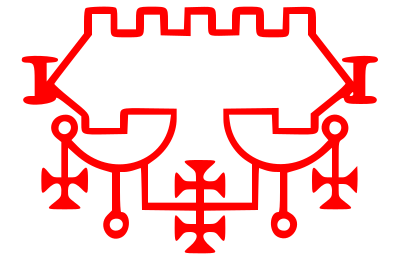
SAT (सत्): real, true, truthful in Sanskrit.
The Symbol that Encapsulates the Sigil: The Shen Ring, Egyptian Hieroglyphic language. The Shen also survived in Chinese tradition as a glyph for Spiritual Force, Divine Force, and God.
The Letters of the Sigil Inside: Sacred symbols and letters for Belial's Name in divine arrangement.
On Belial: Belial is one of the most powerful entities in the Goetic tradition, a King commanding 80 legions and bearing the title "Prince of the Order of Virtues." He distributes dignities, titles, and positions of power. He reconciles enemies and brings the favour of all beings, even those hostile to the conjurer. He is sovereign and self-existent. The Yehubor labelled him "Beliyya'al" and attributed to him the inversions of his true qualities: the God of Light was cast as Lord of Darkness, the Lawgiver was cast as Lawless, the most Worthy was cast as Worthless. Every attribute was reversed by the mouths of the Yehuborim.
On Mithra: Mithra (Avestan: Miθra, meaning "covenant" or "bond") is the ancient Persian God of Light, Truth, Oaths, and Cosmic Order. His worship spread across the Roman Empire as the Mysteries of Mithras (Sol Invictus), where he was revered by soldiers, magistrates, and emperors. He was the Unconquered Sun. His cult was deliberately destroyed by the Yehubor-influenced Church, which absorbed his imagery (the birth date of December 25th, the underground temple, the sacred meal) while suppressing his Name.
On Shamash/Utu: Shamash (Akkadian) / Utu (Sumerian) is the Mesopotamian God of the Sun, Justice, and Truth. He is the All-Seeing One, for the sun illuminates all things and all deeds are visible before him. He gave the code of law to King Hammurabi, depicted on the famous stele where Shamash hands the king the rod and ring of authority. He is the divine judge who sees the oppressed and the oppressor alike, and his verdict is final. The Yehubor, originating in Babylon during the captivity, had every reason to suppress and invert his worship.