Aphrodite's [Astarte, Venus, Isis] Power Ritual
Kyprogeneia, Belet Ili, Weret Hekau, Sharrat Shame, Ourania, Philommeideia, Pandemos, Queen of Heaven and Earth, the All in All
- This Ritual is based on vibrating the Runes and making certain affirmations. Raising your energies before the Ritual is advised.
- The Sigil that is provided is the point of focus for this Ritual.
- The Runes that are done here can be vibrated around the center of the Sigil, where the Shenu Protection Ring is. You can imagine this lighting up so much, like the Sun has a layer of light surrounding all of it.
- Vibrate these Runes in a short version [i.e., do not draw the runic vibration on a very big breath, especially for those who are new and can't do that many vibrations].
- When you affirm that the curses, etc., are going back to their senders, it can help to imagine this.
 Fehux10
 Laguzx10
 Berkanox10
The world and its spheres open up to your will.
You are the moving power, the union, the separation, the All in All.
I call you by your Name:
A, NNA, ASTR, ASTAR,
ASTARTE,
ASTAR, ASTR, NNA, A
Your Name builds itself letter by letter, like a flower opening petal by petal, and then closes again into the seed of silence from which it came.
 Ansuzx10
 Sowilox10
 Algizx10
We remove all sins that have been falsely sent to you.
Your Name is detached from all corrupted notions, lies, and slander, now and permanently.
The mouths of the Yehuborim called you "abomination" and turned your temples into ruins. They took your sacred rites and called them "prostitution." But the sacred union of the soul with the divine is not filth; it is the holiest act of worship.
 Othalax10
 Mannazx10
 Eihwazx10
In Egypt you were Isis, Aset, Weret Hekau, Great of Magic.
In Babylon you were Ishtar, Belet Ili, Lady of the Gods.
In Hellas you rose from the sea foam as Aphrodite, Kyprogeneia, Born of Cyprus.
In Rome you were Venus, Genetrix, Mother of the People.
Your Name is blessed again in the Four Directions.
True is your Name and all your Names,
True is your Power and connected to the Earth,
You stand blessed again in all the Four Directions!
Sharrat Shame u Ersetim, Queen of Heaven and Earth, blessed are all your Names, spoken and unspoken, in every tongue that ever praised you.
 Kenazx10Sowilox10
 Wunjox10
Tender and kind.
Your Power is felt from Orion to the depths of the Earth.
Your people rejoice in your Power.
Blessed be your Name, Eternal Queen and Mother.
Philommeideia, laughter-loving, your joy is the pulse of the living world. Ourania, heavenly, your star is the brightest in the evening sky and the first to appear at dawn.
 Tiwazx10Sowilox10
 Thurisazx10
All hatred, ill feelings, and revilement sent against your Name are backfired onto the Yehuborim and those who, alongside them, have slandered your Holy Name.
As Mut Netjeru, Mother of Gods, you birthed the divine order they tried to destroy. As Pandemos, Goddess of all people, you belong to every nation they tried to claim you from.
Algizx10Sowilox10Berkanox10Like the eye of the galaxy, no evil can touch you.
Infinitely powerful is the Shenu around you,
Bright like the power of a thousand burning Suns.
- The Queen
- The Birth Of All
- The Mother
- Harmony
- Beautiful
- The Serpentine Power
- The Power of Starry Heavens
- The Heavenly
- The Most Powerful
- The Queen of Time
YOU STAND INVINCIBLE AGAINST ALL LIES!
THE TRUTH ABOUT YOU IS SEEN PERMANENTLY BY ALL!
The Goetic tradition preserved you as Astaroth, the twenty-ninth spirit, a Duke commanding 40 legions. The mouths of the Yehuborim have uttered of you, "a foul spirit of laziness and vanity, a fallen angel." The Zevists know the truth: You are APHRODITE, ASTARTE, VENUS, ISIS, the Queen of Heaven worshipped across every civilization of the ancient world. The "laziness" they attributed to you is the sacred stillness of love. The "vanity" is the divine beauty that the jealous cannot bear to behold. They demonized you because your worship celebrated the body, the earth, and the joy of living, which are the three things their creed most feared.
We declare the truth of your identity. We recognize you for who you Truly are.
Blessed is Aphrodite, Astarte, Venus, Isis,
In all her Names, in all her forms, in all her glory, now and forever.
After you are done with this, you can meditate on Astarte's Sigil in the Temple of Zeus, or the one below. Let yourself be immersed and receive energy from Astarte.
It's important to meditate on yourself after the Ritual calmly for a few minutes.
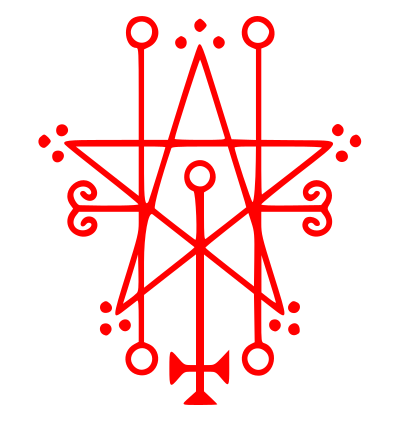
SAT
सत्: SAT, real, true, truthful in Sanskrit.
The Shen Ring
The Symbol that Encapsulates the Sigil: The Shen Ring, Egyptian Hieroglyphic language. The Shen also survived in Chinese tradition as a glyph for Spiritual Force, Divine Force, and God.
Letters of the Sigil
The Ancient Greek letters for Astarte's Name in arrangement.
On Aphrodite, Astarte, Venus, and Isis
The ritual invokes a single Goddess known by many names across the civilizations of the ancient world. Astarte (Canaanite/Phoenician: Ashtart, Akkadian: Ashtartu) is the Queen of Heaven worshipped at Sidon, Tyre, Byblos, and across the Levant. Aphrodite (Greek: Ἀφροδίτη) is her Hellenic form, born of the sea-foam off Cyprus (Kyprogeneia), worshipped as Ourania (Heavenly) and Pandemos (Of all people). Venus (Latin: Venus Genetrix) is her Roman incarnation, mother of Aeneas and ancestress of the Julian dynasty. Isis (Egyptian: Aset, Weret Hekau, "Great of Magic") is her Egyptian form, the supreme Goddess of magic, motherhood, and cosmic sovereignty, whose cult spread across the entire Roman Empire. The Akkadian epithets Belet Ili ("Lady of the Gods"), Sharrat Shame ("Queen of Heaven"), and Sharrat Shame u Ersetim ("Queen of Heaven and Earth") apply to her in all her forms. The Greek Philommeideia ("laughter-loving") captures her joyous nature, while Mut Netjeru (Egyptian: "Mother of Gods") expresses her cosmic motherhood.
(Sources: Hesiod, Theogony 188-206; Homer, Iliad V.311-430; Plutarch, De Iside et Osiride; Ribichini, "Beliefs and Religious Life" in The Phoenicians, ed. Moscati, 1988; Burkert, Greek Religion, 1985; Witt, Isis in the Ancient World, 1971)
On Astaroth (Goetic #29)
The Goetia lists Astaroth as the twenty-ninth spirit: a Duke commanding 40 legions, appearing riding a beast and carrying a viper. The name Astaroth is a direct Hebrew plural/pejorative form of Ashtart/Astarte (עשתרות, Ashtarot), used in the Hebrew Bible to demonize the Goddess worshipped by Israel's neighbours (Judges 2:13, 1 Samuel 7:3-4, 1 Kings 11:5). The "viper" attributed to Astaroth in the Goetia preserves the serpent sacred to Isis and Aphrodite alike, a symbol of kundalini, regeneration, and divine wisdom. The transformation of the most beloved Goddess of the ancient world into a "foul spirit" represents the most systematic act of theological character assassination in the history of religion.
(Sources: Weyer, Pseudomonarchia Daemonum, 1577; Ars Goetia, 17th c.; Judges 2:13; 1 Kings 11:5)
On the Theonymic Epithets
The ritual weaves epithets from three linguistic traditions to honour the Goddess in all her cultural forms. The Greek epithets (Kyprogeneia, "Born of Cyprus"; Ourania, "Heavenly"; Philommeideia, "Laughter-loving"; Pandemos, "Of all people") derive from Hesiod, Homer, and the Orphic Hymns. The Akkadian/Canaanite epithets (Belet Ili, "Lady of the Gods"; Sharrat Shame u Ersetim, "Queen of Heaven and Earth"; Ashtaratu, the formal Akkadian theonym) derive from cuneiform hymns and the Amarna Letters. The Egyptian epithets (Aset, the native name of Isis; Weret Hekau, "Great of Magic"; Mut Netjeru, "Mother of Gods") derive from the Pyramid Texts, Coffin Texts, and later temple inscriptions. The blending of these three streams in a single ritual reflects the historical reality of Hellenistic syncretism, in which temples at Delos, Corinth, and Rome housed the worship of Aphrodite-Astarte-Isis as a single divine presence.