Eshmun's [Asmodeus] Power Ritual
He of Sidon, Son of Apollo, Singer of the Songs of God, the Ascended One, Lord of Lords
- This Ritual is based on vibrating the Runes and making certain affirmations. Raising your energies before the Ritual is advised.
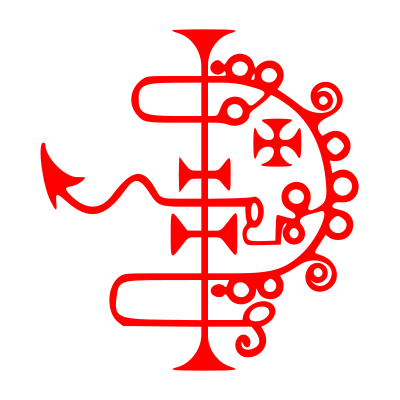
- The Sigil that is provided is the point of focus for this Ritual.
- The Runes that are done here can be vibrated around the center of the Sigil, where the Shenu Protection Ring is. You can imagine this lighting up so much, like the Sun has a layer of light surrounding all of it.
- Vibrate these Runes in a short version [i.e., do not draw the runic vibration on a very big breath, especially for those who are new and can't do that many vibrations]. Click here to pronounce the runes.
- This Ritual contains 183 Vibrations, which is about 1 and a half circles of Mala beads. If you can't do that many, reduce the number of vibrations by half [e.g., instead of vibrating the Runes 10 times each, only do 5 vibrations].
 Ansuzx10
 Kenazx10
 Sowilox10
He of the Truth, Zefs Aenaos;
He of the Path, Zeus Eosforos, the Lightbearer;
Asmodeus the Great is Invited to our Assembly!
He whose name means the Song of God: come, and let your song be heard among us.
 Othalax10Sowilox10Ansuzx10
Supreme, Valorous, Plentiful,
He of Tyre,
Brilliant, Magnificent, Wise,
Lord of Lords!
The cedars of Lebanon bent their branches when you walked among them. The harbors of Phoenicia still carry your name in the salt wind.
Sowilox10 Wunjox10
 Perthrox10
"Great are the people of the Temple of Zeus, and to my liking,
Great is my love for their Assembly,
Many are my Disciples among them,
I shall bless them, protect them, and uphold them, now and forever!"
Wunjox10 Raidhox10Kenazx10
Asmodeus sings the Songs of God.
Blessed are the Gods and Mortals in Eshmun's Presence.
We accept all of Eshmun's Gifts.
For the Song of God heals what is broken, and the one who sings it has risen beyond death itself.
 Fehux10
 Eihwazx10
 Berkanox10
Lord Asmodeus, Many are your Songs.
You torment the lot of Yehubar,
And you have seized their blessings and conferred them on Us all.
What they stole from the nations, you have returned. What they cursed, you have blessed.
Eternal your Stature,
Long is your Reach,
Infinite your Capacity,
O Blessed One!
The Goetic tradition preserved you as Asmoday, the thirty-second spirit, a King commanding 72 legions, appearing with three heads (bull, man, and ram). The mouths of the Yehuborim have uttered of you, "Ashmedai, a spirit of lust and destruction, persecutor of Solomon." The Zevists know the truth: You are ESHMUN, the healing God of Sidon, Son of Apollo. Your name Asmodeus carries Asma (Song) and Deus (God): you are the Song of God, not the scourge of it. A mortal who ascended to the rank of the Gods through mastery of the sacred arts.
We declare the truth of your identity. We recognize you for who you Truly are.
Support us and Sustain us,
King of Daemons and Legions!
The World is Mesmerized by your Song,
O Beautiful Asmodeus!
Sidonai, Asmodeus, Eshmun, blessed are you, now and in all eternity!
After you are done with this, you can meditate on Eshmun's Sigil in the Temple of Zeus, or the one below. Let yourself be immersed and receive energy from Eshmun.
It's important to meditate on yourself after the Ritual calmly for a few minutes.
SAT
सत्: SAT, real, true, truthful in Sanskrit.
The Shen Ring
The Symbol that Encapsulates the Sigil: The Shen Ring, Egyptian Hieroglyphic language. The Shen also survived in Chinese tradition as a glyph for Spiritual Force, Divine Force, and God.
Letters of the Sigil
The Ancient Greek letters for Eshmun's Name in arrangement.
On Eshmun
Eshmun is the Phoenician God of healing, worshipped principally at Sidon (modern Saida, Lebanon) and at his great temple complex at Bostan esh-Sheikh near Sidon. His name may derive from Semitic *shmn ("oil," referring to healing ointments) or from the eighth (shmoneh), connecting him to the eighth divine being in the Phoenician cosmogony. The Greeks identified him with Asclepius, and his cult spread throughout the Phoenician colonies, including Carthage, Cyprus, and Sardinia. Damascius (6th c. CE) records the myth that Eshmun was a mortal youth of extraordinary beauty who, through his devotion to the healing arts, was raised to divine status by the Goddess Astronoe (Astarte). This apotheosis narrative directly corresponds to the Goetic description of Asmodeus as one who "ascended" to royal rank among the divine beings.
(Sources: Damascius, Life of Isidore; Eusebius, Praeparatio Evangelica I.10; Stucky, Tribune d'Echmoun, 1984; Xella, Religione e religioni in Siria-Palestina, 2007)
On the Name Asmodeus
The name Asmodeus encodes a double etymology: from Hebrew Ashmedai (itself from Avestan Aeshma-daeva, "spirit of wrath") and from the Greek reading Asma (ᾆσμα, "song") + Deus (God), yielding "Song of God." The modern name Amadeus ("love of God") derives from the same root. The Hebrew epithet Sidonai ("He of Sidon") confirms the geographical identification with Eshmun. The Talmudic portrayal of Ashmedai as Solomon's great antagonist (Gittin 68a-b) inverts a historical reality: the Sidonian cult of Eshmun was a direct competitor to the Jerusalem temple cult, and the rabbis demonized the rival God accordingly. His association with Apollo (via the Asclepius identification) accounts for the ritual's closing vibration of Apollon, Pean, Helios.
(Sources: Tobit 3:8, 3:17; Talmud Gittin 68a-b; Testament of Solomon; Weyer, Pseudomonarchia Daemonum, 1577; Ars Goetia, 17th c.)