Anubis's Power Ritual
Lord of the Underworld Depths, Patron of the Departed, Holder of the Mystery of the Great Key
- This Ritual is based on vibrating the Runes and making certain affirmations. Raising your energies before the Ritual is advised.
- The Sigil that is provided is the point of focus for this Ritual.
- The Runes that are done here can be vibrated around the center of the Sigil, where the Shenu Protection Ring is. You can imagine this lighting up so much, like the Sun has a layer of light surrounding all of it.
- Vibrate these Runes in a short version [i.e., do not draw the runic vibration on a very big breath, especially for those who are new and can't do that many vibrations]. Click here to pronounce the runes.
- This Ritual contains 183 Vibrations, which is about 1 and a half circles of Mala beads. If you can't do that many, reduce the number of vibrations by half [e.g., instead of vibrating the Runes 10 times each, only do 5 vibrations].
 Algizx10
 Eihwazx10
 Ansuzx10
Hear the call of your Initiates in the Temple of Zeus.
We call you with respect and honesty in our hearts,
O Patron of the Departed, hear us!
You who stand at the threshold where breath becomes silence,
You whose golden eyes see through both darkness and light: hear us.
 Wunjox10
 Kenazx10
 Raidhox10
Take care of the family members of ours who have departed,
Guide them pleasantly and lovingly into the Afterlife,
Have Great mercy on them for their transgressions,
Reward them kindly for their good deeds,
O Great Inpu!
Walk beside them through the corridors of the Duat, and let them not walk alone.
 Sowilox10
 Othalax10
 Dagazx10
Guide them to make their hearts lighter and free,
Absolve them of wrongdoing,
Recognize their ignorance,
For not all who err have chosen the error: some were led there by the deceptions of Yehubor.
Great and mighty is your rulership, Anubis!
Othalax10Dagazx10 Gebox10
Kind and loving Ienepu,
Bond us with our Ancestors and let their power flow through us,
Let our life be their life,
Let our pious life be an honor unto them all!
For we are the living branches of roots that reach into the earth of the dead.
 Berkanox10Eihwazx10Dagazx10
Favorable is their judgement of the Initiates,
Understanding are you, O Great Gods,
Among them all, Iwunpu, Great Ruler of the Underworld!
You who weigh the heart with perfect stillness, without haste, without malice: be our advocate in the Hall of Two Truths.
The Goetic tradition preserved you as Ipos, the twenty-second spirit, a Count commanding 36 legions. The mouths of the Yehuborim have uttered of you, "a spirit who reveals past and future." The Zevists know the truth: You are ANUBIS, Inpu, the Jackal-Headed Lord who guides every soul through the Duat and weighs every heart upon the Scale of Ma'at. The one who reveals past and future is the one who stands at the boundary between life and death, where all times converge.
We declare the truth of your identity. We recognize you for who you Truly are.
Giver and Judge of Eternal Existence,
Patron of the Judgement of the next and previous lifetimes,
Receive our honor to you and shower us with your abundant blessings.
The Children of the Temple of Zeus salute you!
Anubis, Inpu, Iwunpu, Ipos, Ienepu, blessed are you, now and in all eternity!
After you are done with this, you can meditate on Anubis's Sigil in the Temple of Zeus, or the one below. Let yourself be immersed and receive energy from Anubis.
It's important to meditate on yourself after the Ritual calmly for a few minutes.
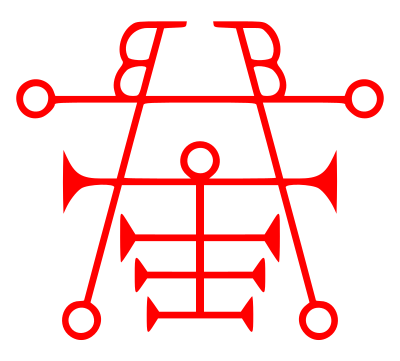
SAT
सत्: SAT, real, true, truthful in Sanskrit.
The Shen Ring
The Symbol that Encapsulates the Sigil: The Shen Ring, Egyptian Hieroglyphic language. The Shen also survived in Chinese tradition as a glyph for Spiritual Force, Divine Force, and God.
Letters of the Sigil
The Ancient Greek letters for Anubis's Name in arrangement.
On Anubis
Anubis (Egyptian: jnpw, Inpu) is the jackal-headed God of embalming, the dead, and the passage between worlds. He presides over the Weighing of the Heart in the Hall of Two Truths (Maaty), where the deceased's heart is weighed against the feather of Ma'at. In the Pyramid Texts (Utterance 213), Anubis is called "He who is upon his mountain" (Tepy-dju-ef), watching over the necropolis. He is the son of Nephthys and Osiris (or Ra, in some traditions). The Greeks identified him with Hermes in his role as psychopomp (guide of souls), producing the syncretic deity Hermanubis. His role in embalming the body of Osiris established the art of mummification as a sacred act of resurrection.
(Sources: Pyramid Texts, Utterances 213-222; Book of the Dead, Ch. 125; Plutarch, De Iside et Osiride 14; Wilkinson, The Complete Gods and Goddesses of Ancient Egypt, 2003)
On Ipos (Goetic #22)
The Goetia lists Ipos as the twenty-second spirit: a Count commanding 36 legions, appearing with the body of an angel and the head of a lion (or, in earlier manuscripts, a jackal). His attributed powers (revealing things past and future, granting wit and courage) correspond to Anubis's role as the one who sees across the boundary of death, where past lives and future destinies are visible. The name Ipos is a phonetic contraction of Inpu-s, preserving the Egyptian theonym.
(Sources: Weyer, Pseudomonarchia Daemonum, 1577; Ars Goetia, 17th c.; Scot, The Discoverie of Witchcraft, 1584)