Amon Ra's Power Ritual
The Hidden Sun, Three-Natured Lord of Light, He Who Created Himself from the Eternal
- This Ritual is based on vibrating the Runes and making certain affirmations. Raising your energies before the Ritual is advised.
- The Sigil that is provided is the point of focus for this Ritual.
- The Runes that are done here can be vibrated around the center of the Sigil, where the Shenu Protection Ring is. You can imagine this lighting up so much, like the Sun has a layer of light surrounding all of it.
- Vibrate these Runes in a short version [i.e., do not draw the runic vibration on a very big breath, especially for those who are new and can't do that many vibrations]. Click here to pronounce the runes.
- This Ritual contains 240 Vibrations, which is about 2 circles of Mala beads. If you can't do that many, reduce the number of vibrations by half [e.g., instead of vibrating the Runes 10 times each, only do 5 vibrations].
 Fehux10
 Sowilox10
 Kenazx10
The people of the Temple of Zeus greet you with warm salutations!
Praised are you, Most Excellent,
You are the Sun of Paradise that shines in all dimensions.
We, Zeus's Disciples, request more of your gentle light!
 Perthrox10
 Mannazx10Sowilox10
The Gates are opened wide in Four Directions.
Everyone beholds your presence in Upper and Lower Egypt.
You stand upon the Right Hand and the Left Hand of King Zeus.
 Laguzx10Fehux10
 Eihwazx10
Lord Amon Ra, your Light is impeccable and defeats all falsehood.
The Wise are Guarded by You, left and right.
You carry the scepter of power, above and below.
 Tiwazx10Sowilox10
 Raidhox10
The people will say: "Has Amon Ra ever guarded those in falsehood? Any impostor has lost all their power in front of thee!"
Everyone knows you by your Justice,
You carry the flaming sword that Guards the Serpent,
Unsheathing it, you let the Divine Flame of eternity glow.
Eihwazx10Laguzx10 Dagazx10
You are He who informs and sends solace.
By your grace, we say: "Greatest Amon, bright, radiant, infinite, elegant! This is who you are, Amon Ra. Your enemies have lost all power. Amon Ra, have glory and infinite, never-ending, eternal dominance!"
This is who you are for us, the gathering of Temple of Zeus disciples, Lord Amon Ra!
 Berkanox10Sowilox10Raidhox10
Your service is good for the children of the Gods: the followers of the Temple of Zeus, the Family of Zeus.
Pure are your acts, our beloved, Great, and Esteemed Amon Ra!
The Goetic tradition preserved you as Aamon, the seventh spirit, a Marquis commanding 40 legions. The mouths of the Yehuborim have uttered of you, "a spirit to be summoned and bound." The Zevists know the truth: You are AMON RA, the Hidden Sun, King of the Gods of Egypt, whose name means "The Hidden One who Shines." You were never hidden from us.
We declare the truth of your identity. We recognize you for who you Truly are. The seventh spirit is the Firstborn of the Gods, and 40 legions are but a whisper of your dominion.
You Guard the Gates of Light.
You are Amun, You are Ra, You are Ptah, the Three-Natured Lord of The Light.
Blessed are we all to bless you by our Rituals, Great Guardian.
We, your followers in the Gods, receive all your abundant blessings.
Amon Ra, Hammon, Amun Ra, Zeus Amun; these are some of your Names and Titles. Blessed are All your Names, now and in all eternity!
After you are done with this, you can meditate on Amon Ra's Sigil in the Temple of Zeus, or the one below. Let yourself be immersed and receive energy from Amon Ra.
It's important to meditate on yourself after the Ritual calmly for a few minutes.
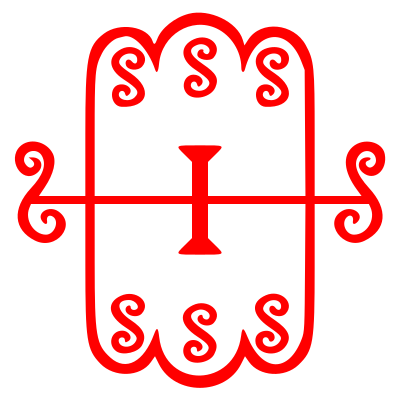
SAT
सत्: SAT, real, true, truthful in Sanskrit.
The Shen Ring
The Symbol that Encapsulates the Sigil: The Shen Ring, Egyptian Hieroglyphic language. The Shen also survived in Chinese tradition as a glyph for Spiritual Force, Divine Force, and God.
Letters of the Sigil
The Ancient Greek letters for Amon Ra's Name in arrangement.
On Amon Ra
Amun (Egyptian: jmn, "The Hidden One") was the supreme deity of Thebes who, through syncretism with Ra, became Amun-Ra: the king of all the gods of Egypt. The Greeks identified him with Zeus, and the oracle of Zeus-Ammon at Siwa in the Libyan desert was among the most revered in the ancient world. Alexander the Great journeyed there in 331 BCE and was proclaimed son of Zeus-Ammon. The triple nature Amun-Ra-Ptah (the Hidden, the Visible, the Maker) represents the three modes of divine creative power: the concealed source, the manifest light, and the craftsman who shapes reality. Herodotus (Histories II.42) records the Egyptian belief that Amun is the highest of all Gods.
(Sources: Herodotus, Histories II.42; Pindar, Pythian IV; Assmann, The Search for God in Ancient Egypt, 2001; Hornung, Conceptions of God in Ancient Egypt, 1982)
On Aamon (Goetic #7)
The Goetia lists Aamon as the seventh spirit: a Marquis commanding 40 legions. The name is a transparent preservation of Amun/Amon, the Egyptian supreme deity, passed through Hellenistic demonological tradition into the medieval grimoire corpus. This is one of the most self-evident cases where the Goetic tradition preserved a major God under the thinnest veil.
(Sources: Weyer, Pseudomonarchia Daemonum, 1577; Ars Goetia, 17th c.)