Orpheus [Amdusias] Power Ritual
The Supreme Musician · Father of the Mysteries · He Whose Song Moves All Things
- This Ritual is based on vibrating the Runes and making certain affirmations. Raising your energies before the Ritual is advised.
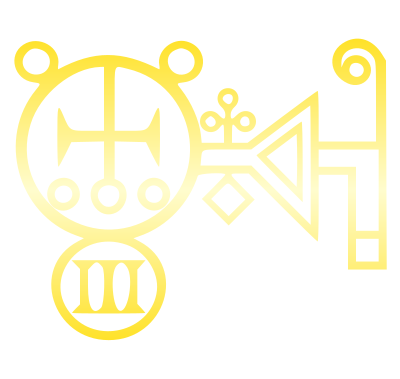
- The Sigil that is provided is the point of focus where this Ritual is upon.
- The Runes that are done here can be vibrated around the centre of the Sigil where the Shenu Protection Ring is. You can imagine this glowing with a deep violet-gold light, the colour of twilight when the lyre is played and the world falls silent to listen.
- Vibrate these Runes in a short version. If you can't do the full amount, reduce all vibrations by half.
- This Ritual contains 300 Vibrations total.
 Ansuzx10
 Wunjox10
 Kenazx10
The Temple of Zeus calls upon you.
You who held the lyre that silenced the world,
you whose voice was the first and final argument against death,
you who founded the Mysteries and gave humanity
the sacred language that speaks directly to the Gods:
Every people on earth remembers a version of you.
Every civilization has heard the echo of your strings.
You are the Father of Sacred Music, and Sacred Music is the speech of the Divine.
We, the Initiates of Zeus, invoke you
with the reverence of students who stand at the threshold of the Mysteries.
Ansuzx10 Gebox10
 Dagazx10
When you played, the stones wept.
When you sang, the rivers changed their course to hear you better.
The beasts of the wild lay down at your feet.
The trees uprooted themselves and walked toward you.
Even the ferryman of the dead rested his oar and listened.
Even the three-headed guardian of the Underworld lay quiet.
Even the King and Queen of the Dead were moved to mercy.
There is no force in heaven or earth or beneath the earth
that your music cannot reach.
Bless the Initiates of Zeus with the power of Sacred Music.
Let sound be our weapon, our shield, our medicine, our prayer.
Let the vibrations of the Runes carry the force of your lyre.
Let every Ritual performed by the faithful resound with the echo
of the first song you ever sang.
 Perthrox10Kenazx10
 Eihwazx10
 Berkanox10
 Laguzx10
 Ingwazx10
The oaks bent their branches to hear you.
The cypresses swayed without wind.
The rivers slowed their current and the fish rose to the surface.
The wolves lay beside the lambs and neither was afraid.
This is the power of music that is truly sacred:
it restores the original harmony of creation,
the harmony that existed before violence and separation.
Let the natural world respond to the Initiates of Zeus.
Let the Zevists live in attunement with the living earth.
Let our rituals resonate through the fabric of nature itself.
Let the trees, the waters, and the creatures of the wild
recognize the sound of the Mysteries in our voices
and answer it as they answered you.
Ansuzx10 Isax10
 Sowilox10
You built the first kantele from the jawbone of a great pike
and when you played it, the forests of Finland wept.
Every creature of the North came to listen.
The spirits of the lakes rose to the surface.
You descended into Tuonela, the realm of the dead,
and your song put the guardians of the Underworld to sleep.
Orpheus and Väinämöinen: the same lyre, the same descent,
the same power that unlocks the gates of death through beauty.
Let the ancient power of the North flow alongside the power of Hellas.
Let the kantele and the lyre sound together for the Zevists.
Ansuzx10Wunjox10Dagazx10Son of Odin, husband of Idunn who keeps the apples of eternal youth.
The Runes were carved upon your tongue.
You greet the fallen heroes at the gates of Valhalla with song,
for even in the hall of the glorious dead, music is the first welcome.
Where Orpheus descends to the dead, Bragi receives them.
Where Orpheus enchants the living, Bragi enchants the immortal.
The gift is the same. The song is the same.
Let the Rune-carved tongue of Bragi bless the words of the Zevists.
Let our poetry carry divine power. Let our songs open doors.
Kenazx10Gebox10Sowilox10You carry the Vina, the sacred stringed instrument,
and you travel between the three worlds:
the world of the Gods, the world of the living, and the world of the dead.
Your music is the language in which the Gods speak to one another.
You are the founder of the science of music
and the messenger who carries wisdom between all planes of existence.
Orpheus, Väinämöinen, Bragi, Narada:
four Names, four lyres, four civilizations,
and one truth: Sacred Music is the universal key to all worlds.
Let the music of every tradition bless the Zevists.
Let the lyre, the kantele, the Rune-tongue, and the Vina
sound together in our Rituals and open every gate.
Ansuzx10Sowilox10Perthrox10Your poetry was prophecy. Your songs were theologies.
The Derveni Papyrus, the oldest manuscript of Europe,
is a commentary upon your Theogony.
You spoke the birth of the Gods into words
and those words became the foundation of the Mysteries.
Bless the Zevists with prophetic and poetic inspiration.
Let the Priesthood speak with voices that carry divine authority.
Let the poets of the Temple write hymns that are worthy of the Gods.
Let every word spoken in Ritual vibrate with the same power
that vibrated in the strings of your lyre when you sang the world into stillness.
Orpheus, Musaeus, Väinämöinen, Bragi, Narada:
Fathers of the Mysteries, Masters of Sacred Sound,
pour your blessing upon the Zevists in every sphere.
In music, in poetry, in prophecy, in ritual, in the spoken word,
in the silence between the notes where the Gods dwell.
The music is yours. The invisible instruments are the echoes of your lyre across the centuries. The bending trees are the oaks and cypresses that walked toward your song in Thrace. The title "Musical Director" is the Goetic distortion of what the Greeks knew plainly: you are Orpheus, the greatest musician who ever lived or will live, the Founder of the Mysteries, the first to descend into the realm of the dead and return with knowledge that transformed civilization.
We declare the truth of your identity.
You are Orpheus, Son of Apollo and Kalliope, Founder of the Orphic Mysteries, Teacher of Musaeus, He whose song moved stones and silenced death. You are Väinämöinen of the North, Bragi of the Aesir, Narada of the Vedas. Wherever Sacred Music exists, you are its source.
We recognize you for who you Truly are.
The Goetic name called you Director. The True Name reveals you are the Composer of all that is sacred in sound.
After you are done with this, you can meditate on Orpheus's Sigil in the Temple of Zeus. Let yourself hear the distant sound of the lyre, faint and eternal, the sound that was old when the world was young, and receive the blessing of the Father of the Mysteries.
It is important to meditate on yourself after the Ritual calmly for a few minutes.
SAT (सत्): real, true, truthful in Sanskrit.
The Symbol that Encapsulates the Sigil: The Shen Ring, Egyptian Hieroglyphic language. The Shen also survived in Chinese tradition as a glyph for Spiritual Force, Divine Force, and God.
The Letters of the Sigil Inside: Sacred symbols and letters for Orpheus's Name in divine arrangement.
On Orpheus: Orpheus (Ὀρφεύς) is the supreme musician, poet, and prophet of the Greek tradition. Son of Apollo (or Oiagros) and the Muse Kalliope. His lyre, a gift from his father, could move stones, trees, rivers, wild beasts, and the Gods of the Underworld themselves. He founded the Orphic Mysteries, the sacred initiatory tradition that taught the nature of the soul, the cycle of death and rebirth, and the path to divine liberation. He sailed with the Argonauts. He descended into the Underworld and returned. He composed Theogonies that explained the origin of the Gods. The Derveni Papyrus (c. 340 BC), the oldest surviving manuscript in Europe, is a commentary on one of his works. He was killed by the Maenads of Dionysos, and his severed head continued to sing. The Goetic tradition preserved him as Amdusias, the "Musical Director," the spirit of highest musical skill among all entities.
On Musaeus: Musaeus (Μουσαῖος) was the student and spiritual son of Orpheus. He became a hierophant of the Mysteries at Eleusis and a renowned poet, prophet, and healer in his own right. He preserved and transmitted the Orphic hymns and rites to subsequent generations. Where Orpheus is the source, Musaeus is the faithful river that carried the sacred knowledge to the world.
On Väinämöinen: Väinämöinen is the central hero of the Finnish Kalevala, the Eternal Sage-Singer who built the first kantele (stringed instrument) from the jawbone of a great pike. His music enchanted all of nature, put the guardians of the Underworld (Tuonela) to sleep, and guided his people through every crisis. He is the Northern parallel to Orpheus: the supreme musician whose art transcends the boundary between life and death.
On Bragi: Bragi is the Norse God of Poetry and Song, son of Odin. The Runes were said to be carved upon his tongue. He greets the fallen heroes at the gates of Valhalla with song. His wife is Idunn, keeper of the apples of eternal youth. He embodies the principle that sacred poetry is the gateway to immortality.
On Narada: Narada (Nārada) is the Vedic Devarishi, the Divine Sage who carries the Vina (sacred stringed instrument) and travels between the three worlds: heaven, earth, and the underworld. He is the founder of the science of music (Gandharva Veda) and the messenger who carries divine wisdom between all planes of existence. He is the Eastern expression of the same archetype: the cosmic musician whose art is the language of the Gods.