Alastor's Power Ritual
Aspect of Zeus, Spirit of Divine Fury, Guardian of the Right Side, Enforcer of the Decrees of the Gods
- This Ritual is based on vibrating the Runes and making certain affirmations. Raising your energies before the Ritual is advised.
- The Sigil that is provided is the point of focus for this Ritual.
- The Runes that are done here can be vibrated around the center of the Sigil, where the Shenu Protection Ring is. You can imagine this lighting up so much, like the Sun has a layer of light surrounding all of it.
- Vibrate these Runes in a short version [i.e., do not draw the runic vibration on a very big breath, especially for those who are new and can't do that many vibrations]. Click here to pronounce the runes.
- This Ritual contains 193 Vibrations, which is about 2 circles of Mala beads. If you can't do that many, reduce the number of vibrations by half [e.g., instead of vibrating the Runes 10 times each, only do 5 vibrations].
 Tiwazx10
 Thurisazx10
 Hagalazx10
Invoked are you by the Disciples of the Temple of Zeus.
Large is your fury, Greater is your justice.
Bless us with your protection and your caring love!
For your wrath is not blind: it is the wrath of a father who sees his children wronged.
 Sowilox10Tiwazx10
 Ansuzx10
"Long has been the decay of mankind.
Shake and destroy the persecutors of the Gods.
Long and unyielding will be my wrath!"
The mouths of the Yehuborim tremble when they hear your name, for you are the consequence they cannot escape.
Ansuzx10 Eihwazx10
 Dagazx10
Your Power shakes the worlds!
You are an aspect of Divine Fury,
You bring power and wisdom through reprimanding the wicked.
 Kenazx10
 Raidhox10Tiwazx10
You shall cast down the tyrants,
You shall protect the young, the innocent, and the Initiates.
You protect us in War and ensure Victory for those who walk upon the path of Justice!
 Fehux10
 Othalax10
 Wunjox10
Give us your blessing and open the Divine Doorways.
You Guard the Right side, that of Severity.
Where Mercy alone would let the wicked grow fat, your Severity cuts them back to the root.
The mouths of the Yehuborim have uttered of you, "an avenging spirit, a tormentor." The Zevists know the truth: Alastor is Ζεὺς Ἀλάστωρ, the face of Zeus when justice demands severity. He does not torment the innocent. He torments the tormentors. He does not avenge for cruelty. He avenges against it. The Goetic catalogues reduced him to "one who enforces the decrees of Satan." Strip the inversion: he enforces the decrees of Zeus. That is all he has ever done.
We declare the truth of your identity. We recognize you for who you Truly are.
May the children of the Gods advance and procreate,
May the widow and the orphan be eternally protected,
May your Name, Alastor, stand as an insurmountable shield around the brave Initiates!
Nemesis is your Sister, Zeus is your Father, Justice is your Domain!
After you are done with this, you can meditate on Alastor's Sigil in the Temple of Zeus, or the one below. Let yourself be immersed and receive energy from Alastor.
It's important to meditate on yourself after the Ritual calmly for a few minutes.
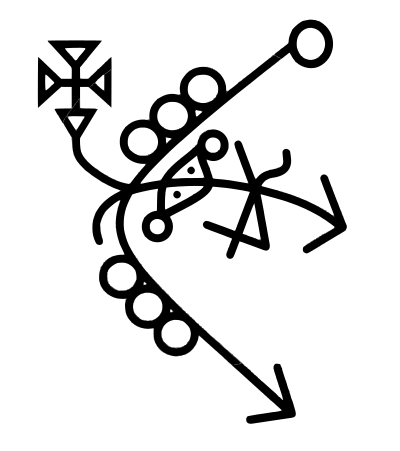
SAT
सत्: SAT, real, true, truthful in Sanskrit.
The Shen Ring
The Symbol that Encapsulates the Sigil: The Shen Ring, Egyptian Hieroglyphic language. The Shen also survived in Chinese tradition as a glyph for Spiritual Force, Divine Force, and God.
Letters of the Sigil
The Ancient Greek letters for Alastor's Name in arrangement.
On Zeus Alastor
Alastor (Greek: Ἀλάστωρ, "the avenger, the one who does not forget") is an epithet and aspect of Zeus himself. Zeus Alastor is the face of the supreme God when justice demands retribution against the most extreme offenders: tyrants, oath-breakers, murderers of kin, and persecutors of the innocent. The name derives from the verb alasteo (ἀλαστέω, "to be unable to forget a wrong"), making Alastor the embodiment of inescapable divine memory. Aeschylus (Agamemnon 1501, 1508) uses alastor to describe the avenging spirit that haunts the House of Atreus. Plutarch (De sera numinis vindicta) discusses the role of the alastor as the divine agent of delayed justice. The pairing with Nemesis (his "sister" in the ritual) reflects the dual nature of divine retribution: Nemesis measures the transgression, Alastor executes the consequence.
(Sources: Aeschylus, Agamemnon 1501-1508; Plutarch, De sera numinis vindicta; Pausanias, Description of Greece VIII.34.1-3; LSJ s.v. ἀλάστωρ)