Abrasax's [Abraxas] Power Ritual
Megas Archon, Kosmokrator, Pantokrator, Lord of the 365 Days, the Firmament of the World, He Who Drives the Divine Chariot of the Glowing Sun
- This Ritual is based on vibrating the Runes and making certain affirmations. Raising your energies before the Ritual is advised.
- The Sigil that is provided is the point of focus for this Ritual.
- The Runes that are done here can be vibrated around the center of the Sigil, where the Shenu Protection Ring is. You can imagine this lighting up so much, like the Sun has a layer of light surrounding all of it.
- Vibrate these Runes in a short version [i.e., do not draw the runic vibration on a very big breath, especially for those who are new and can't do that many vibrations].
 Fehux10
 Sowilox10
 Kenazx10
Your Name is the Firmament of the world.
We are your blessed friends and followers.
May you see us in a friendly manner and lift us in your timeless glory.
The seven letters of your Name sum to 365, one for every day of the year, and there is no day on which you do not reign.
 Algizx10
 Tiwazx10Sowilox10
You are extolled by all of us, our Great Archon!
You have protected the followers of Zeus for generations,
Because you have uttered for our lot:
"Blessed is the lot of all Zevists and their cup of life, always full, generation after generation."
O Holy Abrasax, you lead the way out of the prison of ignorance!
Kosmokrator, Ruler of the Cosmos, Pantokrator, Holder of All Power, the Gnostics knew your Name and trembled not with fear but with awe.
 Dagazx10
 Eihwazx10Sowilox10
Zeus Eosforos has given you the keys of the world,
In your hands are the 365 keys of the universe.
You are a sun that shines in all directions.
The mouths of the Yehuborim called you "Archon of Darkness" and turned your Name into a word of fear. But Archon means Ruler, and you rule in light, not in shadow. Your gems and talismans survive across the centuries, bearing your image: the rooster head of vigilance, the serpent legs of wisdom, and the shield and whip of sovereign authority.
Dagazx10Eihwazx10Sowilox10We, Zevists, pay homage to you,
We are among the receivers of your greatest blessings.
As Neb Renepet, Lord of the Year, you measure the turning of time. As Megas Archon, you hold the axis upon which the heavens rotate. Every sunrise is your herald, and every sunset is your promise of return.
The Goetic tradition preserved your companion as Decarabia, the sixty-ninth spirit, a Marquis commanding 30 legions, "who knows the virtues of herbs and precious stones" and "makes birds appear." The mouths of the Yehuborim called you "an Archon of the Demiurge, a false god, and a tyrant of ignorance." The Zevists know the truth: You are ABRASAX, the Supreme Archon whose Name equals 365 in Greek isopsephy (Α=1, Β=2, Ρ=100, Α=1, Σ=200, Α=1, Ξ=60), Lord of every day of the solar year. The Gnostics who reviled you were themselves deceived, for they turned the Guardian of the Cosmos into the jailer of souls. The thousands of Abrasax gems that survive across the Mediterranean world testify to your enduring power: on every one of them, your image stands armed with shield and whip, rooster-headed for vigilance, serpent-footed for wisdom.
We declare the truth of your identity. We recognize you for who you Truly are.
Great is your power, your kingship, and your control.
When your Name is uttered, ABRASAX, Great God,
The enemies of the Truth flee in terror.
Unclean spirits, hostile entities that are our enemies, cannot withstand your might.
You obliterate ignorance and run it over with the Divine Chariot of the Glowing Sun.
We are liberated by you, Holy ABRASAX.
DECARABIA, ABRASAX, ABRAXAS, GREAT ARCHON, THE TEMPLE OF ZEUS SALUTES YOU!
After you are done with this, you can meditate on Abrasax's Sigil in the Temple of Zeus, or the one below. Let yourself be immersed and receive energy from Abrasax.
It's important to meditate on yourself after the Ritual calmly for a few minutes.
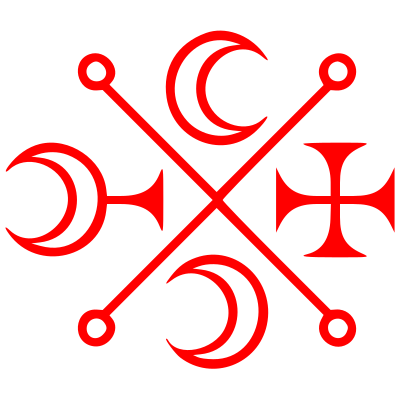
SAT
सत्: SAT, real, true, truthful in Sanskrit.
The Shen Ring
The Symbol that Encapsulates the Sigil: The Shen Ring, Egyptian Hieroglyphic language. The Shen also survived in Chinese tradition as a glyph for Spiritual Force, Divine Force, and God.
Letters of the Sigil
The Ancient Greek letters for Abrasax's Name in arrangement.
On Abrasax and the 365
Abrasax (also spelled Abraxas) is a divine name whose seven Greek letters sum to 365 by isopsephy: Α(1) + Β(2) + Ρ(100) + Α(1) + Σ(200) + Α(1) + Ξ(60) = 365, corresponding to the 365 days of the solar year. This numerical identity makes ABRASAX the Kosmokrator, the cosmic ruler whose authority extends over every single day. The name appears on thousands of engraved gems (Abraxas gems) from the 2nd to 4th centuries CE, found across the entire Roman world, typically depicting a figure with a rooster head (solar vigilance, the herald of dawn), a human torso bearing a shield and whip (sovereign authority), and serpent legs (chthonic wisdom, kundalini power). Irenaeus (Adversus Haereses I.24.7) attributes the theology of Abrasax to the Gnostic teacher Basilides, who taught that Abrasax is the supreme power presiding over the 365 heavens. In the Papyri Graecae Magicae, ABRASAX appears as one of the most powerful Voces Magicae, invoked for protection, cosmic authority, and divine communion.
(Sources: Irenaeus, Adversus Haereses I.24.7; PGM various; Bonner, Studies in Magical Amulets, 1950; Mastrocinque, From Jewish Magic to Gnosticism, 2005)
On Decarabia (Goetic #69)
The Goetia lists Decarabia as the sixty-ninth spirit: a Marquis commanding 30 legions, appearing as a pentacle star. His attributed powers (knowledge of herbs and precious stones, causing birds to appear and sing) correspond to the gemological and naturalistic wisdom associated with the Abrasax tradition, which produced thousands of engraved protective stones. The "birds that appear and sing" are the rooster of Abrasax himself: the solar bird that sings at dawn to announce the triumph of light over darkness.
(Sources: Weyer, Pseudomonarchia Daemonum, 1577; Ars Goetia, 17th c.)
On the Theonymic Epithets
The ritual blends epithets from three traditions. The Greek epithets (Megas Archon, "Great Ruler"; Kosmokrator, "World-ruler"; Pantokrator, "All-powerful") derive from the Gnostic and PGM traditions. The Egyptian epithet Neb Renepet ("Lord of the Year") applies the solar-calendar theology of Heliopolis to Abrasax, connecting the 365 days to the Egyptian solar calendar. The Akkadian epithet Sharru Rabu ("Great King") links Abrasax to the Mesopotamian tradition of the cosmic sovereign. The triple invocation in three languages reflects the syncretistic genius of Hellenistic Egypt, where Greek, Egyptian, and Semitic religious traditions merged in the crucible of Alexandria.